


Victorian Oak Bookstand
These Victorian oak bookstand pieces bring solid construction and practical design to a study or library.
Victorian Oak Bookstand
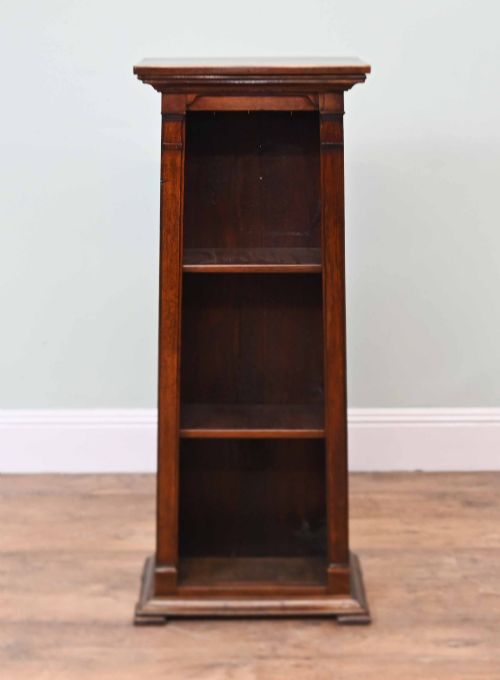
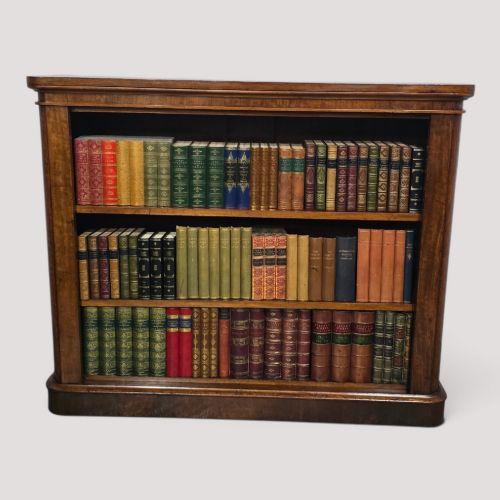
A victorian oak bookstand offers a sturdy platform for holding volumes in a study or library. These items appear in several functional forms, including revolving models, desk accessories, and floor-standing bookcases.
The materials and styles span from the Victorian period through to the nineteen thirties, encompassing Edwardian examples, Gothic Revival influences, and Jacobean Revival details.
Buyers frequently encounter revolving bookcases and stationary stands, alongside adjustable library bookcases and extending book slides.
What varies in quality
The standard of carving and the complexity of the woodwork separate standard examples from finer pieces. Details such as fret-cut panels and substantial solid timber framing indicate careful workshop production.
The smoothness of the mechanical action in revolving models and extending slides also demonstrates the precision of the initial construction and the durability of the internal brass or iron hardware.
The listings on this site combine oak with brass and iron across Victorian, Edwardian, and later twentieth-century periods.
The Victorian Oak Bookstand Glossary
- Revolving bookcase
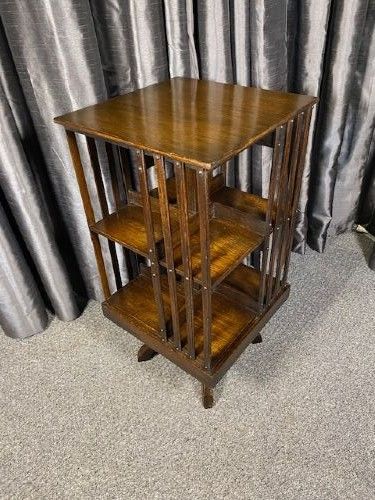
- A freestanding tiered stand mounted on a spindle base designed to turn. This allows easy access to multiple shelves of books from a seated position.
- Extending book slide
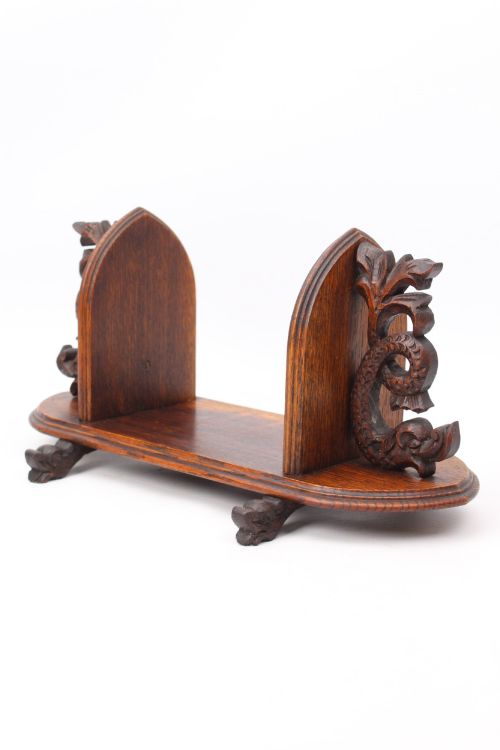
- A portable desk accessory with a sliding mechanism that adjusts in length. It holds a row of volumes upright between two decorative ends.
- Jacobean Revival
- A style popular during the later nineteenth and early twentieth centuries. It mimics seventeenth-century English woodwork through dark finishes, paneling, and geometric turning.
- Fret-cut
- Openwork decoration created by piercing timber with a saw. This technique produces intricate patterns along the crests and sides of bookcases.
Victorian Oak Bookstand: Frequently Asked Questions
How do revolving bookcases work?
Revolving bookcases sit upon a concealed central pivot and bearing system hidden beneath the base. This engineering allows the tiered wooden structure to spin freely with minimal effort.
Users can place heavy reference volumes on the lower shelves and lighter reads on top, keeping an entire library accessible from a single spot.
Where should I place a bookstand?
These pieces suit placement beside an armchair, near a desk, or freestanding in the centre of a study. Their compact footprint makes them practical for corners where traditional wall shelving will not fit.
Floor-standing revolving models function well away from walls because they require clearance on all sides to spin properly.
Are book slides adjustable?
Book slides feature a central base channel with two upright ends where one section slides smoothly within or alongside the other. This mechanical action allows the overall length to contract or expand.
Owners adjust the span to hold varying quantities of books securely between the wooden terminals on a desk or tabletop.