
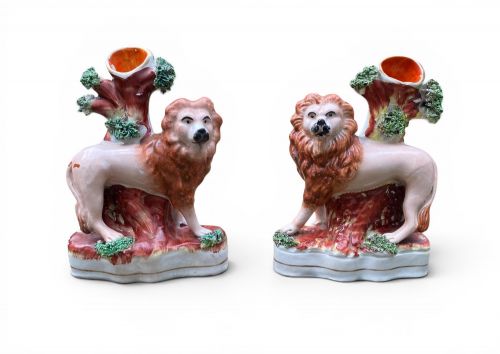


Victorian Lion Ceramic Ornament
These Victorian lion ceramic ornament pieces are commanding nineteenth-century earthenware and terracotta sculptures designed to bring authority to a mantelpiece or library.
Victorian Lion Ceramic Ornament
A Victorian lion ceramic ornament is typically encountered as a pair of Staffordshire pottery figures, spill vases, or heavy bookends modelled in various recumbent or seated postures. These domestic ornaments range from mid-nineteenth-century earthenware figures to larger garden statues and terracotta sculptures.
Makers often drew inspiration from classical forms, such as the famous Medici lions, adapting them into accessible ornaments for Victorian interiors. Collectors will also find specific sculptural narratives, including figures depicting the death of the lion queen alongside traditional heraldic pairings like the lion and unicorn.
The objects serve multiple functional and decorative roles within the home, operating as traditional bookends, mantel ornaments, or large garden sculptures on bases. Most examples originate from British potteries and kilns dating across the nineteenth century and into the early twentieth century.
How They Were Made
Potters shaped these figures primarily using earthenware, terracotta, and heavy salt-glazed ceramic bodies suited to both indoor ornaments and larger garden statues. Artisans then applied foundational coats of paint, metallic lustre glazes, or rich treacle glazes to achieve the characteristic glossy surface finishes.
Manufacturing methods relied on traditional moulding techniques to produce symmetrical pairs of lions, bookends, and spill vases. Once fired, finishing touches such as painted details or specialised lead glazes were added by hand before a final kiln cycle.
Listings feature nineteenth-century earthenware, terracotta, and salt-glazed ceramics finished in treacle glaze and metallic lustre.
What Varies in Quality
The application and richness of the glaze or paint layer also determine the visual hierarchy of these objects. Deep treacle glazes, metallic lustre finishes, and carefully preserved hand-painted accents distinguish the finer studio output from standard commercial output.
Rockingham Pottery·Lancaster and Sons of Hanley·Hurlford Kilmarnock
The Victorian Lion Ceramic Ornament Glossary
- Staffordshire pottery
- Earthenware figures and utilitarian vessels produced in the numerous potteries of the Staffordshire region. These works formed the backbone of nineteenth-century domestic mantelpiece decoration.
- Treacle glaze
- A dark, translucent brown glaze containing manganese that produces a rich, glossy finish. This lustrous coating is particularly characteristic of nineteenth-century Staffordshire animal figures.
- Spill vase
- A hollow ceramic vessel featuring an attached upright holder designed to contain wooden tapers used for lighting fires or pipes. They were frequently modelled as flanking animal figures.
- Terracotta
- Fired, unglazed or slip-coated clay possessing a characteristic reddish-brown earthen colour. It was frequently utilised for larger garden statues and architectural ornaments.
- Medici lions
- A pair of marble sculptures of lions, one with a ball under its paw, dating from classical antiquity and placed in the Villa Medici in Rome. British potteries frequently copied these iconic statues in miniature ceramic form.
Victorian Lion Ceramic Ornament: Frequently Asked Questions
How were ceramic lion ornaments displayed?
These figures were traditionally arranged in symmetrical pairs on opposite ends of a mantelpiece, sideboard, or bookcase. Large terracotta versions were also placed directly onto garden bases or flanking doorways.
Smaller examples with integrated hollow cylinders served the dual purpose of displaying decorative form while holding wooden spill lights near the hearth.
How do I distinguish terracotta from earthenware?
Terracotta is a porous, coarse-grained clay body fired to a characteristic reddish-brown hue, often left unglazed or treated with a simple surface paint. Earthenware used for finer mantel figures is typically smoother and finished with coloured glazes or metallic lustre.
Garden statues and large architectural sculptures generally utilise the heavier terracotta body for durability.
What are Medici lions?
Medici lions are classical feline sculptures depicted with one paw resting upon a sphere, originating from ancient Roman art. Nineteenth-century British potteries reproduced these famous statues in ceramic form for domestic display.
They represent a more formal, academic style of sculpture compared to folk-art Staffordshire animals.