



Victorian Inlaid Sewing Table
When you search for a victorian inlaid sewing table, you are looking at clever multi-purpose furniture designed for needlework, games, and storage.
Victorian Inlaid Sewing Table
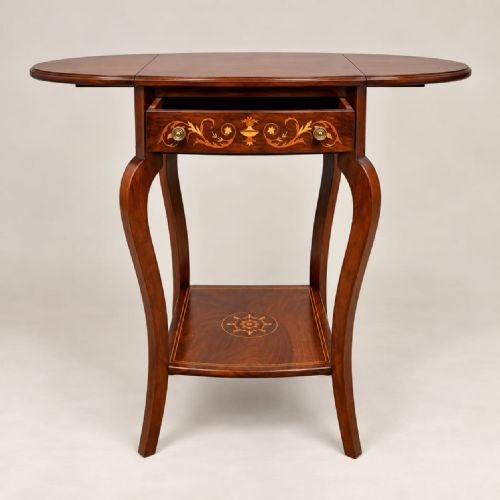
A victorian inlaid sewing table combines a compact container for threads and needles with a small surface suitable for writing or light display. Many examples incorporate fold-over tops or sliding compartments arranged for chess, backgammon, and card games.
The dominant version on this page is the burr walnut trumpet table, named for its flared pedestal base and octagonal or circular hinged lid. Walnut and rosewood dominate the selection, often accompanied by complex marquetry and contrasting light wood stringing.
How they were made
Cabinetmakers built these pieces using solid timber frames faced with decorative veneers like burr walnut, rosewood, and occasional exotic woods. Surface ornament relied on wood inlay, marquetry, and boxwood stringing, sometimes augmented by Tunbridge ware mosaics or hand-painted panels.
Internal compartments utilised lightweight secondary timbers fitted together with careful box joints to form trays, wells, and sliding work bags suspended below the main body.
Listings feature walnut, rosewood, mahogany, and occasional exotic woods paired with brass fittings.
What varies in quality
The distinction between standard production and exceptional craftsmanship rests in the depth of the timber figuring and the precision of the marquetry. Top-tier pieces feature book-matched burr walnut veneers and crisp, tightly fitted boxwood stringing that does not lift or chip.
Internal complexity also separates the grades, with superior tables offering fully fitted cedar or mahogany interior trays rather than plain fabric wells, alongside sturdy pedestals and well-engineered pivoting mechanisms.
Waring and Gillow
The Victorian Inlaid Sewing Table Glossary
- Marquetry inlay
- The art of forming decorative patterns using thin veneers of different coloured woods, fitted together within a prepared ground.
- Trumpet table
- A form featuring an octagonal or circular body widening towards a hinged lid, set upon a flared octagonal pedestal and carved tripod feet.
- Tunbridge ware
- Small mosaic woodwork created from thousands of tiny tinted wood blocks to form geometric or pictorial motifs.
- Stringing
- Thin lines of contrasting timber inlaid into channels around the edges of tabletops and drawers to create geometric borders.
Victorian Inlaid Sewing Table: Frequently Asked Questions
What is a trumpet sewing table?
A trumpet sewing table is a specific Victorian form featuring an octagonal or circular body that widens upward like a horn. The hinged lid opens to reveal fitted compartments for thread, thimbles, and sewing tools.
Beneath the main body, a suspended fabric bag traditionally held unfinished needlework. These tables stand on slender, carved pedestals supported by tripod feet.
How were these tables used originally?
These tables served as multifunctional pieces for middle and upper-class ladies during the nineteenth century. They provided a tidy station for embroidery and needlepoint while keeping sewing implements hidden out of sight.
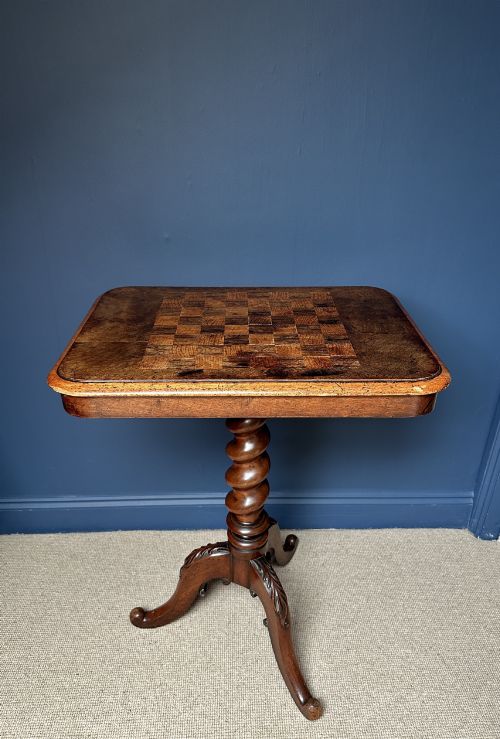
Many versions also doubled as games tables by incorporating chess or backgammon boards into their removable or reversible tops.
How do I tell walnut from rosewood?
Walnut displays a rich brown tone with prominent swirling grain patterns and lighter honey-coloured highlights, especially visible in burr walnut veneers. It feels slightly softer in appearance.
Rosewood presents a much darker, reddish-brown colour marked by distinct near-black streaks and an oily lustre. It tends to look heavier and more formal than walnut.
Where should I place a sewing table?
These compact tables fit well beside armchairs, sofas, or beds as functional side surfaces with internal storage. Their finished backs and detailed marquetry tops mean they look correct viewed from any angle in a room.
Keep them away from direct heat sources and strong sunlight to protect the fragile wood veneers and nineteenth-century polish from drying out.