
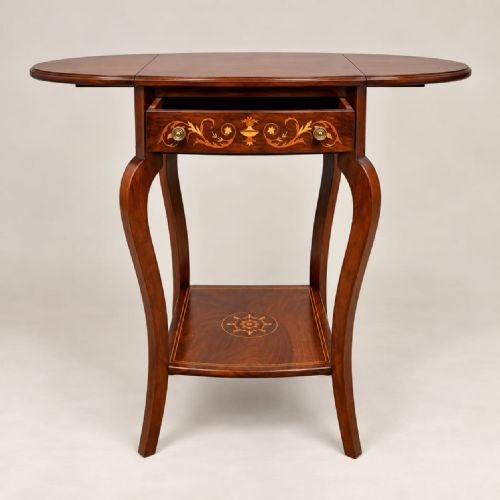
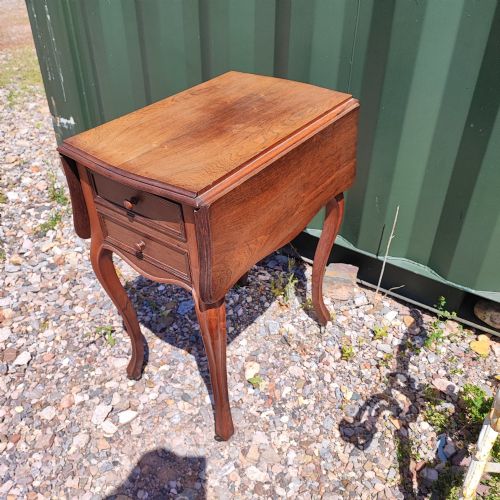


Brown Rosewood End Table
These brown rosewood end table pieces are compact occasional surfaces offering rich timber tones and varied stylistic origins for daily placement beside chairs or beds.
Brown Rosewood End Table
A brown rosewood end table brings together a dense tropical timber and versatile domestic utility, appearing in forms ranging from compact lamp tables to nests of four. Buyers searching for a brown rosewood end table will find pieces spanning the nineteenth century through the art deco period, drawing on diverse traditions including Victorian English workshop designs, French marquetry, and Qing dynasty Chinese carving.
The selections on this page show distinct stylistic branches rather than a single uniform type. You encounter drop leaf occasional tables, scrolling kang tables in huali hardwood, and nests of tables designed for flexible placement in reception rooms.
Most examples originate from the broader nineteenth century, leaning heavily into Victorian utility and Chinese Qing dynasty craftsmanship. These pieces serve practical needs for bedside storage or lamp placement while displaying the deep grain patterns inherent to rosewood and related hardwoods.
Materials and construction
The primary material across these pieces is dense rosewood, often paired with contrasting secondary timbers or exotic veneers such as satinwood, kingwood, and huali hardwood. Workshops utilised natural timber properties to create robust frames, sometimes incorporating brass fittings or intricate floral marquetry to accent the surface grain.
Construction methods vary according to regional origin, uniting English drop leaf mechanisms, French inlay traditions, and Chinese carved joinery. Artisans shaped structural hardwoods and applied detailed relief carving or scrolling ends directly to the timber, prioritising stability alongside visual texture.
Listings feature 19th-century periods alongside materials like brass, satinwood, and timber veneer.
Assessing quality and execution
Quality in these tables rests on the precision of the timber selection and the execution of surface details, such as carved leaf motifs or inlaid marquetry. Finer examples display tight, consistent grain matching across visible surfaces and crisp, intentional carving that retains sharp definition along edges and scrollwork.
The structural integrity of joints, drop leaf hinges, and nesting frames marks the difference between standard production and superior craftsmanship. Well-executed pieces maintain smooth operation in moving parts and stable alignment across multiple tiers without relying on heavy modern reinforcement.
The Brown Rosewood End Table Glossary
- Rosewood
- A dense, heavily figured tropical timber prized for its deep brown colour and durability in fine furniture. This material forms the primary visual foundation for the pieces gathered here.
- Drop leaf
- A table top configuration featuring hinged flaps that fold down to save space or extend upwards for surface area. This mechanism appears frequently on nineteenth-century occasional pieces.
- Kang table
- A low domestic table originating from Chinese tradition, often featuring scroll ends and carved hardwood construction. These low forms serve similar functional roles to western end tables.
- Marquetry
- The art of applying decorative pieces of veneer to a structure to form intricate floral or geometric designs. French workshops utilised this technique on side tables.
- Huali
- A traditional Chinese hardwood category associated with valuable furniture of the Qing dynasty. Pieces utilising this timber display notable density and carved detail.
Brown Rosewood End Table: Frequently Asked Questions
How do I style an end table in a modern room?
Pair the deep timber tones of a rosewood table with neutral walls to let the natural grain and carving stand out as a focal point.
Keep surface accessories minimal, such as a single lamp or a small ceramic dish, to preserve the proportions of the piece.
Were these tables used as bedside stands originally?
Many nineteenth-century occasional and drop leaf designs were adapted for multiple domestic rooms, including bedrooms and drawing rooms.
Compact dimensions made them suitable for holding lamps, books, or small personal items beside seating or sleeping areas.
What is the difference between an occasional table and a side table?
An occasional table typically refers to a movable, smaller surface designed to be brought out for specific needs, while side tables maintain a fixed position against a wall.
Both categories overlap significantly in nineteenth-century vernacular and serve identical functional roles in contemporary spaces.
How do I care for nineteenth-century rosewood surfaces?
Protect the timber from direct sunlight and extreme humidity fluctuations to prevent the wood veneers from drying or splitting over time.
Dust regularly with a dry cloth and avoid harsh chemical polishes that can degrade the traditional finish.
Why do some tables come in nests?
Nesting tables were manufactured to provide multiple surfaces that occupy the footprint of a single small table when stored.
This space-saving design became popular across various nineteenth and early twentieth-century traditions for entertaining.