


Victorian Index Cabinet
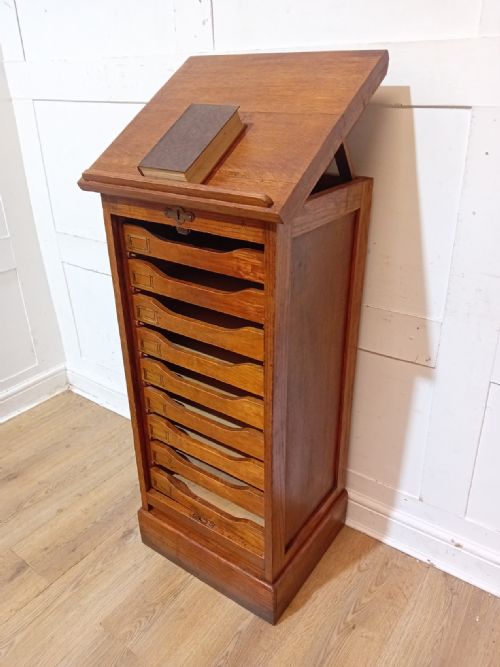
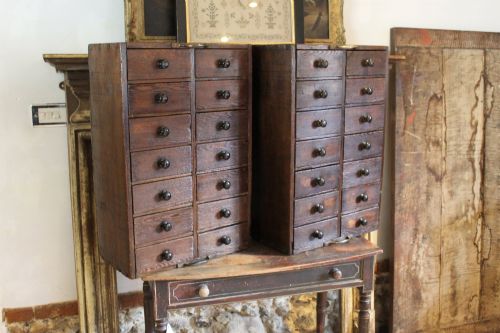
These Victorian index cabinet pieces are purposeful storage furniture built to organise papers and small objects, offering solid construction for modern utility.
Victorian Index Cabinet
A Victorian index cabinet provides partitioned storage for cards, papers, letters, or small collectables within banks of shallow drawers. When searching for a Victorian index cabinet, buyers encounter diverse forms ranging from shop fittings and office filing systems to jewellers' chests and watchmakers' banks of drawers. These pieces reflect the organisational needs of late nineteenth-century businesses and workshops through modular drawer arrangements.
The selection on this page spans from the mid nineteenth century through to the Edwardian period, with occasional later utility examples. Common configurations include multi-drawer pine shops, patent letter files with specialised internal mechanisms, and walnut or oak desktop cabinets. The smaller items function well on tabletops while larger banks serve as freestanding storage units.
How they were made
Cabinet makers utilised durable timbers like oak, walnut, and pine to construct these robust storage units. Hardwoods such as oak and walnut provided strength for frequently opened drawers, while pine served well for large multi-drawer shop fittings and utility pieces.
Metal hardware played a crucial role in daily operation, with brass handles, label holders, and patent locking systems fitted to secure contents. Construction often involved tight joinery designed to withstand heavy commercial use, alongside specialised internal mechanisms for holding correspondence.
Listings feature pieces spanning from the mid nineteenth century to the mid twentieth century, utilising oak, pine, walnut, and brass.
What varies in quality
Quality differences lie in the selection of timber and the sophistication of the internal mechanism or patent hardware. Simpler utility pieces rely on painted pine and basic pulls, whereas higher-end examples feature figured walnut or oak with integrated patent letter files and original brass fittings.
The degree of specialisation also separates standard storage from finer workshop pieces. A jewellers' cabinet or a watchmakers' tall bank demonstrates greater refinement in drawer scaling and timber selection than a standard office filing cabinet.
D Napier & Sons·Amberg
The Victorian Index Cabinet Glossary
- Bank of drawers
- A chest featuring numerous shallow drawers arranged vertically or horizontally, commonly used by tradesmen and offices. These units maximise storage capacity for small items while keeping them sorted.
- Patent cabinet
- A piece incorporating a legally protected mechanical system, such as Amberg's letter file designs. These innovations improved document retrieval in Victorian offices.
- Shop fitting
- Furniture built specifically for retail environments, such as multi-drawer pine counters and display units. They were engineered for heavy daily interaction with customers and stock.
- Collectors cabinet
- A specialised piece designed to house small specimens or items in shallow dust-proof drawers. They often feature tightly fitted timber and subtle internal divisions.
Victorian Index Cabinet: Frequently Asked Questions
What were index cabinets used for?
These cabinets served offices, shops, and workshops for organising letters, index cards, and small components. Businesses relied on them to keep paperwork and stock items sorted efficiently.
Over time, their precise partitioning made them adaptable for storing modern stationery, craft materials, or household collections.
Will these cabinets fit modern paperwork?
Many older filing and index drawers were built for specific historical paper sizes, patent systems, or trade items rather than standard modern formats. Buyers should check internal drawer dimensions carefully before planning specific uses.
Some variations accommodate modern items easily, while others suit smaller ephemera and stationery best.
How should I care for the wood?
Maintain timber surfaces by keeping them away from direct heat sources and sudden humidity changes to prevent wood movement. Gentle cleaning with a soft cloth preserves the finish.
Occasional application of appropriate wax keeps hardwood and pine nourished without building up heavy residues.