
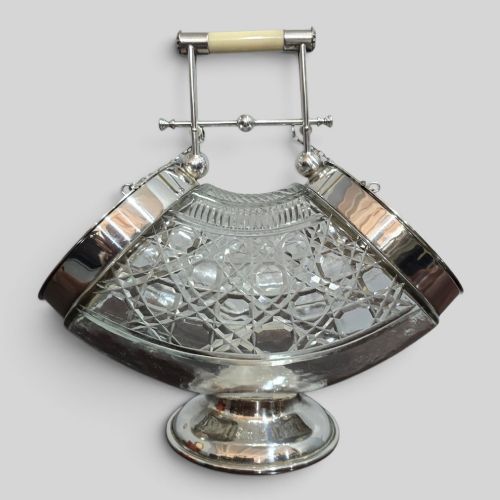
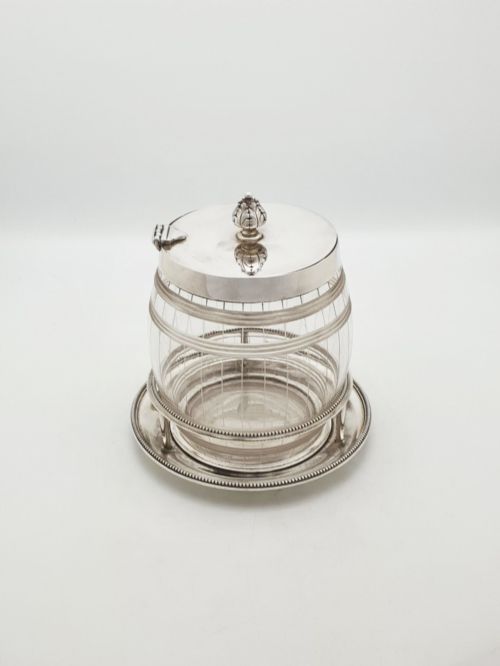


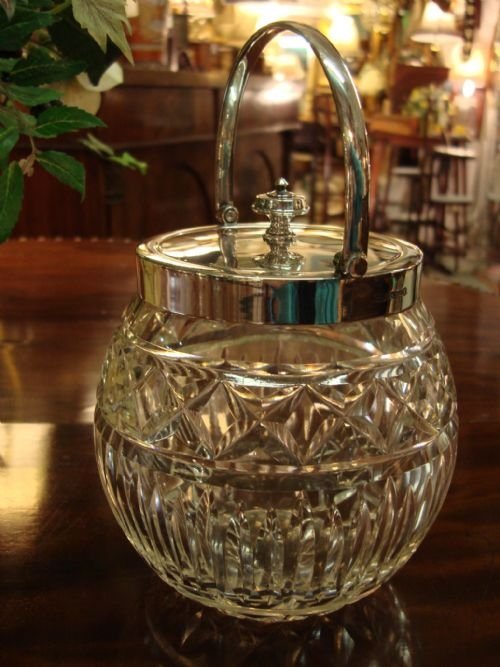
Victorian Glass Biscuit Jar
A victorian glass biscuit jar sits on the drawing room sideboard, holding dry treats for afternoon callers with quiet elegance.
Victorian Glass Biscuit Jar
A victorian glass biscuit jar combines pressed or cut glass vessels with metal mounts to store dry baked goods. These tablewares date primarily from the Victorian and Edwardian eras, spanning the mid-nineteenth century into the early twentieth century.
The form typically appears as a rounded or panelled barrel with a fitted lid and a matching metal swing handle. Most examples found here pair clear cut glass or rich cranberry glass with silver-plated mounts.
Makers also produced variations featuring enamel painting, gold leaf detailing, and heraldic finials. Collectors frequently encounter these pieces under alternate terms such as biscuit barrels or cookie jars.
Materials and construction methods
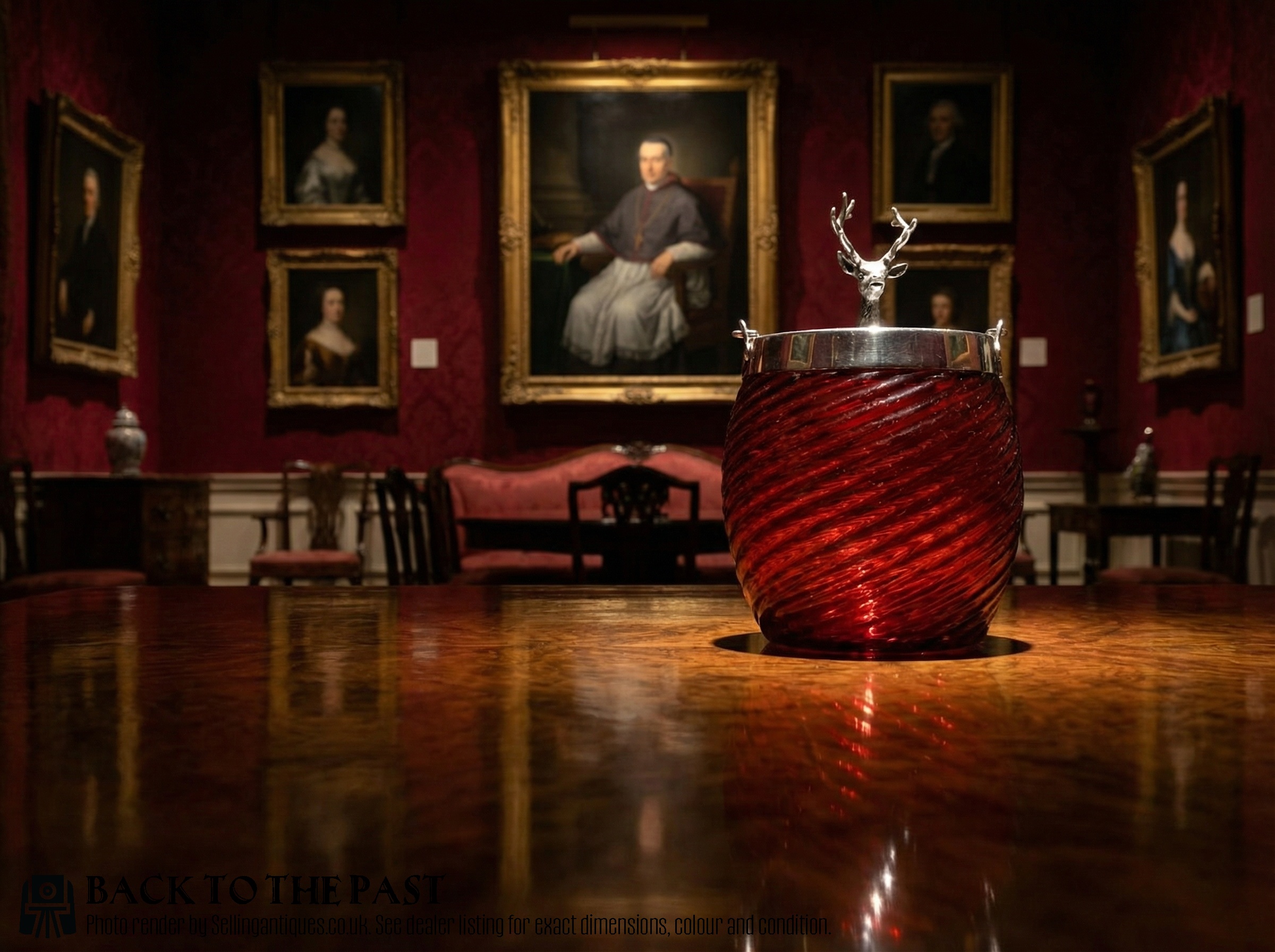
Artisans formed the glass bodies through heavy cutting, moulding, or blowing, particularly utilising deep hobnail patterns and twisted designs. Cranberry glass achieved its distinct reddish-pink tone through the addition of gold chloride to the molten batch.
Metalworkers fabricated the rims, lids, and swing handles from silver plate or sterling silver, often securing them to the glass with collar mounts. Workshops such as Elkington, Walker and Hall, and James Dixon and Sons applied precise plating and hallmarking techniques to these mounts.
Some Victorian manufacturers added automated mechanical actions to open the lid when the handle tilted, delighting guests during tea.
Factors that separate examples
Quality rests heavily on the clarity and crispness of the glass cutting, where sharp facets catch the light more successfully than soft, pressed moulds. Heavier glass vessels with substantial wall thickness demonstrate superior material use from the period.
The execution of the metal mounts also dictates standard, particularly where silversmiths incorporated detailed engraving, heraldic finials, or sturdy silver plating. Intricate hand-painted enamel decoration or gold leaf work adds a distinct layer of craftsmanship to select vessels.
Elkington·Walker and Hall·James Dixon and Sons
The Victorian Glass Biscuit Jar Glossary
- Biscuit barrel
- A lidded container designed specifically for serving dry biscuits or cookies in the parlour. This term is largely interchangeable with biscuit jar or biscuit box.
- Cranberry glass
- A transparent pinkish-red glass created by adding gold to the molten mixture during production. It became immensely popular for decorative tableware during the Victorian period.
- Hobnail cut
- A raised, multi-faceted geometric pattern cut into the surface of glassware. This technique produces a textured finish that refracts light brilliantly.
- Silver plate
- A layer of silver fused to a base metal core such as nickel silver or Britannia metal. It provided households with the appearance of solid silver at a lower cost.
- Sterling silver
- An alloy consisting of silver and other metals, traditionally copper, containing a fixed purity proportion. Hallmarks stamped into the metal verify this standard.
Victorian Glass Biscuit Jar: Frequently Asked Questions
How were biscuit jars used?
Victorian households placed these lidded glass jars on parlour tables or sideboards to offer dry sweet biscuits to afternoon guests. The fitted lid kept the baked goods fresh while the swing handle allowed servants or hosts to carry the vessel easily.
Over time, these pieces moved from dining spaces into general display, reflecting changing domestic habits and interior decoration styles.
How can I tell Victorian from Edwardian pieces?
Victorian examples often lean towards heavier, more ornate designs with deep hand-cutting, heraldic motifs, and rich cranberry glass colouring. Edwardian pieces, dating from around the turn of the century, frequently exhibit lighter proportions and crisper geometric patterns like hobnail cutting.
Examining the style of the metal mounts and any maker's marks helps clarify the specific decade of production.
Are these jars safe for food?
While these vessels were originally manufactured to hold edible biscuits, antique glass and older silver-plated interiors require careful consideration before modern use. Modern food safety standards differ from nineteenth-century production methods, particularly regarding the composition of older metal plating.
Many collectors prefer to display these jars as decorative objects rather than utilising them for daily food storage.