

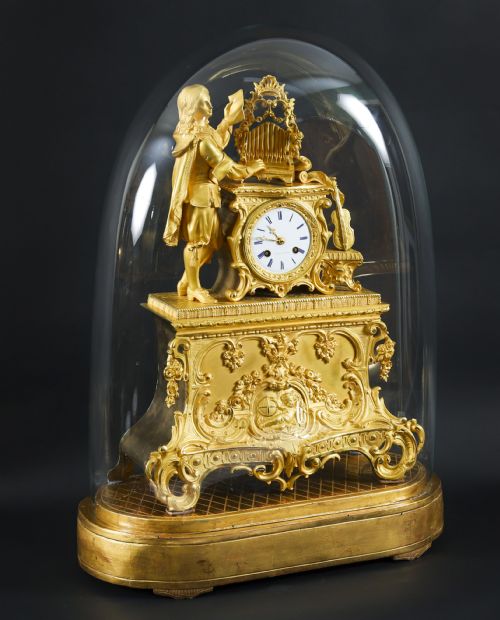


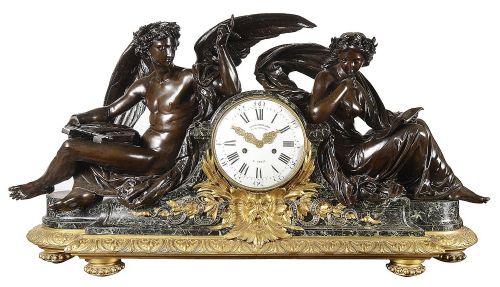


Victorian Figural Mantel Clock
These Victorian figural mantel clock pieces combine sculptural figures with precise timekeeping, bringing nineteenth-century craftsmanship directly to the mantelpiece.
Victorian Figural Mantel Clock
A victorian figural mantel clock is a striking timekeeper incorporating human, animal, or mythological figures into its design. The listings on this page span the nineteenth century, drawing heavily from periods between 1850 and 1900.
Most examples originate from French workshops adhering to styles like French Rococo Revival, Louis XVI Revival, and Second Empire aesthetics. Forms range from standalone mantel and table clocks to multi-piece clock garnitures accompanied by matching side ornaments.
Materials and construction methods
Maker construction relies on heavy foundational materials such as marble, onyx, and carved linden wood to support the weight of the internal movements. Metal components utilise brass, bronze, gilt bronze, ormolu, and spelter, often cast into ornate sculptural shapes.
Visual detail is added through hand-painted enamel dials, porcelain panels, and cold-painted bronze finishes. Glass domes frequently protect delicate table clocks and associated stands from dust.
A putto relaxes with a dog in one bronze mantel clock model, capturing a domestic scene frozen in gilt metal.
Assessing quality in figural clocks
Quality differentiates by the crispness of the metal casting and the depth of the chasing on gilt bronze and ormolu surfaces. Sculptural figures executed by named founders or artists display superior anatomical detail compared to generic castings.
The integration of the dial with hand-painted porcelain or enamel elements also dictates standard. Complete clock sets and garnitures retaining original matching components hold greater architectural coherence.
Leroy Paris·Bergen & Co·Auguste Moreau·Lemerle Charpentier·Victor Paillard·John Bennett Cheapside London·Louis Hottoot·F Marti·P.H. Mourey
The Victorian Figural Mantel Clock Glossary
- Ormolu
- Gilding technique involving the application of a finely ground high-carat gold-mercury amalgam to a bronze object. This creates a durable golden finish seen across nineteenth-century French pieces.
- Garniture
- A set of decorative matching objects designed for display together on a mantelpiece. These typically comprise a central clock flanked by two matching vases, urns, or candelabra.
- Spelter
- A zinc alloy commonly utilised as a less costly alternative to bronze for figural statues. It is frequently given a bronze-colored coating to mimic heavier metal work.
- Enamel dial
- A clock face created by fusing powdered glass to a metal substrate at high temperatures. Hand-painted numerals and minute markers are subsequently fired onto the surface.
- Striking clock
- A timepiece equipped with a mechanism that chimes the hours or half-hours on a bell or gong. Most nineteenth-century examples utilise an eight-day movement.
Victorian Figural Mantel Clock: Frequently Asked Questions
What is a clock garniture?
A clock garniture consists of a central clock accompanied by matching side ornaments like urns or candelabra. These matched sets were designed to sit together across a fireplace mantel.
They create a balanced decorative display typical of nineteenth-century interiors. Each piece shares the same materials and sculptural themes.
How do eight-day movements work?
An eight-day movement requires winding approximately once a week to keep the clock running and striking. This mechanism uses springs or weights to power both the timekeeping gear train and the strike train.
Clock keys are used to wind the springs through holes on the dial. The design freed owners from daily maintenance.
Where were these clocks made?
The pieces originate primarily from French and British workshops active during the nineteenth century. Paris served as a major hub for gilt bronze and porcelain-mounted mantel clocks.
Swiss makers contributed specialised carved wood designs, particularly from the Black Forest region. London retailers also retailed and signed imported movements.
What material is ormolu?
Ormolu refers to gilded bronze created using a mercury-gilding process popular in nineteenth-century France. The technique produces a rich golden lustre on decorative mounts and sculptural figures.
It provides durability and a distinct metallic sheen. This finish is frequently found on Rococo Revival and Louis XVI style clocks.