

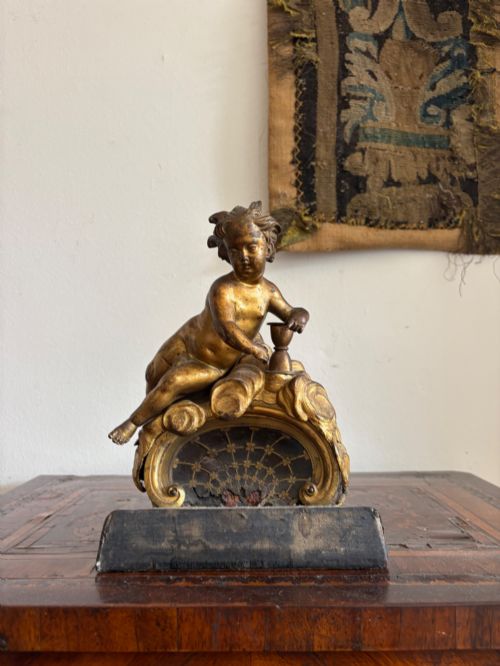
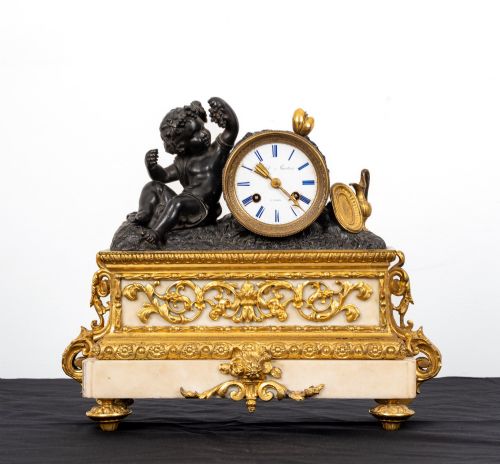
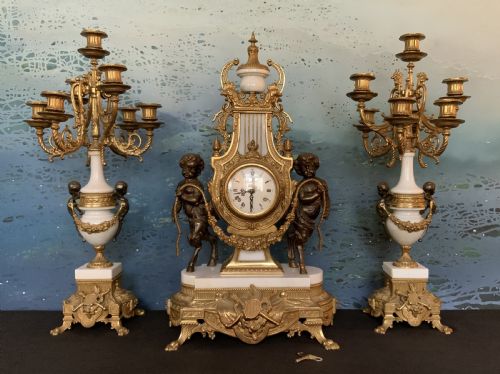


Antique Bronze Fireplace Clock
An antique bronze fireplace clock anchors a room with sculptural weight, bringing French elegance and timekeeping together on the mantelpiece.
How they were made
Makers utilised cast bronze and ormolu for the sculptural figures, mounts, and decorative frames that define these clocks. Gilding and patination techniques brought out the fine detail in cast motifs like acanthus leaves, cherubs, and classical drapery.
Bases and bodies relied on contrasting natural materials such as red, white, or rouge marble, often paired with enamel dial faces and brass clock movements. Some iterations integrated porcelain plaques or glass domes to protect the delicate gilt metalwork.
What varies in quality
The crispness of the bronze casting and the precision of the hand-chiselled ormolu surface separate standard production from superior examples. Workshops employing named makers achieved greater depth and definition in figures like putti and floral swags.
The choice and integration of materials also distinguish the range, particularly the weight of the marble base and the preservation of the original fire-gilding. Complete garniture sets with matching candelabra represent a higher tier of domestic display.
Listings here concentrate heavily on nineteenth century French production, uniting gilt bronze, ormolu, and various coloured marbles in mantel clocks and garniture sets.
Siffel and Cartier·PH Mourey·Lemerle Charpentier·Deniere and Cailleaux·James Ritchie and Son·Vincenti
The Antique Bronze Fireplace Clock Glossary
- Ormolu
- A technique of applying finely ground high-carat gold to a bronze object, creating a rich golden finish. This surface treatment appears widely across nineteenth century French mantel clocks.
- Garniture
- A set of matching decorative objects designed to be displayed together on a mantelpiece, usually comprising a central clock flanked by candelabra or urns.
- Portico clock
- A mantel clock featuring a architectural frame supported by four columns, often housing a suspended pendulum. These forms frequently combine marble and gilt bronze elements.
- Putto
- A plump, winged infant figure, frequently depicted as a cherub in bronze or ormolu mounts on rococo and neoclassical clock cases.
- Enamel dial
- A clock face made by fusing powdered glass to a metal substrate at high heat, yielding a smooth, glossy white surface with painted numerals.
Antique Bronze Fireplace Clock: Frequently Asked Questions
What is an antique bronze fireplace clock?
These are heavy mantel clocks and garniture sets, predominantly French in origin, combining cast bronze or ormolu with marble and enamel.
They functioned as both timekeepers and sculptural ornaments for nineteenth-century domestic interiors.
How were clock garnitures displayed?
A central mantel clock was placed on the fireplace, flanked by matching candelabra or decorative urns to create a symmetrical arrangement.
Some sensitive pieces were housed beneath glass domes to protect the delicate gilt surfaces from dust.
How do I identify Louis XVI style?
Louis XVI style pieces feature neoclassical restraint, straight architectural lines, and symmetrical motifs like ribbons, urns, and acanthus leaves.
They contrast with the asymmetrical curves and exuberant foliage found in earlier Rococo designs.
What materials make up these clocks?
The primary structure relies on cast bronze or brass, frequently enhanced with fire-gilded ormolu and mounted on red or white marble bases.
Clock faces are typically white enamel with painted numerals, sometimes accompanied by visible pendulums or porcelain plaques.