




French Classical Figure Clock
These french classical figure clock pieces bring sculptural bronze and marble presence to a room, driven by nineteenth century European horology.
French Classical Figure Clock
A french classical figure clock combines a mechanical timekeeper with cast metal or carved stone figures, emerging from nineteenth century workshops in forms such as mantel clocks and multi piece garniture sets. These pieces draw on French Empire, Louis XVI, and Regency aesthetics, often pairing a central dial with flanking garnitures or standing figures.
The most common versions met on this page date from the nineteenth century, spanning Victorian periods and Napoleon III styles. They incorporate subjects from literature and history, sitting beneath glass domes or upon architectural marble bases.
Materials and construction
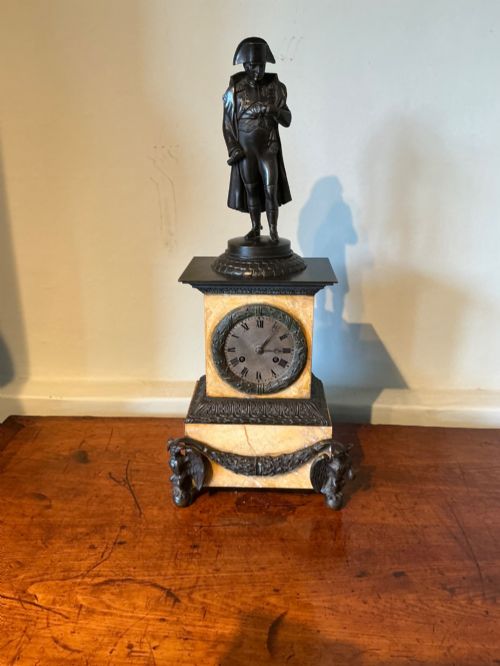
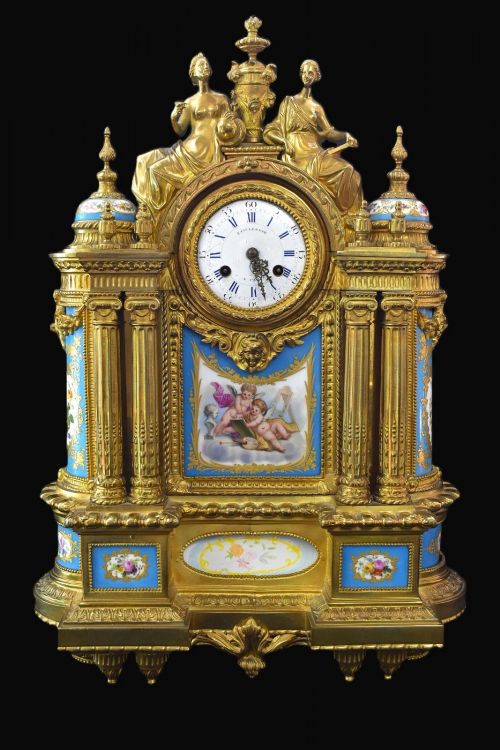
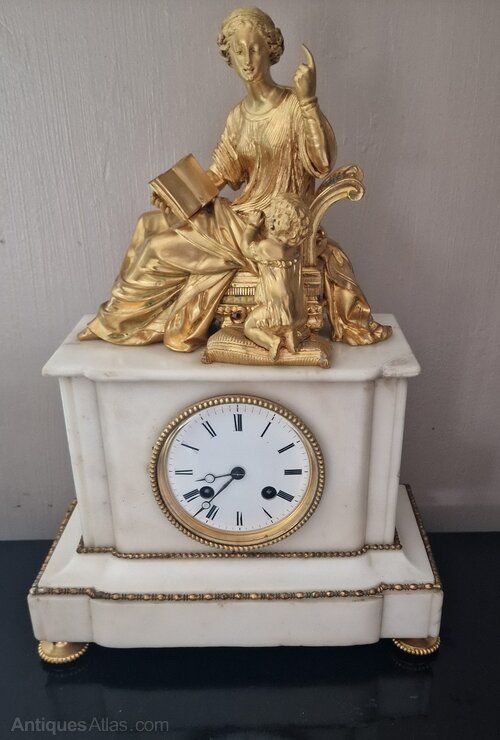
Maker workshops utilised bronze, ormolu, and brass for the figural castings and decorative mounts, applying fire gilding and patination to achieve deep tonal contrast. These metal elements were combined with marble and rouge marble bases, housing eight day striking movements behind enamel dials.
Movements required precise gear cutting and escapement fitting, while cases integrated carved alabaster or glass domes to protect the delicate surface finishes of the bronze and ormolu components.
Figures of literature and historical personages such as Napoleon frequently stand watch over the ticking mechanisms.
Distinctions in quality
Quality rests in the crispness of the bronze chasing and the depth of the ormolu gilding, where sharper cast details separate workshop output. Superior examples show refined hand finishing on the figural subjects and integrated architectural stone bases.
The sophistication of the movement and the integration of signed dial work or maker markings also define the tier of the piece, alongside the preservation of original fire gilt surfaces.
Etienne Lenoir·Deniere Et Fils·Lemerle Charpentier·Japy Freres·Deniere Paris
The French Classical Figure Clock Glossary
- Ormolu
- Gilded bronze produced by applying a mercury and gold amalgam to a bronze base and firing it. This technique creates a durable, warm metallic finish seen across nineteenth century decorative work.
- Garniture set
- A matching group consisting of a central clock flanked by ornamental objects such as vases or candelabra. These sets were designed to sit symmetrically on a mantelpiece.
- Patinated bronze
- Bronze treated with chemical solutions to produce a darkened or coloured surface finish. It provides contrast against bright ormolu mounts in figural compositions.
- Fusee movement
- A mechanism utilising a conical pulley and chain to equalize the driving force of the mainspring as it unwinds. This improves timekeeping consistency across the running cycle.
- Enamel dial
- A metal dial face coated with fused glass powder and fired to create a smooth, white ground. Roman or Arabic numerals are then painted onto this surface.
French Classical Figure Clock: Frequently Asked Questions
How do I wind a french classical figure clock?
Most of these movements require a key inserted into the winding holes on the enamel dial to tension the spring. Care should be taken not to overwind the mechanism.
Moving the hands should be done gently in the direction of the time, avoiding rapid adjustments that might damage the escapement.
Where should I place a clock garniture set?
These sets require a stable, level surface such as a mantelpiece or heavy sideboard to support the weight of the marble and bronze components. Sufficient clearance is needed for glass domes if present.
Keeping the pieces away from direct heat sources and damp environments protects both the movement and the delicate ormolu surfaces.
How can I tell a nineteenth century piece apart?
Examination of the casting style, dial construction, and movement signatures helps determine the period of manufacture. Nineteenth century pieces often combine cast ormolu with patinated bronze and heavy marble bases.
Stylistic cues draw directly from Regency, Louis XVI, and Napoleon III revivals, reflecting the historical tastes of the Victorian era.