
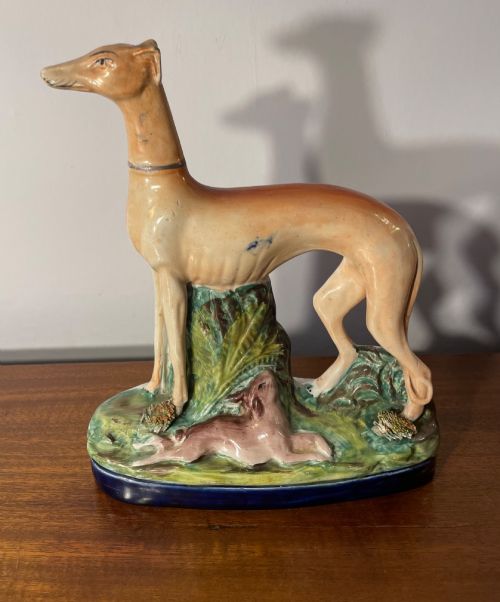


Victorian Earthenware Sculpture
Victorian earthenware sculpture brings solid nineteenth-century presence to a room through modelled figures, animals, and decorative ornaments formed in clay.
Victorian Earthenware Sculpture
Victorian earthenware sculpture covers a diverse range of modelled ceramic objects produced throughout the nineteenth century, including figures, groups, and animal studies. These pieces capture the tastes of the period, spanning domestic animal pairs, military commemorative subjects, and sculptural ornaments.
The selections available here lean heavily toward Staffordshire pottery figures and continental terracotta works. Buyers frequently encounter iconic Staffordshire dogs, pairs of lions or poodles, and more ambitious continental terracotta subjects originating from makers active in Austria.
Forms range from intimate mantel ornaments and bookends to substantial lifesize figures and garden or interior sculptures. The common thread is the use of fired clay, shaped to record nineteenth-century decorative and narrative art.
Materials and methods
Makers shaped these sculptures from earthenware and terracotta clays, utilising moulds or hand-modelling techniques to achieve detailed anatomical and decorative forms. Once shaped, pieces were fired in kilns to harden the porous clay body.
Listings feature works spanning the nineteenth century, utilising materials such as earthenware, terracotta, and majolica glaze.
Assessing quality and execution
Quality in these sculptures rests upon the crispness of the modelling and the care taken in the initial moulding or hand-shaping. Superior examples retain sharp facial details and clean anatomical proportions rather than softening into blurred outlines.
The application of glaze and enamel paint marks a distinct tier in craftsmanship, with finer pieces showing careful brushwork, rich majolica colours, or well-controlled lead glazes. The reputation of the pottery or the individual sculptor also elevates certain works above standard commercial production.
Thomas Parr·Bernard Bloch·Albert Carrier
The Victorian Earthenware Sculpture Glossary
- Earthenware
- A porous pottery body fired at lower temperatures than stoneware or porcelain. It requires a glaze to become completely watertight.
- Terracotta
- An unglazed or slip-coated fired earthenware clay with a characteristic brownish-red colour. It was widely used for continental figural sculpture and animal models.
- Majolica
- A colourful, glossy lead glaze applied over an opaque tin-white or direct earthenware body. It produces vibrant, rich tones popular for Victorian decorative figures.
- Lead glaze
- A transparent or tinted glossy coating containing lead oxide, applied to earthenware before a second firing. It gives a glassy, protective sheen to Staffordshire figures.
- Enamel paint
- Opaque pigments applied over the fired glaze or biscuit body to add fine details and colours. It allows for precise decoration on ceramic surfaces.
Victorian Earthenware Sculpture: Frequently Asked Questions
What is Victorian earthenware sculpture?
These pieces are three-dimensional ceramic objects modelled from clay during the nineteenth century. They include Staffordshire animals, figural groups, and continental terracotta sculptures.
They reflect the domestic and artistic preferences of the era, serving as decorative ornaments for the home.
How do I identify a Staffordshire figure?
Staffordshire figures typically feature earthenware bodies decorated with lead glazes or enamel paint. Common subjects include dogs, historical figures, and pairs of seated characters.
They date primarily from the mid-nineteenth century and were produced in large numbers in the Staffordshire pottery district.
What is terracotta sculpture?
Terracotta refers to fired, porous clay left unglazed or treated with a simple slip. Continental makers used this material to create detailed figural works and large animal studies.
These pieces often display a warm red-brown tone and are valued for their sculptural depth.
How should I care for these sculptures?
Earthenware and terracotta are relatively robust but remain susceptible to moisture and sharp impacts. Dust them gently with a dry, soft brush.
Keep them away from damp environments to protect the porous clay and any painted enamel surfaces.