
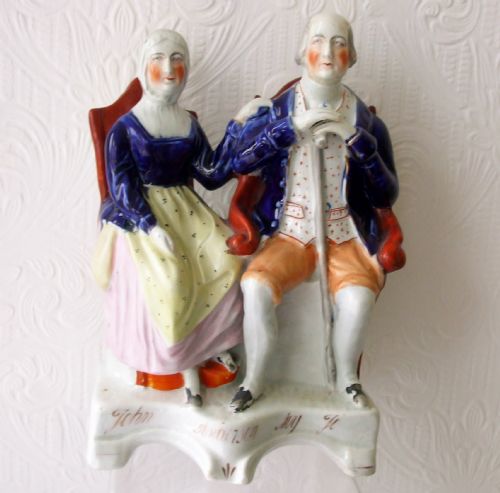


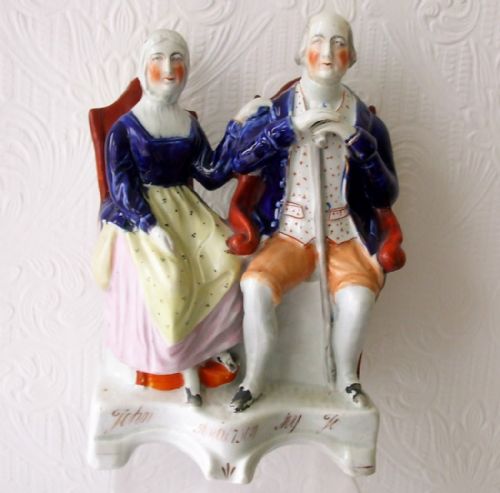
Victorian Earthenware Couple Figure
These Victorian earthenware couple figure examples bring domestic narrative and portraiture straight from the nineteenth century into your home.
Victorian Earthenware Couple Figure
A victorian earthenware couple figure typically depicts a pair of figures, ranging from country couples and Scottish lairds to harvesters, theatrical duos, and literary characters like John Anderson, My Jo. Most pieces found here belong to the Staffordshire flatback tradition, designed to stand neatly against a wall.
You will encounter various forms, including spill vases where the figures flank a central receptacle, alongside standard decorative figurines and royal portrait groups such as Princess Alice and Louis of Hesse. These pairs capture domestic and cultural narratives popular during the nineteenth century.
The styles span traditional Victorian folk art alongside occasional Dutch Art Nouveau pieces from makers like Rozenburg. While many represent anonymous country folk or theatrical companions, others identify specific historical or literary personages.
Materials and construction
Potters built these earthenware figures using ceramic clay, shaping them into flatback forms and decorative figurines that were fired in kilns. The resulting ceramic bodies provided a stable canvas for subsequent surface decoration.
Finishers applied lead glaze and enamel paint by hand to bring colour and detail to the clothing, faces, and settings of each couple. This combination of glaze and enamel gives the figures their characteristic sheen and vibrant palette.
Ben Backstay stands ready alongside his companion, proving that even a Victorian mantelpiece needed a salty theatrical crew.
Assessing quality and execution
The scale and ambition of the piece also distinguish the range, from simple small figures to large flatbacks and complex spill vases. Better modelling preserves the liveliness of the subjects, whether theatrical characters or harvesters.
Rozenburg
The Victorian Earthenware Couple Figure Glossary
- Flatback
- A Staffordshire figure modelled with a finished front and sides, but left largely plain and flat at the back because it was intended to stand against a wall on a mantelpiece.
- Spill vase
- A ceramic hollow cylinder incorporated into the figure group, designed to hold wooden spills for lighting fires or pipes.
- Earthenware
- A porous type of pottery fired at lower temperatures, requiring a glaze to render it waterproof and provide a smooth surface for enamel decoration.
- Lead glaze
- A glossy coating containing lead compounds applied to pottery before firing, producing a bright, smooth finish that protects the painted surface underneath.
- Enamel paint
- Vitreous coloured pigments fused onto the glazed ceramic surface during a secondary low-temperature firing to add durable details and hues.
Victorian Earthenware Couple Figure: Frequently Asked Questions
What is a flatback figure?
A flatback figure is a ceramic ornament moulded primarily for display on a mantelpiece or shelf. The back is typically unadorned and flat so the piece sits flush against a wall.
These figures were produced in large numbers during the nineteenth century to decorate Victorian homes with domestic and theatrical scenes.
How were spill vases used?
Spill vases incorporated a small cylindrical tube alongside the figures to hold thin wooden spills. These wooden tapers were lit from the hearth fire and used to transfer flames to candles or pipes.
This practical function combined utility with the decorative appeal of a couple figure on the mantelpiece.
How do I date these figures?
Dating relies on stylistic clues, materials, and specific historical or literary subjects depicted in the titles. Most pieces on this page date from the nineteenth century, specifically between 1850 and 1900.
Changes in glaze texture, ceramic body composition, and subject matter help separate mid-Victorian pieces from later nineteenth-century examples.
How should I display them?
These figures suit stable surfaces such as mantelpieces, sideboards, or enclosed shelves where they can be viewed from the front. Because they are earthenware with enamel decoration, keep them away from direct moisture and bright sunlight.
Allowing adequate space around each pair highlights their modelling and prevents accidental knocks.