
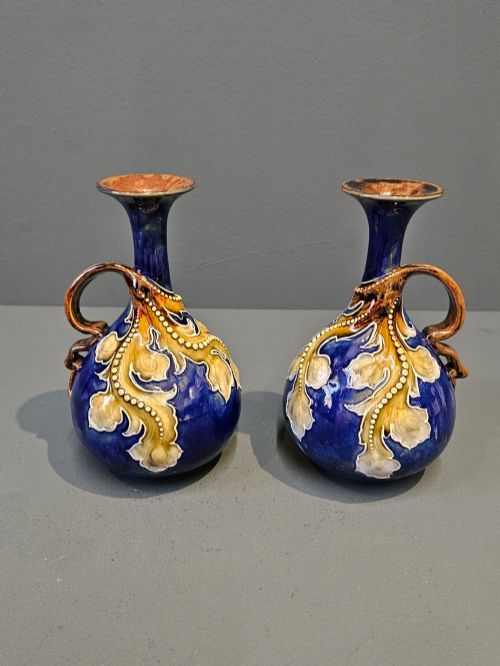
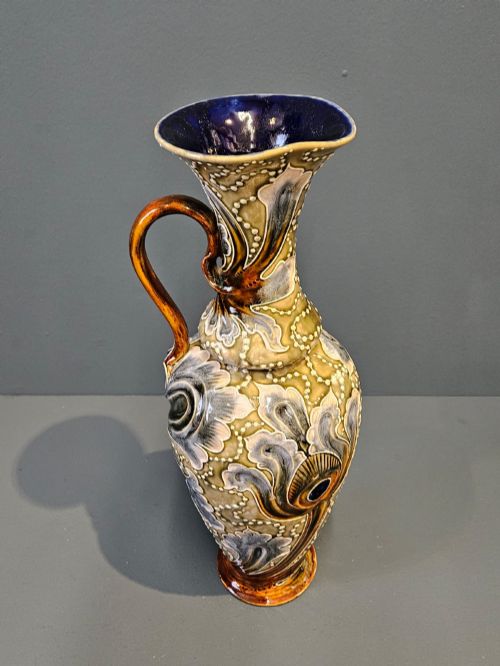


Victorian Doulton Stoneware Vase
These Victorian Doulton stoneware vase pieces bring tactile richness and varied glazes to any room.
Victorian Doulton Stoneware Vase
A Victorian Doulton stoneware vase embodies the robust ceramic traditions of the nineteenth century, emerging predominantly from the late Victorian decades. These pieces span distinct manifestations such as the Lambeth wares, Faience productions, and Slater's Patent designs. Buyers encounter individual vessels alongside matched pairs in various sizes.
The aesthetic vocabulary encompasses Victorian, Art Nouveau, Arts and Crafts, and Aesthetic Movement sensibilities. Forms range from large exhibition ewers and jugs to small decorative vases with shaped profiles. The evidence shows origins largely anchored in the 1880 period alongside later 1900 examples.
How they were made
Makers utilised stoneware and ceramic bodies, frequently applying salt glazes to achieve characteristic textured surfaces. Decoration involved intricate enamel work, gold leaf accents, and gilt detailing applied over fired clay. Sprigged stoneware details added further relief and tactile dimension.
Specialised surface treatments like Slaters Patent introduced patterned textures impressed directly into the ceramic body. Individual artists then painted, glazed, and finished each vessel by hand, resulting in nuanced variations across individual pieces.
Some Victorian potters pressed actual lace into damp clay to create intricate patterns that still catch the eye today.
What varies in quality
Quality rests upon the crispness of the impressed patterns and the control evident in the glazed surfaces. Pieces carrying attribution to named artists demonstrate superior execution in hand-painted detail and decorative depth.
The scale and ambition of the form dictate distinction, with large exhibition pieces and matched pairs representing more complex production than smaller standard vessels. The integration of gold leaf, enamel, and sprigged ornamentation further elevates the finish of the finer examples.
Eliza Simmance·Emma Shute·Emily Edwards·Emily Stormer·Florence Barlow
The Victorian Doulton Stoneware Vase Glossary
- Stoneware
- A robust, vitrified ceramic body fired at high temperatures until impervious to liquid. It forms the heavy, durable foundation for these nineteenth-century vessels.
- Salt glaze
- A glassy, slightly textured finish achieved by throwing common salt into the kiln during high-temperature firing. This creates the distinctive orange-peel surface texture seen on salt-glazed pieces.
- Slaters Patent
- A patented manufacturing technique involving the pressing of lace or other textiles into damp clay to create intricate surface patterns. This method produced richly textured backgrounds for hand-painted decoration.
- Faience
- A type of earthenware or ceramic pottery decorated with opaque coloured glazes before firing. It allowed makers to produce smooth, painterly surfaces distinct from standard salt-glazed stoneware.
- Sprigged
- A decorative technique where separately moulded clay reliefs are applied to the surface of an unfired vessel using slip as an adhesive. This creates raised ornamental motifs in contrasting colours or textures.
Victorian Doulton Stoneware Vase: Frequently Asked Questions
What is a Victorian Doulton stoneware vase?
It is a nineteenth-century ceramic vessel produced by Doulton potteries, known for textured stoneware bodies and decorative glazes.
These pieces reflect design movements such as the Arts and Crafts and Art Nouveau styles.
How were these vases used?
They served primarily as decorative ornaments within Victorian homes, displayed on mantelpieces and tabletops.
Larger ewers and jugs also functioned as display pieces for floral arrangements or as standalone works of art.
How do I identify the period?
Dating relies on stylistic markers, applied patent stamps, and specific decorative techniques associated with the late nineteenth century.
Many pieces from this era carry specific marks or artist ciphers that point to production around the 1880s.
How do I care for stoneware?
Keep the pieces clean by dusting gently with a soft, dry cloth to protect the delicate enamel and gilt surfaces.
Avoid using harsh chemical cleaners or submerging decorated items in water for extended periods.