

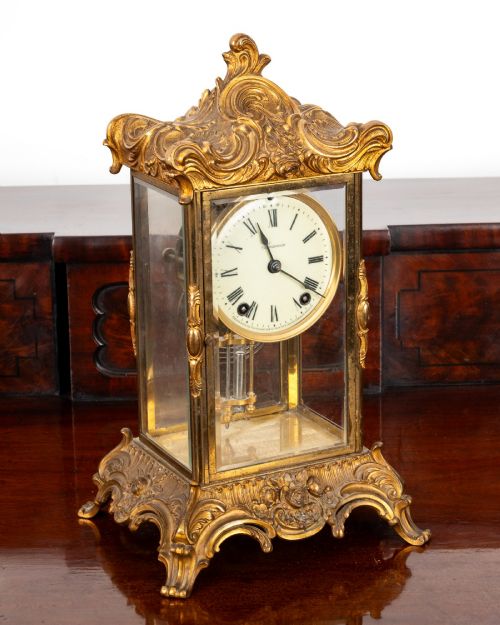


Victorian Crystal Regulator
These Victorian crystal regulator clocks are precision timepieces housed in bevelled glass and brass, bringing movement and light into any room.
Victorian Crystal Regulator
When you search for a victorian crystal regulator, you are looking at sophisticated mantel clocks designed to showcase internal mechanics through transparent glass panels. The pieces on this page span the 1870s, 1880s, and 1890s, capturing the height of French and late Victorian horological taste.
You will most frequently meet mantel clocks taking rectangular or oval forms, often ornamented with coloured enamel panels or green onyx. These objects combine heavy brass or gilt bronze framing with four glass sides, allowing uninterrupted views of the pendulum and movement.
Originating predominantly from French workshops alongside American makers like Ansonia, these items reflect diverse stylistic influences including Louis XVI style, Rococo Revival, and French Beaux-Arts. They function simultaneously as reliable timekeepers and striking architectural centrepieces for a mantelpiece.
How they were made
Makers constructed these clocks using heavy cast brass, gilt bronze, and gilt brass frameworks designed to support thick bevelled glass panels without distortion. The glass allows light to pass directly through the case, illuminating the dial and the swinging pendulum within.
Surface decoration frequently incorporates hand-painted enamel panels in blue, pink, or green, sometimes accented with paste stones or mounted upon green onyx bases. Metalwork relies on traditional casting and gilding techniques typical of late nineteenth-century European workshops.
Victorian Crystal Regulator Retail Price Guide 2026
Typical asking prices for victorian crystal regulator among the pieces listed under this phrase on Sellingantiques today, from the lower quarter to the upper quarter. They describe what is for sale here now, not the wider market.
Listings feature items from the 1870s, 1880s, and 1890s, utilising brass, gilt bronze, enamel, and bevelled glass.
What varies in quality
Quality in a victorian crystal regulator is defined by the weight of the metal cast, the clarity and bevelling of the glass panels, and the refinement of the painted enamel decoration. Heavier gilt bronze frames and substantial green onyx bases separate high-end examples from lighter, simpler brass variations.
The sophistication of the movement also dictates value, with signed works by known makers such as Samuel Marti demonstrating superior mechanical execution compared to unsigned alternatives. Finer pieces display intricate ornamentation across the dial and pendulum that complements the overall architectural proportions.
Samuel Marti·Ansonia New York
The Victorian Crystal Regulator Glossary
- Crystal regulator
- A mantel clock featuring glass panels on all four sides, allowing the movement and pendulum to be viewed from multiple angles. These pieces were developed in France during the nineteenth century.
- Bevelled glass
- Glass panes possessing angled edges that catch and refract light around the perimeter of the clock case. This technique adds depth and visual interest to the transparent housing.
- Gilt bronze
- Copper alloy treated with a gold or gilt surface finish to impart a bright, reflective metallic sheen. It provides durability and decorative elegance to the clock frame.
- Enamel panel
- A fused glass powder coating applied to metal surfaces and fired at high temperatures to create smooth, colourful decorative inserts. They appear in shades of blue, pink, and green on these clock faces and cases.
- Green onyx
- A decorative natural stone featuring distinct banding and green tones utilised as a substantial base material for mantel clocks. It adds weight and a polished mineral texture to the design.
Victorian Crystal Regulator: Frequently Asked Questions
What is a crystal regulator clock?
A crystal regulator is a mantel clock encased in heavy brass or gilt bronze with glass panels on four sides. This design exposes the movement and swinging pendulum to ambient light.
Originating largely in France during the nineteenth century, these clocks served both a domestic timekeeping function and a decorative display purpose in formal rooms.
How do you date these clocks?
Dating relies on stylistic clues such as the presence of Rococo Revival, Louis XVI style, or French Beaux-Arts ornamentation combined with material choices like green onyx or coloured enamel. The active periods span the 1870s through the 1890s.
Maker signatures stamped on the internal movements also help pinpoint the exact decade of production in nineteenth-century workshops.
Where were they placed?
These clocks were designed specifically for mantelpieces, sideboards, or console tables where their four-glass construction could benefit from surrounding light. Their reflective gilt bronze and bevelled glass surfaces made them focal points in Victorian parlours.
Because the movement is visible from all angles, they worked best when positioned where people could walk around them or view them side-on.
Who made these clocks?
Many of the finest examples originated in French workshops, including pieces produced by Samuel Marti during the late nineteenth century. American firms such as Ansonia in New York also manufactured gilt bronze crystal regulator models.
These makers combined precision clockmaking with decorative metal casting and enamelling to create unified architectural objects.