

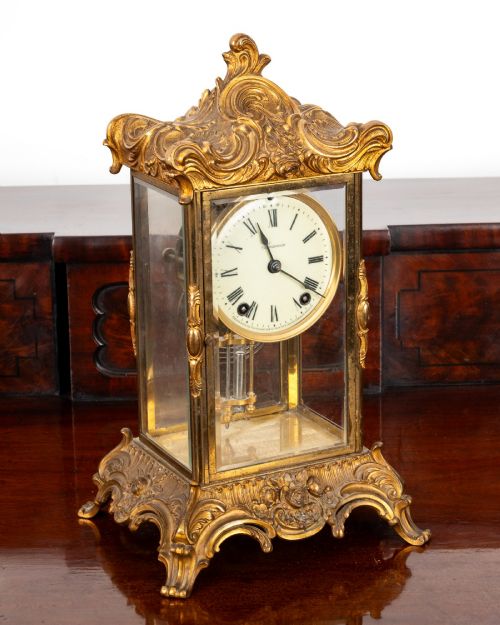


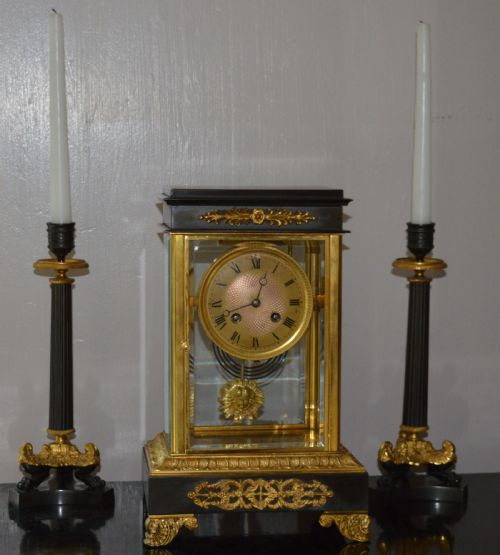


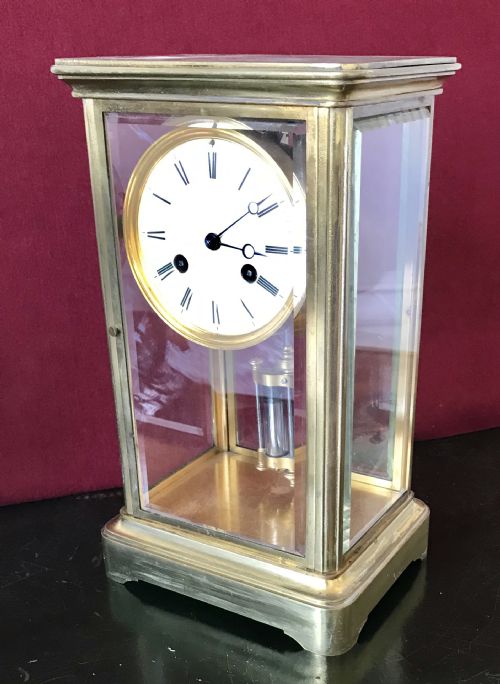
Gold Crystal Regulator
A gold crystal regulator is a precision timepiece housed in bevelled glass and brass, prized for its transparency and mechanical elegance.
Materials and construction
These clocks are constructed using substantial brass, gilt bronze, or ormolu frames that support heavy bevelled glass panels. The metallic components are frequently gilded to achieve a bright, reflective finish that complements the interior movement.
Assessing quality and craftsmanship
The distinction between standard production and finer examples rests upon the execution of the cast metal mounts and the refinement of the movement. Superior pieces exhibit crisp chasing on the gilt bronze and feature named makers whose mechanical standards were exceptionally high.
The integration of the glass panels within the metal frame dictates the overall aesthetic harmony. High-quality pieces utilise thick, bevelled glass panes that fit flush without gaps, whereas lesser examples feature simpler flat glass and coarser casting.
Gold Crystal Regulator Retail Price Guide 2026
Typical asking prices for gold crystal regulator among the pieces listed under this phrase on Sellingantiques today, from the lower quarter to the upper quarter. They describe what is for sale here now, not the wider market.
Listings feature pieces spanning from the 1870s to 1900, incorporating materials such as green onyx, bevelled glass, and gilt bronze.
Samuel Marti et Cie·Ansonia New York
The Gold Crystal Regulator Glossary
- Crystal regulator
- A mantel clock featuring glass panels on four sides to display the internal movement. This form became popular in France during the late nineteenth century.
- Bevelled glass
- Glass with edges cut and polished at an angle. This technique adds depth and catches light more effectively than standard flat panes.
- Ormolu
- Finely ground high-carat gold applied to a bronze base using mercury amalgamation. It provides a durable and rich metallic finish characteristic of fine decorative objects.
- Enamel
- A glassy substance fused to a metal substrate through firing. Used primarily for clock dials to create a smooth, durable surface for painted numerals.
- Escapement
- The mechanical linkage that controls the release of power in a clock. In these regulators, the escapement is often visible through the glass panels.
Gold Crystal Regulator: Frequently Asked Questions
What is a gold crystal regulator?
A gold crystal regulator is a tall mantel clock enclosed in glass on all sides, framed in gilt brass or bronze. These clocks were designed to let light pass through and showcase the intricate internal mechanics.
Originating primarily in France and America during the late nineteenth century, they served as grand decorative timepieces for formal parlours and drawing rooms.
How do you wind these clocks?
Winding is typically performed using a matching metal key inserted directly into winding holes on the enamel dial. This tensions the internal springs that drive both the timekeeping and striking trains.
Care must be taken not to overwind the mainsprings, as this can damage the vintage mechanical components inside the brass frame.
Where were these clocks made?
The majority of these timepieces were produced in France, particularly during the Belle Epoque and late nineteenth century. Famous Parisian foundries and movement makers supplied the components for many of these decorative pieces.
American manufacturers such as Ansonia also produced their own interpretations of the style for domestic markets during the 1880s.
How do I date a crystal regulator?
Dating relies heavily on stylistic cues, materials, and maker signatures stamped on the brass movement plates. Pieces from the 1880s often display robust architectural or Rococo Revival influences, while later 1900 examples lean towards refined Louis XVI styles.
Examining the type of escapement and the style of the enamel dial also provides reliable chronological markers for these nineteenth-century clocks.