

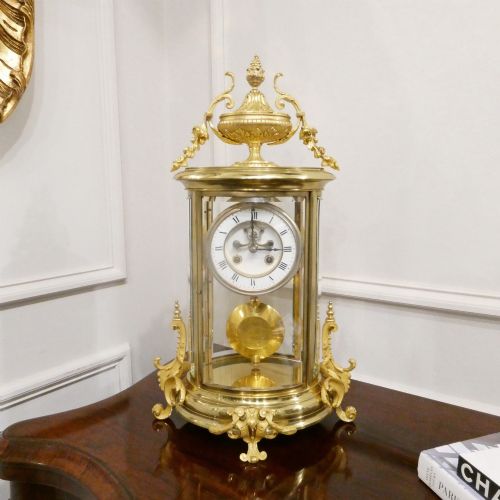


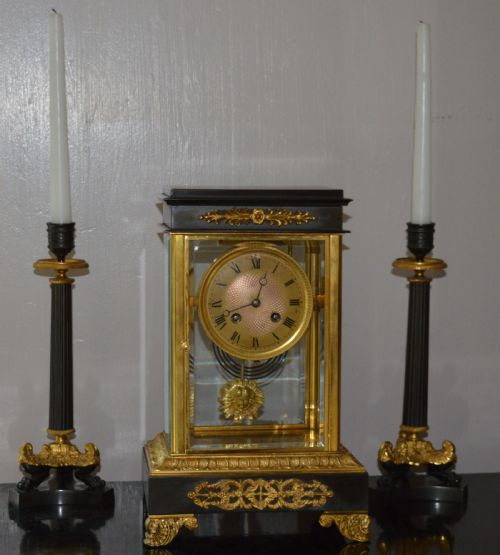


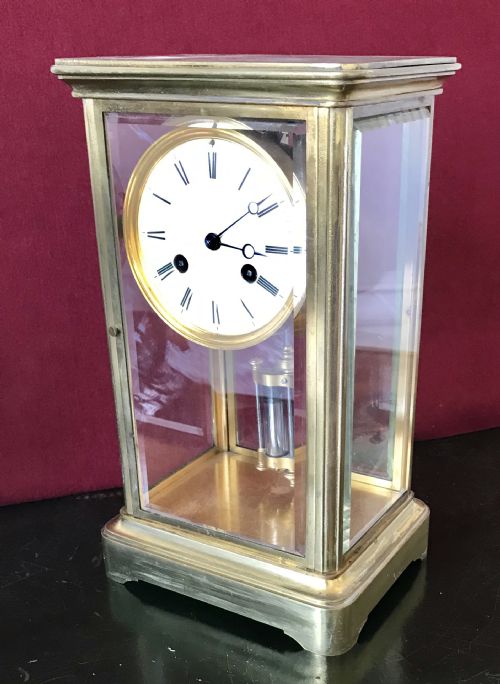
Gold French Regulator Clock
These gold french regulator clock pieces bring precision timing and brass-framed glass display into nineteenth-century interiors.
Gold French Regulator Clock
A gold french regulator clock typically takes the form of a four glass mantel clock or crystal regulator originating from the late nineteenth century. These tall or mantel-standing timepieces house movements within brass and glass frameworks that allow light to pass through the sides. Examples here range across the Victorian era into the Belle Epoque, incorporating styles from Rococo Revival to Louis XVI.
Most entries follow the standard crystal regulator or four-glass format, often featuring enamelled dials and exposed escapements. Makers such as Samuel Marti produced many of these architectural pieces during the 1870s, 1880s, and 1900s. Variations include green panels, oval cases, moon-phase dials, and associated clock sets.
Materials and construction
Gilt bronze, ormolu, and gilded brass form the primary structural housings for these movements, providing a bright metallic finish around the glazed panels. Heavy brass castings supply the rigid framework required to support thick bevelled glass panes on multiple sides. Enamel is utilised for the dial faces, often featuring painted numerals and fine subsidiary hands.
Makers integrated glass cases to showcase the mechanical gear trains and oscillating pendulums from every angle. The combination of mercury or standard pendulum systems with intricate brass wheels demanded high precision during assembly in French workshops.
Gold French Regulator Clock Retail Price Guide 2026
Typical asking prices for gold french regulator clock among the pieces listed under this phrase on Sellingantiques today, from the lower quarter to the upper quarter. They describe what is for sale here now, not the wider market.
Materials recorded across current items include gilt bronze, ormolu, bevelled glass, enamel, and solid brass.
Assessing quality and execution
The weight and crispness of the gilt bronze or ormolu casting define the upper tier of these timepieces, alongside the clarity and thickness of the bevelled glass panels. Finer examples display meticulous chasing on the brass mounts and sophisticated dial work, such as hand-painted enamel and moon-phase complications.
The presence of a recognised maker like Samuel Marti adds distinction to the movement and case pairing. Simpler brass-and-glass housings sit at the broader commercial end, while grander ormolu and grandfather formats represent more ambitious design scales.
Samuel Marti Et Cie
The Gold French Regulator Clock Glossary
- Crystal regulator
- A timepiece housed in a brass frame with glass panels on four sides and the top, allowing the movement and pendulum to be viewed clearly. These clocks gained popularity in France during the late nineteenth century.
- Ormolu
- Finely chopped leaf gold applied to a copper-zinc base metal using mercury amalgamation, or modern electroplating methods achieving a similar golden lustre. It decorates the exterior mounts and bezels.
- Bevelled glass
- Glass panes with edges cut and polished at an angle to refract light and fit neatly into rebated brass frames. This technique adds depth and refinement to the display case.
- Moon-phase dial
- A specialised clock face mechanism that tracks the lunar cycle through a rotating disc showing the phases of the moon. It appears on selected larger regulator models.
- Escapement
- The mechanical linkage that restrains the gear train, converting continuous force into controlled impulses for the pendulum. Visible escapements are a common feature in these French designs.
Gold French Regulator Clock: Frequently Asked Questions
What is a french regulator clock?
A french regulator clock is a precision timepiece enclosed in a glass and brass case, designed to display the movement and pendulum from all sides. These pieces date predominantly from the late nineteenth century and Victorian periods.
They reflect architectural and decorative styles of their era, ranging from simple four-glass mantel models to elaborate ormolu-mounted variations with enamel dials.
How do I wind the clock?
Winding requires a matching key inserted into the winding arbor holes on the enamel dial face. Care must be taken not to overwind the mainspring.
Most mechanical movements require regular attention to maintain accurate timekeeping and keep the pendulum swinging evenly within its glass enclosure.
Where should I place it?
These clocks need a stable, level surface such as a mantelpiece, bracket, or sturdy table away from direct sunlight and draughts. A level foundation ensures the pendulum swings freely and keeps accurate time.
Because the cases feature glass panels on multiple sides, positioning them where light can pass through enhances the visibility of the internal mechanics.
How do I identify the period?
Dating relies on stylistic clues, dial signatures, and movement stamps associated with makers active during the nineteenth century. Victorian and Belle Epoque designs often exhibit specific revival motifs like Louis XVI or Rococo details.
Examining the casting quality of the gilt bronze, the type of enamel on the dial, and any maker stamps on the backplate helps narrow down the decade of production.