


Victorian Ceramic Candle Holders
Victorian ceramic candle holders bring functional nineteenth-century lighting and intricate figurative modelling into domestic interiors.
Victorian Ceramic Candle Holders
Victorian ceramic candle holders encompass domestic lighting pieces formed from porcelain, ironstone, and hard-paste ceramic, frequently styled as candlesticks and multi-arm candelabra. The selection spans straightforward pairs and elaborate figural compositions drawing on revival motifs.
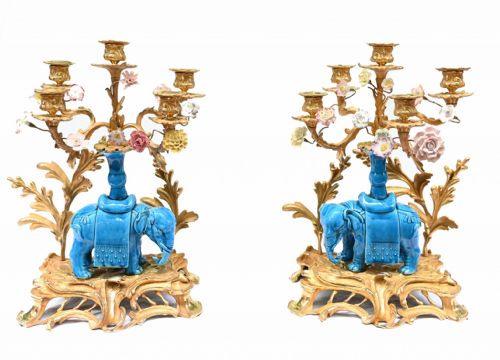
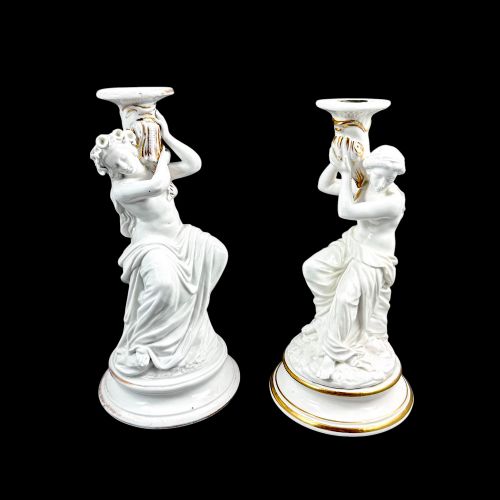
Moulded porcelain figures, cherubs, and allegorical subjects dominate the surviving forms, often enriched with hand-painted details and gilding. These pieces reflect nineteenth-century dining and parlour customs where decorative lighting served as a centrepiece.
English factories such as Royal Worcester and Minton sit alongside continental European works from Germany, producing items that balance utilitarian function with sculptural ambition. Buyers encounter everything from restrained Aesthetic Movement designs to exuberant Rococo Revival pieces.
What varies in quality
Quality rests upon the crispness of the ceramic moulding and the precision of the hand-painted decoration, where fine brushwork distinguishes superior studio output from standard factory production. Relief details on figures and foliage retain sharper definition on better examples.
The integration of ceramic components with brass or gilt mounts determines structural integrity, as well-fitted mounts prevent wobbling. Preservation of original gilding and enamel colours without excessive rubbing elevates the standing of a piece.
Listings feature items dated across the nineteenth century, with materials spanning porcelain, brass, and Hispano-Moresque glazed ceramics.
Royal Worcester Hadley·Doulton Lambeth·Mason's Ironstone China·Sitzendorf Porcelain·Volkstedt Porcelain·Helena Wolfsohn
The Victorian Ceramic Candle Holders Glossary
- Hard-Paste Porcelain
- A dense, durable ceramic composed of kaolin and petuntse, fired at high temperatures. It forms a vitreous body that resists scratching.
- Candelabra
- A branched candlestick holding multiple candles on separate arms. These pieces often feature a central stem flanked by symmetric lights.
- Aesthetic Movement
- A late nineteenth-century design style emphasising visual beauty over narrative content. It drew inspiration from Japanese art and simplified forms.
- Rococo Revival
- A mid-nineteenth-century decorative style marked by C-scrolls, asymmetric ornamentation, and naturalistic shell motifs. It heavily influenced Victorian porcelain figures.
Victorian Ceramic Candle Holders: Frequently Asked Questions
How were victorian ceramic candle holders used?
These pieces provided illumination in nineteenth-century drawing rooms and dining tables, holding wax or tallow candles securely.
They also functioned purely as decorative ornaments on mantelpieces and sideboards when unlit.
Are these candle holders safe to use?
Modern users can burn standard taper candles in them, provided the sockets match the candle diameter.
Care is required to protect delicate ceramic arms and gilded surfaces from heat damage and wax drips.
How do I identify different periods?
Factory marks, impressed culls, and registration numbers stamped on the base offer the most reliable dating evidence.
Stylistic shifts from early Rococo Revival forms to later Aesthetic Movement designs also indicate the manufacturing decade.
Why do some pieces have brass parts?
Makers incorporated brass and gilt metal components to reinforce slender ceramic stems and support multi-arm candelabra.
Metal bobbins also provided a secure, non-flammable socket for receiving the candle.