
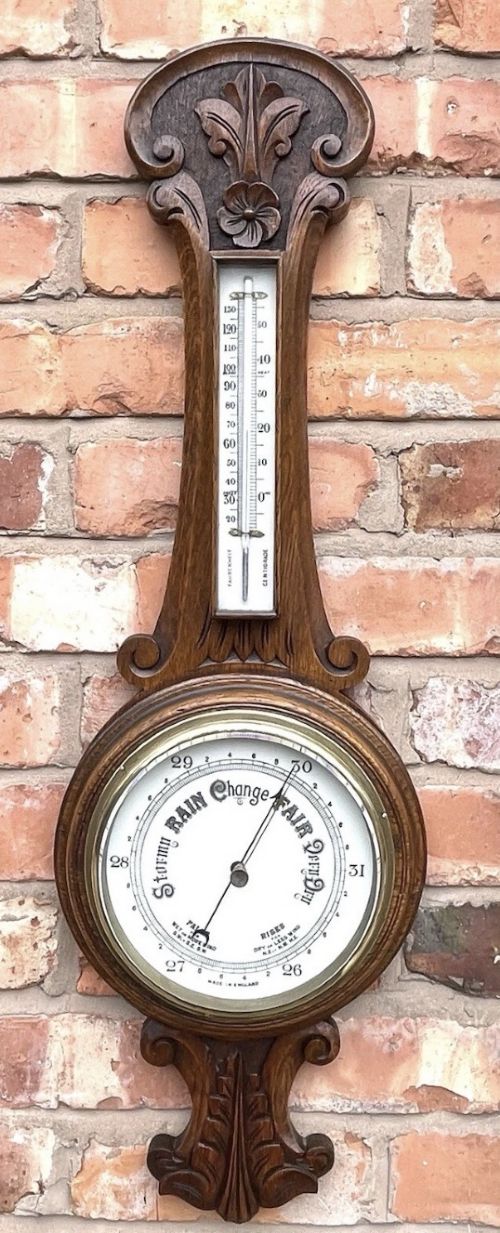

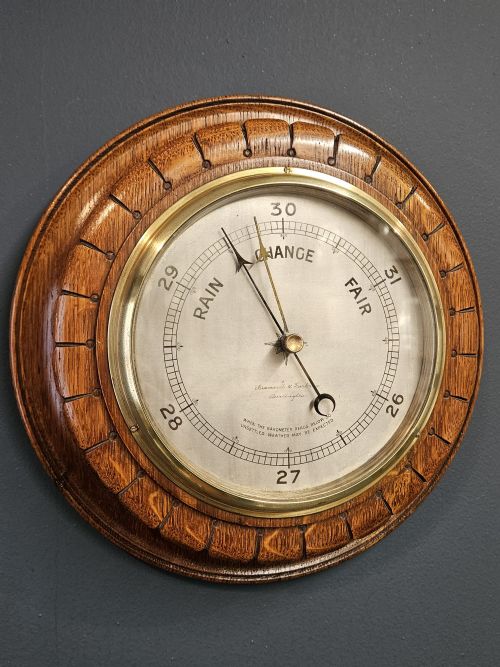

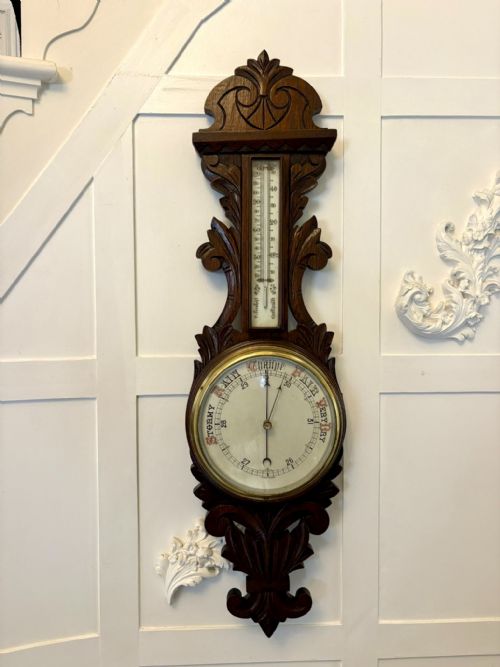


Victorian Carved Aneroid Barometer
A Victorian carved aneroid barometer brings reliable atmospheric tracking indoors, housed in richly textured timber that captures nineteenth-century craftsmanship.
Victorian Carved Aneroid Barometer
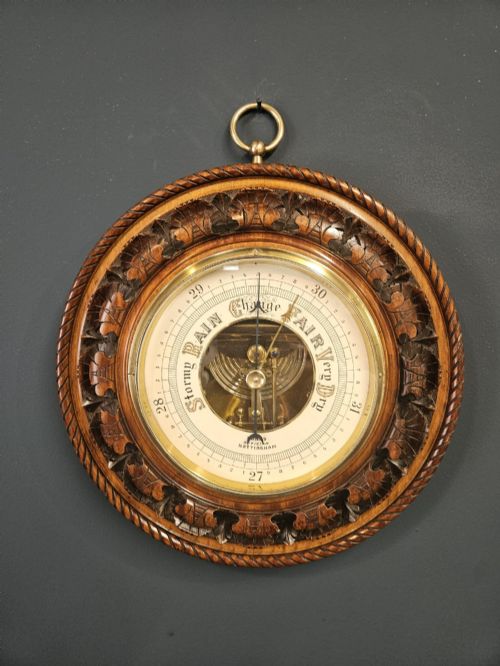
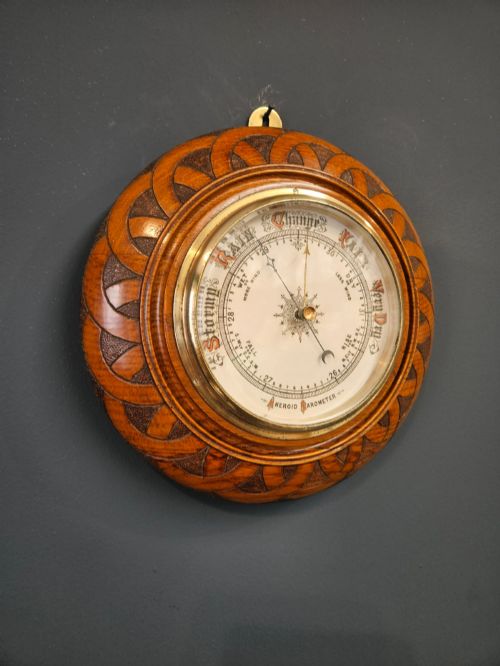
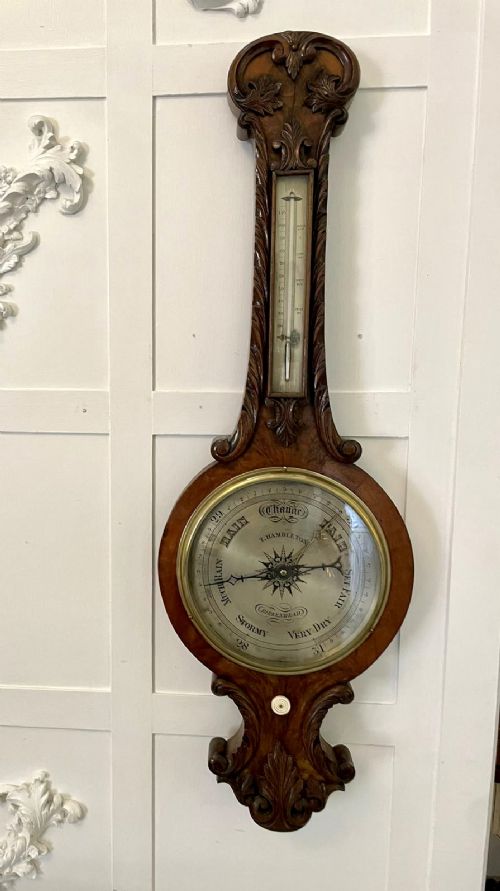
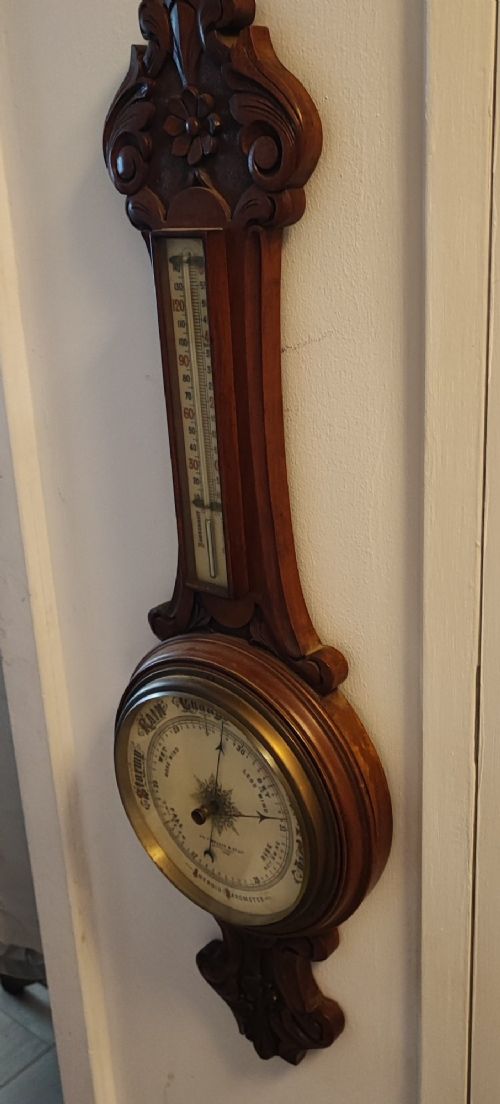
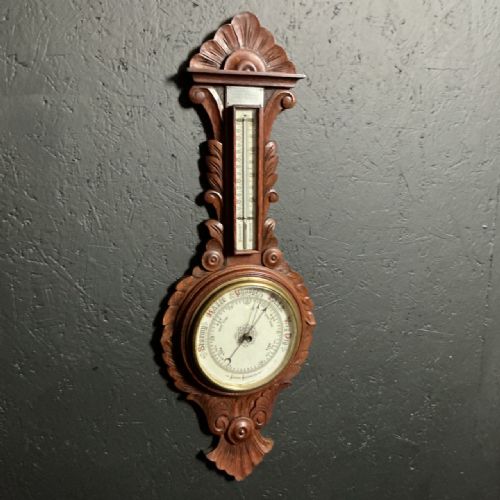
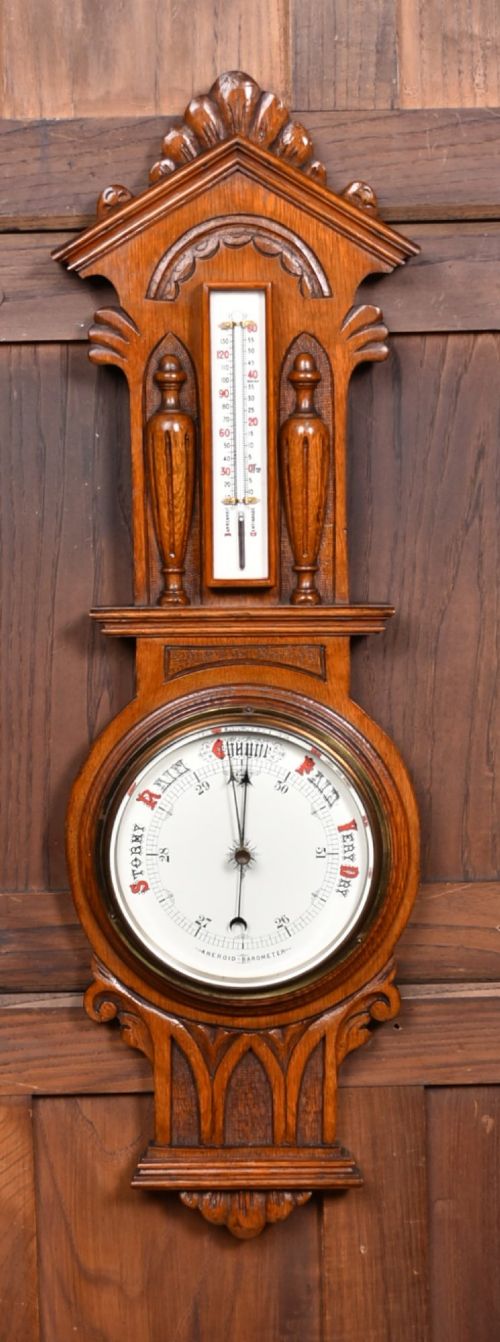
A Victorian carved aneroid barometer is a domestic weather-measuring instrument housed in an ornate wooden wall case, relying on an internal metallic vacuum chamber rather than liquid mercury to register barometric pressure changes. These domestic instruments appear frequently in resilient oak or figured walnut, often taking the familiar banjo shape with an integrated thermometer.
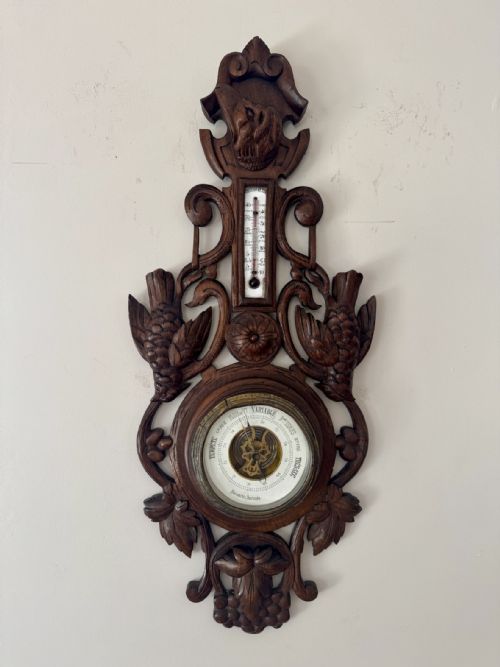
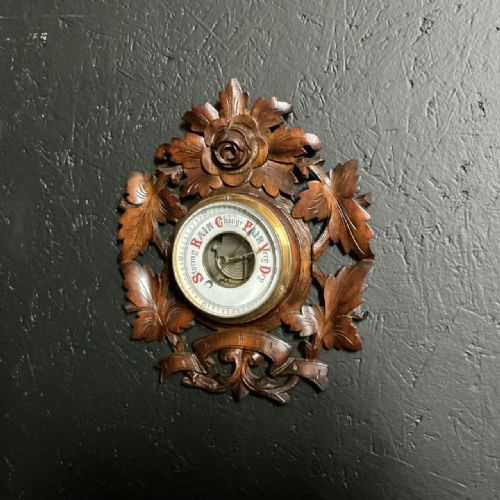
Most examples originate from the Victorian period, though related pieces extend into the Edwardian era with influences ranging from Black Forest animal carvings to Gothic Revival and Neo-Classical geometry. Wall-hanging banjo forms dominate the selection, alongside compact skeletonised models and occasional circular or architectural frames.
How They Were Made
Cabinetmakers shaped dense hardwoods like oak, mahogany, and walnut using deep relief carving, geometric turning, and delicate marquetry inlay to frame the scientific mechanism. Artisans applied these techniques to create substantial banjo surrounds, architectural wall cases, and intricate Black Forest foliage motifs.
The delicate interior aneroid movement connected to a mechanical linkage system that drove a needle across a graduated silvered metal, porcelain, or ceramic dial protected beneath glass and framed by brass bezels.
The selection spans compact desk instruments to massive carved wall banjo barometers with thermometers.
What Varies in Quality
Quality rests in the depth and crispness of the timber carving, distinguishing masterwork foliage and sculptural birds from simpler geometric mouldings. The presence of secondary instruments like thermometers and the calibre of the engraved silvered or porcelain dial further separate standard production from exceptional examples.
Makers who signed their dials, such as Negretti and Zambra or James Pitkin, anchor the higher tier of the market through superior movement engineering and refined case proportions.
Bramwell and Harbron·W Watson and Sons·Negretti and Zambra·Frederick Cox·James Pitkin·J Hicks
The Victorian Carved Aneroid Barometer Glossary
- Aneroid barometer
- An instrument that measures atmospheric pressure by the expansion and contraction of a sealed corrugated metal box, eliminating the need for liquid mercury. This dry mechanism made wall-hanging barometers far more stable and practical for domestic interiors.
- Banjo barometer
- A domestic wall barometer shaped like a banjo, featuring a circular dial at the top above a long tapering body that typically houses a thermometer. This symmetrical silhouette became the defining domestic weather glass format of the nineteenth century.
- Silvered dial
- A brass or metal clockface treated with a silver compound and engraved with weather indicators and pressure numbers. These dials reflect ambient light softly and offer sharp contrast against dark timber cases.
- Skeletonised barometer
- An instrument design where the dial plate is cut away or omitted to expose the intricate brass levers, springs, and cogs of the aneroid movement. This mechanical transparency allowed nineteenth-century owners to view the working mechanics directly.
- Black Forest style
- A carving tradition originating in central Europe known for deeply undercut foliage, rustic animal motifs, and naturalistic wood sculpture. Pieces in this style utilise walnut and oak to render lifelike birds and dense leaf scrolls.
Victorian Carved Aneroid Barometer: Frequently Asked Questions
How do aneroid barometers work?
An aneroid barometer measures atmospheric pressure using a sealed, flexible metal capsule that expands or contracts as pressure shifts outdoors. This microscopic movement transfers through internal levers to turn the indicator needle on the dial face.
Because the system uses no liquid, these instruments hang securely on walls in any room without risk of spills or calibration loss from tilting.
Where should I hang a barometer?
Hang your barometer on an interior wall away from direct sunlight, heating vents, and exterior doors to ensure stable ambient temperature readings. A location in a hallway or study keeps the instrument protected from extreme micro-climates within the home.
Ensure the wall fixing is secure, as denser carved oak and walnut models carry considerable weight.
How do I read the dial?
Read the main pointer to see the current barometric pressure, then check if the secondary manual marker needle has been set over it to track weather movement. Rising pressure indicates improving weather, while falling pressure points toward rain or wind.
Many examples pair this dial with a thermometer to show ambient room temperature alongside atmospheric trends.
Can antique barometers still predict weather?
These instruments continue to register real-time atmospheric changes accurately if their internal mechanical linkage remains clean and undamaged. Regular gentle tapping on the glass helps settle the linkage to show true current pressure.
Professional calibration against a local digital reference can align the mechanism if the needle drifts over time.