


Brown Mahogany Barometer
A brown mahogany barometer brings rich wood grain and practical science into a room, recording atmospheric shifts through centuries of fine craftsmanship.
Brown Mahogany Barometer
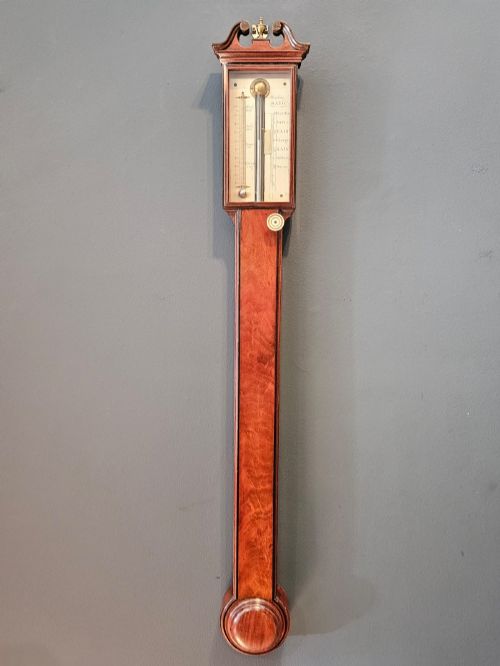
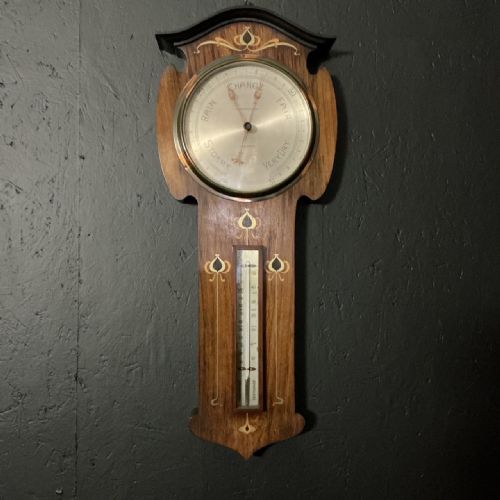
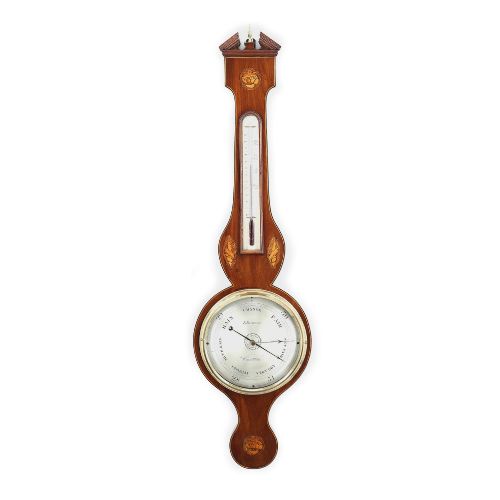
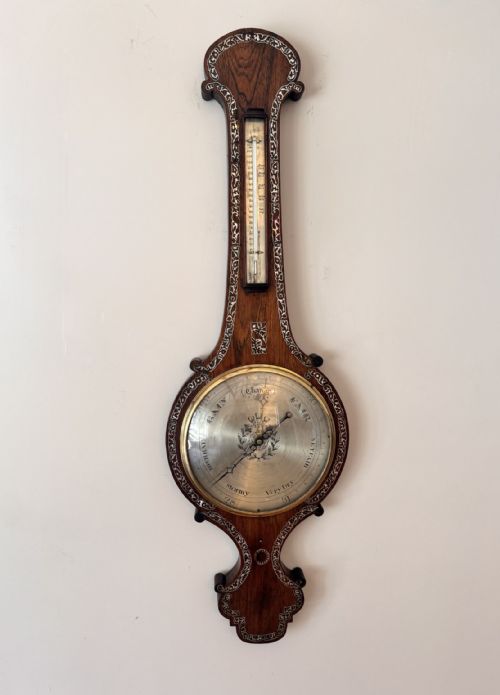
A brown mahogany barometer can take several distinct shapes, from the slender upright tube of a stick barometer to the sweeping curves of a banjo wheel barometer or the flat profile of a wall-mounted barograph. The selection spans Georgian, Regency, Victorian and Edwardian eras, reflecting changing domestic tastes for weather instruments over generations.
Most examples you encounter merge utility with cabinet-making, housed in rich timber cases sometimes enhanced by boxwood or mother of pearl inlay. Alongside traditional wall instruments, you occasionally find table-bound mantel clocks with built-in barometers or mechanical barographs complete with chart drawers.
Materials and Construction
Cabinet makers utilised solid and figured mahogany for the main housing, often adding contrasting boxwood stringing or delicate wood inlay to accentuate the silhouette. Dial faces required precise engraving on silvered metal, while delicate thermometer plates frequently incorporated bone or polished brass fittings.
Internal mechanisms depended on sensitive mercury columns or aneroid capsules, protected behind bevelled glass fronts and fitted into onion-top or banjo cases. Makers inscribed signatures and locations directly onto the metal scales or ivory register plates, marking their workshop origins.
The listings on this page span Georgian, Regency, Victorian and Edwardian periods, utilising mahogany, brass, glass, bone, silvered metal, wood inlay, mother of pearl and boxwood.
Judging Quality and Craftsmanship
The distinction between standard domestic instruments and exceptional pieces rests upon the depth of the mahogany grain and the crispness of the brass or silvered dial engraving. Master makers elevated simple weather glasses into decorative focal points through balanced proportions and restrained inlay.
Integrity of the timber case and retention of original mercury tubes or aneroid movements dictate the scholarly interest of a piece. Finer examples display signed dials from reputable opticians and instrument makers, uniting scientific precision with high-tier period cabinet-making.
B. Besozzi of Weymouth·Short & Mason London·Molton of Norwich·Jenkins of Old Swindon·L Casatelli of Liverpool·W.E. Pain of Cambridge·S&B Solomons of London·J Groce York·S. P. Cohen Glasgow·Negretti & Zambra·Malacrida of Dublin
The Brown Mahogany Barometer Glossary
- Stick barometer
- An upright instrument that measures atmospheric pressure directly via a vertical column of mercury in a glass tube. These offer a clean, architectural profile against a wall.
- Banjo barometer
- A household weather glass housed in a shaped wooden case resembling a banjo, typically combining a dial barometer with a dry-and-damp thermometer.
- Barograph
- A self-recording aneroid barometer that traces atmospheric pressure fluctuations onto a rotating paper chart using an inked arm. They often include a fitted mahogany case with a chart drawer.
- Silvered metal
- A brass or copper dial plate treated with a silver finish and engraved with weather legends and numerical scales. This surface provides high contrast for legible readings.
- Atmos barometer
- A mechanical timepiece or barometer driven entirely by thermal expansion and contraction of gas in a hermetically sealed capsule. It requires no manual winding.
Brown Mahogany Barometer: Frequently Asked Questions
How do I read a stick barometer?
You read the height of the mercury column against the scale marked on the silvered metal plate. Rising mercury indicates improving weather, while falling levels signal approaching storms.
Most stick instruments include a movable vernier cursor operated by an ivory or brass key. Setting this cursor against the current mercury level allows you to track day-to-day pressure changes accurately.
Where should I hang a wall barometer?
Hang your barometer on an internal wall away from direct sunlight, central heating radiators and heavy vibrations. Stable ambient temperatures ensure the internal mechanism or mercury column responds solely to atmospheric pressure.
Ensure the wall fixings match the weight of the mahogany case and brass bezel. Securing the instrument firmly at eye level makes daily observation straightforward.
What is the difference between a wheel and stick barometer?
A stick barometer displays raw atmospheric pressure through an exposed vertical glass tube. A wheel barometer uses a concealed siphon tube and a pulley mechanism to drive a visible pointer around a circular dial.
While stick models favour scientific accuracy and a minimalist silhouette, wheel banjos provide an easier glance-read dial and often incorporate spirit thermometers and hygrometers.
How do I date a mahogany barometer?
Dating relies on stylistic clues in the mahogany case, the shape of the pediment, and the technology of the dial. Georgian and Regency pieces often feature simple architectural lines or classic banjo curves, whereas Victorian versions embrace heavier carving and onion tops.
Maker signatures engraved on the dial or paper trade labels pasted inside the case provide the most reliable chronological markers. Cross-referencing these names with trade directories narrows the period of manufacture.
Can antique barometers still be calibrated?
Many mercury and aneroid barometers can be adjusted to local barometric pressure using a calibration screw or by comparing readings with a reliable digital reference. Professional restoration is recommended for instruments requiring internal adjustments.
Moving mercury barometers requires tilting the tube to prevent air bubbles from entering the column. Transporting them safely usually involves locking the cistern or removing the mercury entirely.