
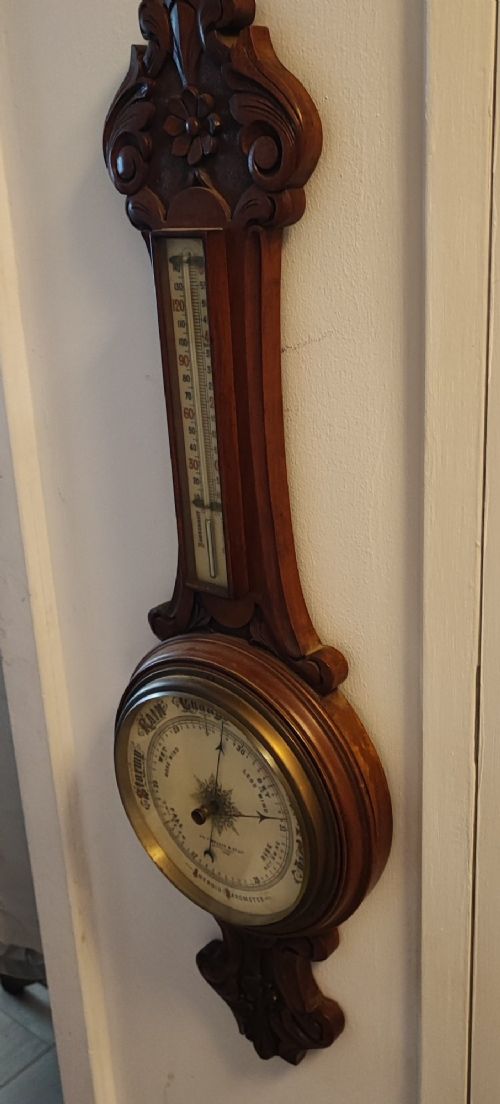


Carved Mahogany Wall Barometer
These carved mahogany wall barometer pieces are functional weather instruments built to hang in a room, offering both traditional utility and period presence.
Carved Mahogany Wall Barometer
A carved mahogany wall barometer is a domestic weather glass housed in timber, appearing primarily in banjo, wheel, and stick forms across this selection. Buyers find specimens spanning from the Georgian and Victorian eras through to the early twentieth century.
The banjo and wheel variations dominate the offerings, often featuring circular dials paired with hygrometers, thermometers, or spirit levels set into the wooden trunk. Stick barometers also appear, presenting a long, narrow wooden stem designed to show direct mercury column readings.
Most pieces date from the nineteenth century, reflecting the widespread Victorian production of domestic weather instruments. Georgian and 1800s examples represent the earlier end of the available stylistic range.
Materials and construction methods
Makers utilised solid and figured mahogany for the primary carcass, shaping the timber through sawing, turning, and hand carving. Marquetry inlay and shell inlay appear on select surfaces as decorative ornamentation.
Dials and indicators employ silvered metal, brass, and glass to protect the delicate scales and pointers. Bone also occurs as a material detail on specific components within the construction.
Some wheel barometers include a small spirit level at the bottom inscribed with the maker's name, ensuring the instrument hung straight before anyone read the weather.
Assessing quality in construction and detail
The refinement of the cabinetwork dictates the standard of the piece, separating plain timber housings from those enhanced by detailed carving, marquetry, and shell inlay. Figured mahogany grain patterns contribute significantly to the visual depth of the better specimens.
The execution of the dial and the surrounding brass or silvered metal work shows the hand of specialised instrument makers. Cases retaining their original proportions and integrated thermometers or spirit levels represent the higher tier of surviving examples.
James H Kelly of Glasgow·Bianchi Ipswich·Alexander Adie·S P Cohen Glasgow·Negretti & Zambra·Russell of Liverpool
The Carved Mahogany Wall Barometer Glossary
- Banjo barometer
- A domestic weather glass shaped broadly like a banjo, featuring a circular dial at the base and a tall stem containing a thermometer or hygrometer. This form became the standard domestic design during the Georgian and Victorian periods.
- Stick barometer
- A tall, narrow wall instrument that houses a direct vertical tube of mercury against a scale. These pieces rely on a exposed glass column rather than a circular dial.
- Android barometer
- A weather instrument that measures atmospheric pressure using an internal sealed metal capsule rather than liquid mercury. It drives a mechanical pointer visible on the dial face.
- Silvered metal
- A brass or copper alloy plate treated to achieve a bright silver finish upon which dial graduations and maker inscriptions are engraved. This surface provides high contrast for the black indicator text.
- Marquetry inlay
- The art of applying fitted pieces of contrasting wood veneers to a timber surface to form decorative patterns. It appears on select period cases to enrich the visual appearance of the mahogany.
Carved Mahogany Wall Barometer: Frequently Asked Questions
How do I hang a wall barometer safely?
These instruments require secure wall fixings suited to the weight of the timber case and glass components. Hang the piece upright on a sturdy screw or bracket to ensure the internal mechanism functions correctly.
Avoid placing the instrument near direct heat sources or damp areas, as fluctuating temperatures and moisture affect the wood and the mechanical parts.
What is the difference between a stick and a banjo barometer?
A stick barometer displays the atmospheric pressure through a straight, vertical glass tube mounted on a narrow wooden backing. It offers a direct view of the mercury column.
A banjo barometer uses a mechanical linkage to translate pressure changes into the rotation of a pointer around a large circular dial. This second style often includes secondary dials for humidity or temperature.
How do I date a mahogany barometer?
Dating relies on the stylistic details of the wooden case, the shape of the pediment, and the materials used for the dial. Georgian examples often feature simpler outlines and damp or dry indicators, while Victorian pieces introduce heavier carving and android movements.
Maker signatures inscribed on the silvered dial plate provide a direct reference point for establishing the period of manufacture.
Do these antique barometers still work?
Many examples retain their mechanical components and respond to atmospheric pressure changes. The listings indicate whether a piece is in working order or sold primarily as a decorative object.
Mercury tube instruments require careful handling if transported, and internal mechanisms occasionally need professional adjustment to record accurate pressure.