
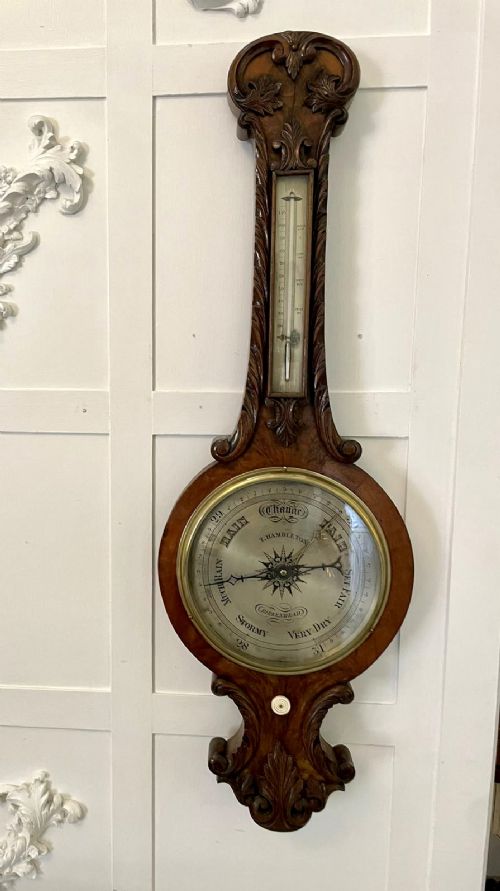
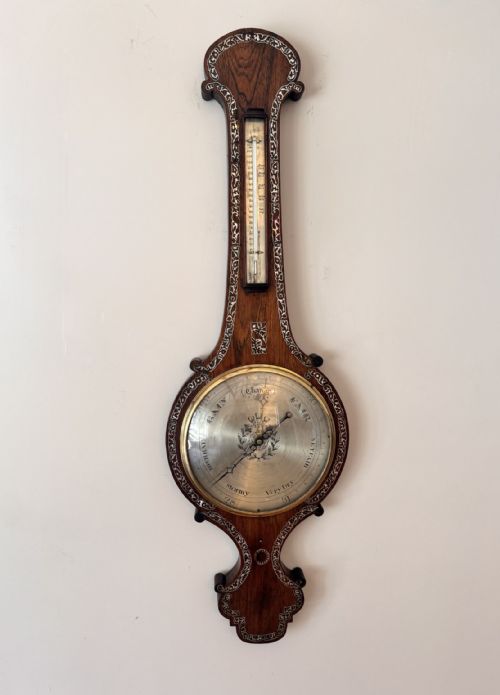


19th Century Banjo Barometer
A 19th century banjo barometer is an instrument that measures atmospheric pressure while adding a striking vertical silhouette to a wall.
19th Century Banjo Barometer
A 19th century banjo barometer combines utility with distinct domestic charm, featuring a rounded top and an elongated trunk that resembles the stringed instrument. These instruments span the Georgian, Regency, and Victorian periods, capturing shifts in interior taste over a hundred years.
The mahogany and rosewood variants are the ones most frequently encountered in these records, often enhanced with mother of pearl inlay or burr walnut veneers. Alongside these traditional British timbers, American carved walnut examples appear, demonstrating the transatlantic reach of the form.
Most examples function as wheel barometers containing mercury, though combined clock and barometer pieces also emerge from the workshops. Buyers find themselves choosing between compact domestic instruments and larger dials intended for grander reception rooms.
What varies in quality
Quality rests upon the crispness of the cabinet work, from the depth of the carved foliage on Victorian burr walnut to the precision of the mother of pearl inlay. The presence of a named maker inscribed upon the silvered dial elevates an instrument from a standard furnishing to a documented piece of scientific craft.
The choice of secondary woods and the complexity of the dial layout also distinguish finer pieces from simpler ones. Examples featuring multiple dials for hygrometers, thermometers, or spirit levels demand greater technical skill from the maker than a single-dial weather glass.
Makers in provincial towns from Ipswich to Taunton ensured the weather was measured across the British Isles, not just in London.
Ganthony of London·Prada of High Wycombe·Molton of Norwich·Jenkins Of Old Swindon·L Casatelli of Liverpool·James H Kelly of Glasgow·Roncoroni·BIANCHI IPSWICH·J Groce York·J C Moretti·Russell of Liverpool·L Malacrida·P Nolfi of Taunton
The 19th Century Banjo Barometer Glossary
- Wheel barometer
- An instrument that uses a pulley and weight system connected to a mercury tube to move a pointer around a circular dial. This form creates the characteristic banjo shape.
- Silvered metal
- A brass or copper dial plate treated to achieve a silvery, reflective surface which is then engraved with weather descriptions and numbers. The fine black lettering is filled in by hand.
- Mother of pearl
- An iridescent inner layer of mollusc shell used by craftsmen to cut tiny geometric shapes and flowers for inlaying into rosewood and mahogany cases.
- Mercury
- A heavy liquid metal enclosed within the glass tube of the barometer that rises and falls with atmospheric pressure changes.
- Bezel
- A brass or metal ring that holds the glass cover securely in front of the dial face.
19th Century Banjo Barometer: Frequently Asked Questions
How do I read a wheel barometer?
The pointer moves clockwise as atmospheric pressure increases, pointing toward terms like set fair, change, or rain inscribed on the dial. Many instruments include a secondary manual pointer that you can set over the main hand to track daily weather movements.
Changes in the mercury column behind the dial drive the internal pulley mechanism, causing the visible hand to turn. Tapping the glass lightly before reading helps settle the mechanism if friction has slightly delayed the movement.
Where should I hang a banjo barometer?
Choose an interior wall that avoids direct sunlight, dampness, and sudden temperature fluctuations from radiators or open fires. Stable conditions protect both the delicate wood veneers and the internal mercury mechanism from unnecessary stress.
Ensure the wall fixing is secure, as these instruments are surprisingly heavy due to the dense hardwoods and glass components. Hanging the barometer at eye level allows you to easily read the engraved dial and consult the thermometer if one is fitted.
How do I identify a Georgian barometer?
Georgian instruments often display restrained mahogany cases with subtle string inlay, focusing on elegant proportions rather than heavy carving. The dial layout tends to be straightforward, reflecting the neoclassical tastes of the eighteenth and early nineteenth centuries.
Examining the construction of the case and the style of the engraved lettering on the silvered metal helps confirm the period. Maker signatures from this era often appear directly on the dial face alongside their trading town.
Can these barometers still be calibrated?
Calibration is possible for those familiar with traditional mercury instruments, though it should be handled with care. Adjusting the screw at the base or back aligns the pointer with current local barometric readings.
Because they contain liquid mercury, transporting or tilting the instrument requires specific handling to prevent air from entering the glass tube. Consulting a specialist in historic scientific instruments is advisable if the mechanism requires more than a simple external adjustment.