


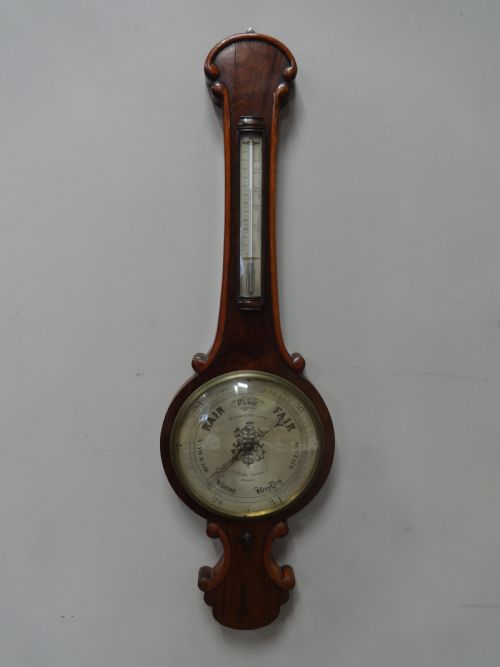

Rosewood Wheel Barometer
A rosewood wheel barometer brings domestic weather tracking into the hall, framed in rich dark timber and bright brass.
Rosewood Wheel Barometer
A rosewood wheel barometer is a domestic weather glass housed in a banjo-shaped wooden case, designed to hang on a wall. These instruments date from the nineteenth century, spanning the Georgian, Regency, and Victorian periods.
Most examples found here present a dial face paired with mother-of-pearl inlay, brass bezels, and mercury glass tubes. The form combines utility with decorative appeal, making it a prominent feature in period hallways.
Makers often signed the silvered metal dials, linking surviving pieces to workshops in London and regional towns alike. The combination of dense rosewood and contrasting shell inlay defines the visual character of the group.
Materials and Construction
Casings are built from rosewood veneers laid over secondary timbers, chosen for deep grain patterns and polished to a dark lustre. Mother-of-pearl shell is hand-cut and set into channels in the wood for floral or geometric decoration.
Rosewood Wheel Barometer Retail Price Guide 2026
Typical asking prices for rosewood wheel barometer among the pieces listed under this phrase on Sellingantiques today, from the lower quarter to the upper quarter. They describe what is for sale here now, not the wider market.
The records show rosewood wheel barometers spanning from the Georgian era through the late Victorian period, featuring both plain wood and mother-of-pearl inlay.
Assessing Quality and Execution
Quality rests on the crispness of the dial engraving and the complexity of the mother-of-pearl inlay work across the case. Finer examples retain their original mercury tubes, cast brass bezels, and signed maker plaques.
The choice of rosewood and the balance of the banjo proportions separate standard production from master-level work. Intact crests, original thermometers, and dry storage condition further distinguish the upper tier of instruments.
Ganthony of London·Fagioli of Clerkenwell London·Jenkins Of Old Swindon·Joseph Somalvico & Co·Francis Amadio London·Newton & Co of Fleet Street London·J Tara, Louth·W. N. Telford, Chester·D.Cattaneo & Co of Leeds·Huggins of Colchester·A.Burt of Tunbridgewells
The Rosewood Wheel Barometer Glossary
- Wheel barometer
- An instrument that uses a float inside a siphon tube connected to a pulley and pointer to show barometric pressure on a circular dial. This layout superseded the earlier stick barometer for domestic interiors.
- Banjo barometer
- A common nickname for the wheel barometer due to the instrument's distinctive neck and rounded bulbous base. The shape accommodated the mercury tube alongside the circular dial.
- Silvered metal
- A brass or copper dial plate treated with a silver compound to create a matte white surface for engraved lettering. This treatment provides high contrast for reading pressure numbers.
- Mother-of-pearl
- The iridescent inner layer of mollusc shell used extensively for decorative inlay on nineteenth-century instrument cases. Pieces are shaped by hand and fitted tightly into the wood.
- Mercury
- The liquid metal sealed inside the glass tube to measure atmospheric pressure changes. It responds to barometric shifts by rising or falling within the siphon.
Rosewood Wheel Barometer: Frequently Asked Questions
What is a wheel barometer?
A wheel barometer is a wall-mounted instrument that measures atmospheric pressure through a sealed mercury column connected to a visible pointer and dial face.
The circular dial allows users to read weather changes at a glance, translating tube movements into terms like set fair, change, and rain.
How do you read the dial?
The pointer moves clockwise or anti-clockwise across the engraved scale as air pressure rises and falls. An auxiliary pointer, adjusted by a central knob, is often set over the main hand to track daily changes.
Changes in the weather are anticipated by watching whether the mercury pushes the pointer toward higher or lower barometric readings.
Were these made of solid rosewood?
Instrument makers typically applied dense rosewood veneers over stable secondary woods like pine or mahogany to prevent warping. This construction method maximised the visual impact of the decorative grain.
The solid timber sections are generally restricted to mouldings, edgings, and structural blocked areas around the bulb base.
Can these barometers still be used?
Many surviving examples retain functional mercury systems and can indicate relative barometric shifts in the home. Transporting them requires care to secure the mercury column against sudden shocks.
Calibration can be checked against modern instruments, though their primary role today is decorative historical interest.