
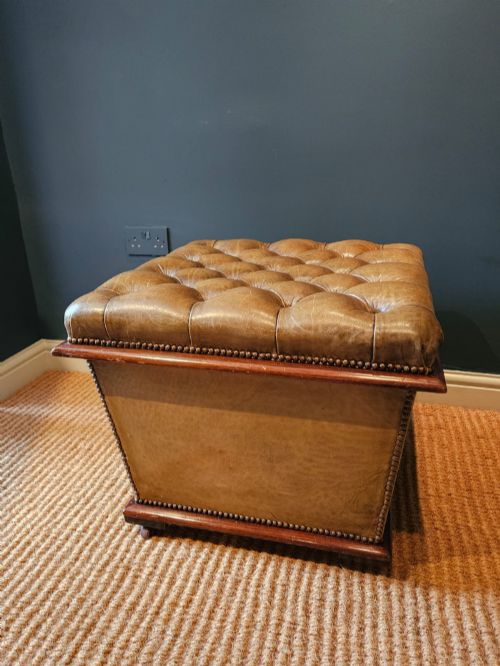


Victorian Buttoned Ottoman
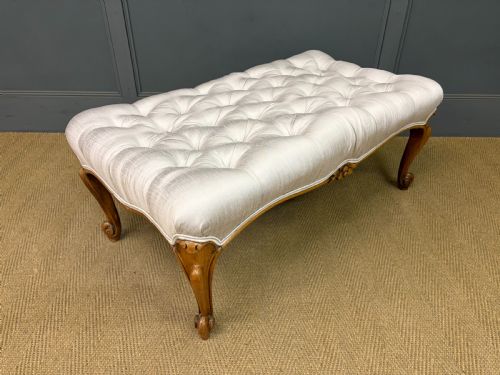
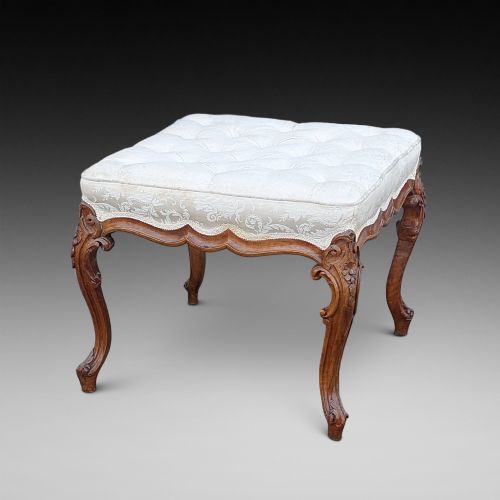
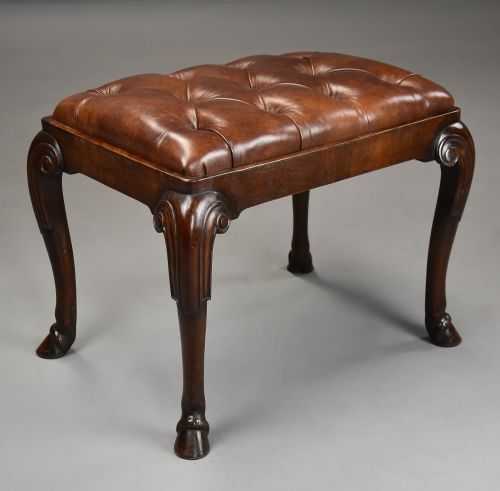
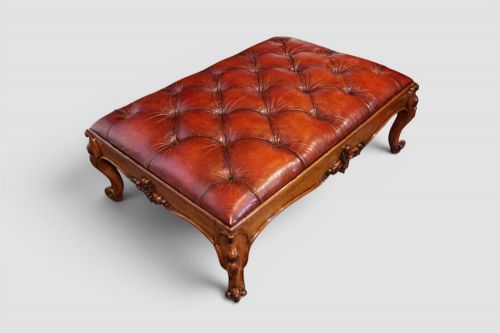
These Victorian buttoned ottoman pieces are substantial, deep-tufted seats designed for heavy salon use and comfortable lounging.
Victorian Buttoned Ottoman
A victorian buttoned ottoman is fundamentally a low, upholstered seat designed for the centre of a room or the end of a bed, built to support the feet or provide extra seating. Most examples appearing here take the form of large rectangular or square footstools and centre stools, heavily padded and tufted across the top surface.
The materials and frames underneath range widely across the nineteenth century, pairing robust hardwoods like walnut, mahogany, and rosewood with supple hand-dyed leathers and rich damask fabrics. Makers often employed cabriole legs, X-frames, or concealed castors to support these weighty proportions, ensuring the furniture could be easily moved across grand reception rooms.
Materials and construction
Makers built the structural frames of these pieces using dense timbers such as walnut, mahogany, and rosewood, often shaping the wood into cabriole legs or turning it for stability. These solid frames supported deep internal stuffing held in place by intricate buttoning, which pulled the leather or fabric firmly down into the padding.
Leather and damask served as the primary coverings, secured with close-nailing or decorative trim around the lower borders. Many versions incorporate brass castors fitted beneath the wooden feet to ease movement across heavy carpets.
Listings feature woods such as walnut, mahogany, rosewood, and light oak, paired with leather, brass, and damask.
Evaluating the pieces
Quality rests significantly in the timber selection and the precision of the framecarving, particularly where cabriole legs or X-frames meet the main body. Dense walnut and figured rosewood indicate a higher tier of production compared to simpler secondary woods.
The integrity of the upholstery work also dictates the standard, noting the evenness of the deep buttoning and the depth of the hide. Hand-dyed leathers that show rich patination without brittle cracking separate finer salon examples from standard utility seating.
James Shoolbred·A.M.E. Fournier
The Victorian Buttoned Ottoman Glossary
- Buttoned
- An upholstery technique where twine pulls the surface fabric deep into the stuffing to form a geometric pattern of indentations. This secures the internal padding and creates firm support.
- Cabriole leg
- A furniture leg that curves outward and then tapers inward, mimicking an animal's leg. It appears frequently on mid-nineteenth century walnut frames.
- Damask
- A reversible figured fabric woven on a jacquard loom, frequently utilised for formal nineteenth century seating upholstery. It displays patterns created by contrasting warp and weft satin weaves.
- X-frame
- A structural base formed by two intersecting diagonal members resembling the letter X. This configuration provides rigid support for heavy low stools.
Victorian Buttoned Ottoman: Frequently Asked Questions
What is a Victorian buttoned ottoman?
A Victorian buttoned ottoman is a low, heavily padded seat featuring deep tufted upholstery across the top surface. These pieces were designed for drawing rooms and libraries as footrests or casual seating.
The wooden frames underneath typically utilise walnut, mahogany, or rosewood, often finished with turned legs or castors.
How were they used originally?
Victorians placed these large stools in the centre of rooms, beside library windows, or at the foot of beds. They served as comfortable footrests or extra seats during large gatherings.
The incorporation of castors allowed servants to reposition the heavy furniture easily across thick carpets.
Are the leathers usually original?
Many surviving examples retain hand-dyed leather upholstery that has developed a deep patina over generations of use. Other pieces feature later replacement leather or period damask fabric.
Examination of the underlying webbing and tacking helps determine whether the surface materials match the age of the wooden frame.
How do I spot a quality frame?
Superior examples employ dense hardwoods like rosewood or walnut for visible components such as cabriole legs. The joinery remains rigid, and the internal stuffing holds firm under pressure.
Finer versions often include decorative elements like X-frames or finely turned mahogany supports.