
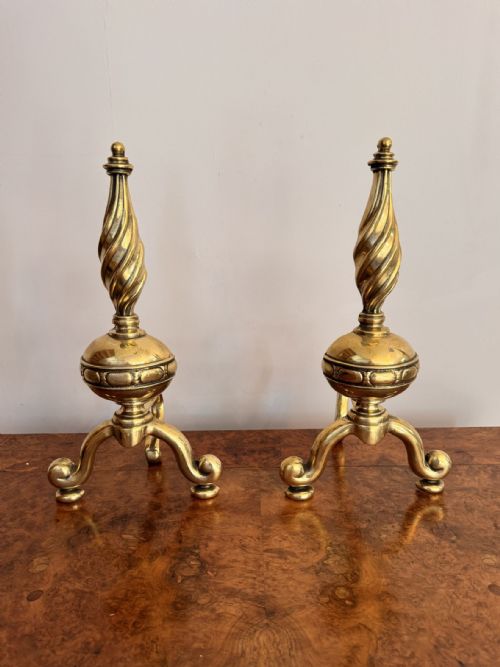
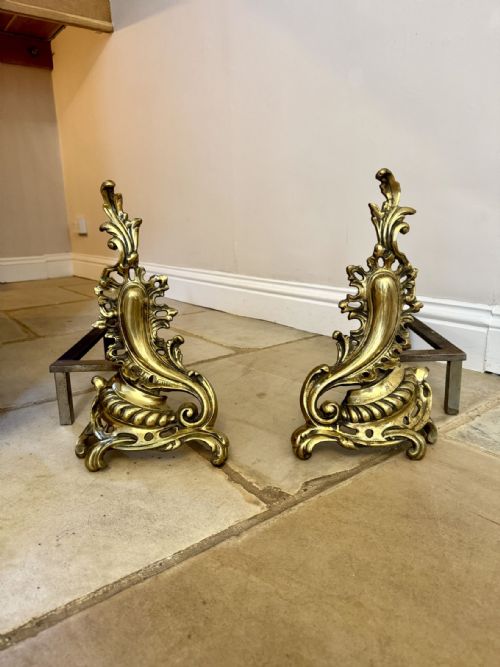
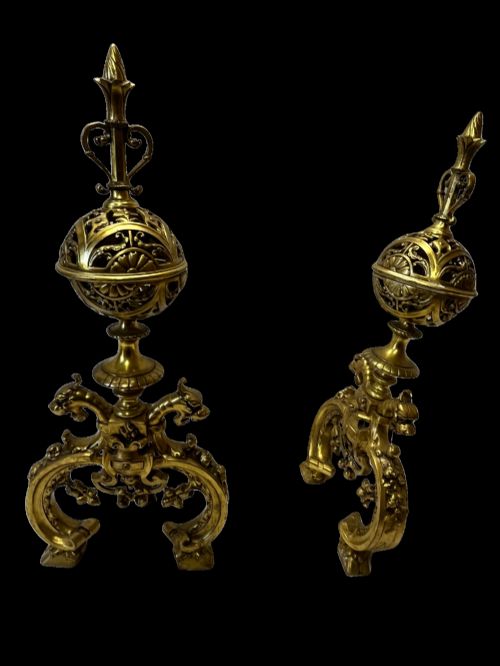


Victorian Brass Chenets
Victorian brass chenets are substantial hearth furniture designed to hold logs above the grate, bringing both function and period character to a fireplace.
Victorian Brass Chenets
Victorian brass chenets, also catalogued as fire dogs, andirons or firedogs, sit at the front of a fireplace to support wood fuel and frame the hearth. When you search for victorian brass chenets, you are looking at substantial pairs of metal supports that often match fenders or fire guards.
The pieces appearing on this page span the nineteenth and early twentieth centuries, running from the mid nineteenth century through to nineteen twenty. You will encounter straightforward domestic pairs alongside ornate revival forms that draw on seventeenth century, baroque, rococo, and classical styles.
Most examples are cast in brass or iron, while others utilise gilt bronze and ormolu for a brighter metallic finish. They range from simple utilitarian uprights to large, highly decorative pairs featuring sculptural details like owl faces or rococo scrolls.
Materials and construction
Makers relied primarily on brass and cast iron to build these hearth supports, often combining both metals to give the pieces weight and stability at the hearth base. Iron provides the heavy internal structure required to withstand intense coal and wood fires, while brass forms the visible decorative front.
Casting was the defining technique for shaping the intricate details seen on these fireside accessories. Molten metal poured into moulds allowed artisans to create elaborate surface textures, ornamental scrolls, and figural elements such as owl faces or classical motifs.
Finer pairs received additional surface treatments like gilding, producing ormolu and gilt bronze finishes that caught the firelight. These refined finishes elevated the chenets from simple hearth furniture to decorative reception room showpieces.
Some Victorian designers looked beyond standard scrolls to incorporate watchful owl faces directly into the brass hearth furniture.
Assessing quality and craftsmanship
Weight and solidity indicate superior manufacture. Better items are cast from substantial gauges of metal that sit solidly on the hearth without wobbling, whilst lower quality equivalents feel lighter and less robust when handled.
The ambition of the design and the finish set the best examples apart. Hand-chiselled chasing after casting, refined ormolu surfaces, and sophisticated stylistic revivals distinguish finer workshop output from standard production items.
James Cartland and Son
The Victorian Brass Chenets Glossary
- Chenet
- French term for an andiron or fire dog used to support logs in an open fireplace. They typically feature a decorative front pillar raised on horizontal legs.
- Andiron
- A horizontal metal support raised on legs, used in pairs to hold logs off the hearth floor to improve air circulation. They are synonymous with fire dogs and chenets.
- Ormolu
- Gilt bronze decoration applied to metalwork, popular in nineteenth century revival pieces. It provides a bright, gold-coloured metallic surface finish.
- Fender
- A low metal guard placed in front of an open fireplace to contain falling embers. They frequently match the style and metal of the accompanying chenets.
Victorian Brass Chenets: Frequently Asked Questions
What is the difference between chenets and andirons?
Chenets and andirons serve the exact same function of holding logs within an open fireplace. Chenet is simply the French term, often used when pieces display rococo or continental styling.
In practice, British and French makers used both names interchangeably throughout the nineteenth century. The choice of term usually depends on the decorative vocabulary of the specific pair.
How do I date Victorian brass chenets?
Dating relies on examining the casting quality, fastening methods, and the prevailing design style of the period. Pieces from the mid nineteenth century often favour robust classical or baroque revival forms, whilst later examples lean towards art nouveau or simpler turning.
Maker marks, where present, help pinpoint the exact decade of production. Construction details like threaded bolts versus hand-forged pins also offer clues to age.
Can these be used in a working fireplace?
Most pairs are robust enough for actual fires if they are made with substantial iron billets behind the brass fronts. You should check the condition of the metal and ensure the rear bars can withstand heat.
Lighter decorative or ormolu pairs are better suited to decorative hearths where they do not face extreme temperatures. Regular use can discolour delicate gilt bronze finishes.
How do I clean brass chenets safely?
Dust the surface regularly with a soft dry cloth to prevent soot and ash accumulation. Avoid abrasive metal polishes that can strip away original patination or damage gilt bronze surfaces.
Gentle cleaning with mild soapy water and a soft brush is usually sufficient for removing stubborn hearth grime. Pat the metal thoroughly dry to prevent tarnishing.