
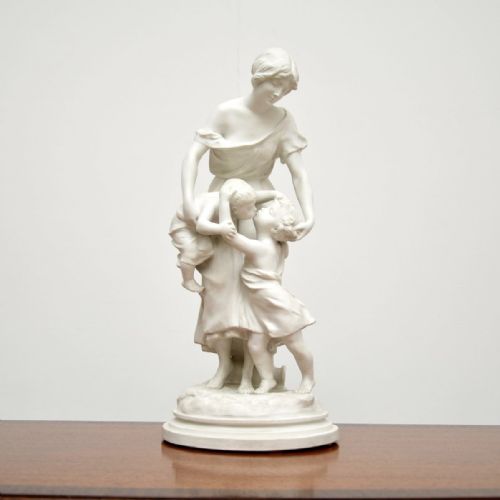


Victorian Bisque Figurine
These Victorian bisque figurine examples bring unglazed ceramic charm and classical form straight to your mantelpiece.
Victorian Bisque Figurine
When you search for a victorian bisque figurine, you are looking at unglazed ceramic sculpture produced during the nineteenth century. These pieces capture human figures, classical subjects, and romantic pastoral scenes in crisp detail.
You will most commonly meet pairs of decorative figures, classical women with doves, and piano babies dating from the eighteen-fifties onwards. French, German, and English potteries dominate this selection, ranging from domestic shelf ornaments to large scale cabinet pieces.
The forms span straightforward portrait figures and complex groups depicting children, fishermen, and mythological subjects. Makers employed these unglazed porcelain bodies to mimic carved marble without the reflective sheen of traditional glaze.
How they were made
Potters produced these objects using bisque porcelain, also known as biscuit porcelain or parian ware, which received a single firing without a final glaze. This technique left a matte, tactile surface that accepted fine moulding and sharp undercuts.
Piano babies stretched out in permanent afternoon naps across upright instruments, keeping solemn watch over endless hours of parlor scales.
What varies in quality
The crispness of the modelling separates superior examples from mass produced output. Finer pieces retain sharp hand chased details in drapery, hair, and fingers, whereas inferior castings appear soft and blurred.
Subtlety in the application of enamel and gilt distinguishes atelier work from standard factory production. The purity of the white porcelain body and the absence of firing warping also mark out the better objects in this field.
Letu & Mauger Paris·Minton·Vion et Baury·Copeland·Royal Dux·Triebner Ens & Co·Gebruder Heubach
The Victorian Bisque Figurine Glossary
- Bisque porcelain
- Unglazed ceramic body fired once to produce a matte, porous finish resembling marble.
- Parian porcelain
- Fine grained white biscuit porcelain developed in England to imitate marble for sculptural figures.
- Piano baby
- Large unglazed ceramic figure designed to sit on the front of a piano during the late nineteenth and early twentieth centuries.
- Enamel
- Opaque vitreous paint applied to the surface of fired porcelain and fixed in a muffle kiln.
Victorian Bisque Figurine: Frequently Asked Questions
How do I clean a bisque figurine?
Dust these unglazed porcelain surfaces gently with a soft dry brush to prevent dirt settling into the porous material. Avoid using water or liquid cleaners, which can stain the matte ceramic body.
For stubborn marks, use a dry artist's sponge or a clean rubber eraser with light pressure. Take care around hand painted enamel or gilt highlights to avoid rubbing the decoration away.
Were these figures made in pairs?
Many nineteenth century potteries produced these decorative sculptures in matched pairs designed to sit symmetrically on a mantelpiece or side table. These often depicted complementary subjects such as day and night, or female and male figures.
Single figures also occurred frequently, particularly larger mythological studies and piano babies. Collectors value complete pairs highly when both pieces share identical manufacturing marks and sizing.
What is the difference between parian and bisque?
Parian ware is a specific type of English biscuit porcelain formulated with a high feldspar content to vitrify partially and resemble carved marble. Bisque porcelain serves as the broader term for any unglazed ceramic sculpture.
While both share a matte finish, parian generally exhibits a denser weight and a slightly warmer tone. German and French factories tended to use standard soft or hard paste bisque rather than parian.
How do I date these figures?
Examine the style of dress, hair, and base construction to establish a reliable period for each piece. Nineteenth century examples often display classical drapery or Victorian attire characteristic of the eighteen-fifties through to the nineteen-hundreds.
Maker's marks stamped or impressed on the underside provide the most precise chronological clues. Many factories used specific registration numbers or changing crests during the Victorian era.