


Victorian Barometer Clock
These pieces combine timekeeping and weather forecasting, bringing Victorian barometer clock designs into domestic spaces.
Victorian Barometer Clock
A victorian barometer clock unites the practical measurement of atmospheric pressure with a working timepiece, often incorporating a thermometer into a single housing. These combination instruments served domestic and scientific purposes in nineteenth-century interiors, functioning as both desk compendiums and wall-mounted weather stations.
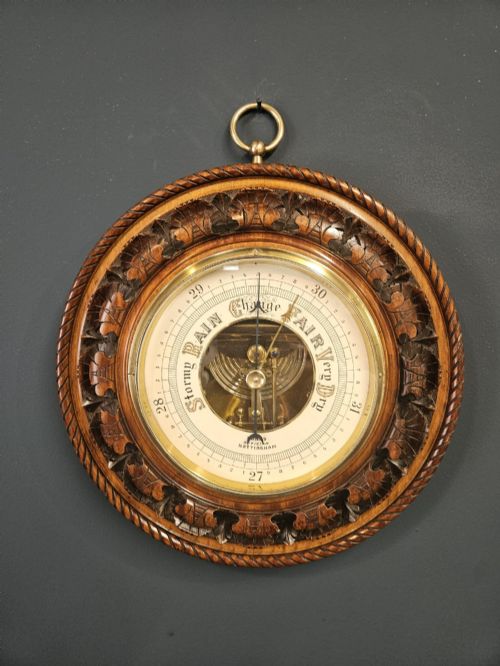
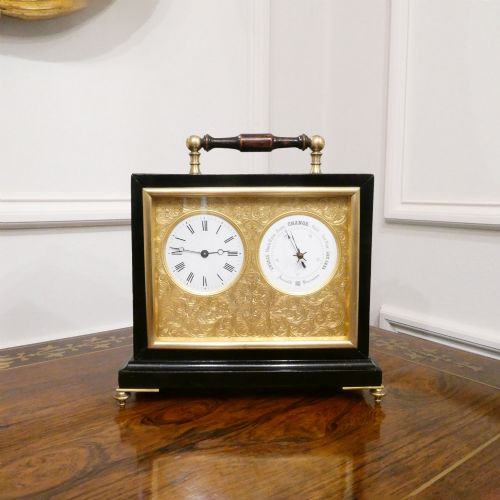
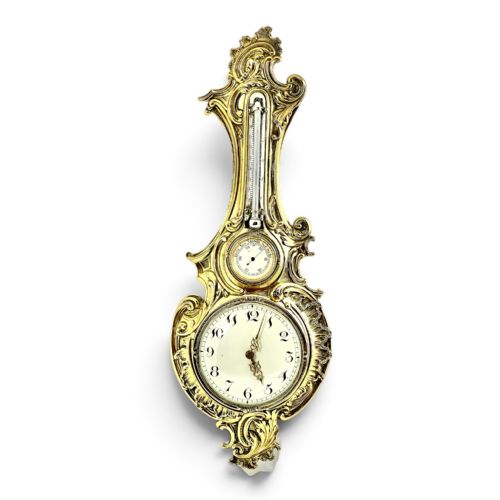
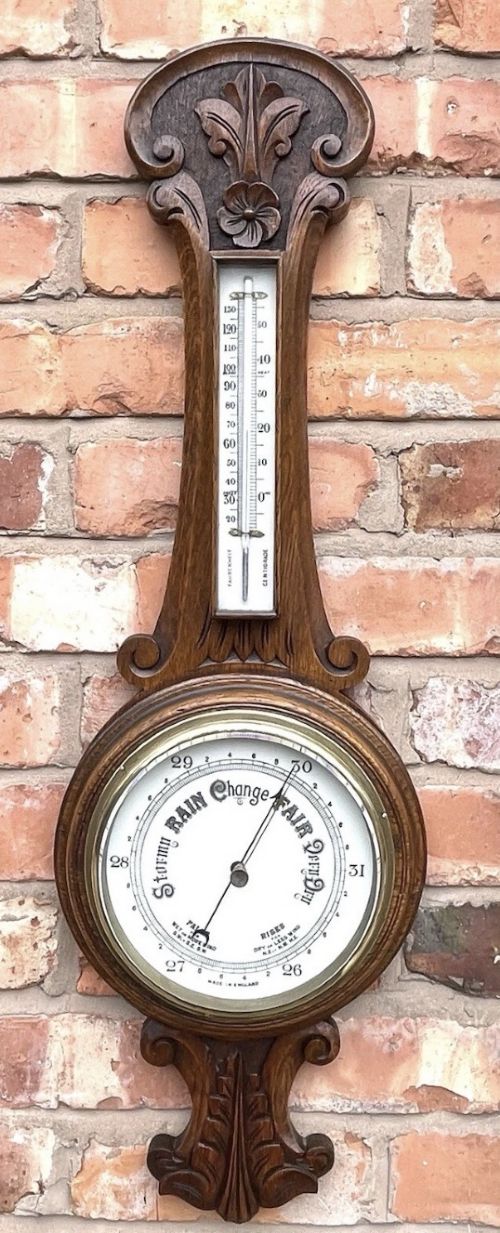
The versions most commonly met on this page span the nineteenth century into the Edwardian era, rendered in carved oak, walnut, and mahogany. Formats range from banjo-style wall instruments to architectural desk clocks and complex marine-inspired Fitzroy pieces.
Maker signatures occasionally appear on dials or movements, connecting individual instruments to established workshops and retailers of the period. The integration of dials for time, barometric pressure, and temperature creates a dense, informative face that defines the aesthetic of these scientific domestic objects.
Materials and Construction
Cabinetmakers utilised dense hardwoods such as oak, walnut, and mahogany to house the delicate mechanical movements and glass-faced barometric instruments. Carved wood details, ebonised elements, and occasional gilt or silvered bronze mounts defined the exterior cases.
Movements relied on brass gear trains, aneroid capsules measuring air pressure without liquid mercury, and enamel dials with precise hand-painted numerals. Fusee movements and mercury tubes appeared in specialised wall-hanging drop-dial configurations.
The site's listings show these instruments spanning the 19th century through the Edwardian period, executed in oak, walnut, mahogany, and ebonised wood.
Distinctions in Quality
Quality rests in the crispness of the wood carving, the complexity of the combined dials, and the reputation of the maker inscribed on the movement plate. Examples featuring matched sets or integrated calendars and thermometers show higher ambition than single-purpose housings.
The legibility of the enamel dial, the retention of original glass covers, and the robustness of the brass and bronze mountings separate standard production items from workshop pieces bearing signatures like Negretti and Zambra or Russell of Liverpool.
Negretti and Zambra·Russell of Liverpool
The Victorian Barometer Clock Glossary
- Aneroid barometer
- A device that measures atmospheric pressure by the expansion and contraction of a flexible metal box, omitting liquid mercury. This mechanism allowed for compact wall and desk instruments.
- Banjo barometer
- A wall-mounted weather instrument housed in a symmetrical wooden case shaped like a stringed banjo. It typically pairs a circular dial at the top with a thermometer and dampness indicator below.
- Desk compendium
- A multi-functional desktop object combining a clock, barometer, and thermometer in a single architectural or figural case. These pieces sat upon office desks and library tables.
- Fusee movement
- A conical pulley mechanism connected to a chain or cord that equalises the driving force of the mainspring as it winds down. This ensures consistent timekeeping accuracy across the power reserve.
- Drop-dial wall clock
- A clock featuring a circular dial mounted above an extended wooden trunk that houses the pendulum or barometer tube. This form was common in public and domestic spaces during the nineteenth century.
Victorian Barometer Clock: Frequently Asked Questions
What is a Victorian barometer clock?
A Victorian barometer clock is a dual-function or multi-function instrument that combines a mechanical clock with a barometer for measuring atmospheric pressure. Many examples also include a thermometer to provide a complete weather station.
These pieces were produced in various forms, from large wall-hanging banjo cases to compact desk compendiums, reflecting the nineteenth-century fascination with domestic science.
How do I read an aneroid barometer?
An aneroid barometer uses an internal metal capsule that flexes as atmospheric pressure changes, moving a needle across a calibrated dial. Readings typically indicate weather trends such as fair, change, or rain based on the pressure level.
Comparing the current needle position against a secondary set marker allows you to track whether pressure is rising or falling over the course of the day.
Where were these instruments placed?
These instruments were traditionally hung on walls in hallways, libraries, or drawing rooms where household occupants could check the weather before venturing outside. Desk versions sat on library tables, captain's desks, and office surfaces.
Their substantial wooden cases and decorative dials made them prominent decorative fixtures as well as functional scientific tools.
How do I identify a Victorian piece?
Victorian pieces are identified by their characteristic timber selections, including carved oak, walnut, and mahogany, alongside specific dial typologies and movement styles. Dating relies on stylistic cues such as Rococo Revival carving, Black Forest motifs, or Edwardian simplification.
Inscribed signatures on the enamel dials or brass backplates often provide definitive attribution to nineteenth-century makers and retailers.