


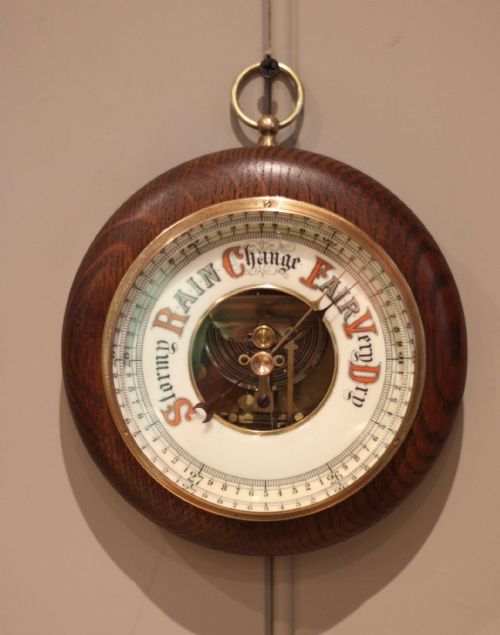


Victorian Weather Indicator
These Victorian weather indicator pieces bring atmospheric observation into domestic spaces, offering both scientific utility and traditional craftsmanship.
Victorian Weather Indicator
A victorian weather indicator encompasses scientific instruments and outdoor vanes used to monitor atmospheric conditions during the nineteenth century and into the Edwardian period. Buyers searching this phrase encounter domestic timing and measuring devices alongside external direction markers.
The domestic versions appear most frequently on this page, dominated by aneroid barometers and barographs housed in wooden cases. These instruments range from simple circular wall pieces to elaborate banjo configurations and recording rain gauges.
Exterior examples also surface within these listings, represented by copper and iron weather vanes. These metal forms originate from both workshop production and folk art traditions.
How they were made
Makers utilised a combination of hardwoods for cabinetry, selecting oak, walnut, and mahogany to house delicate internal mechanisms. These timber cases often feature carved details or inlaid decoration.
Metal components utilise brass, copper, iron, and steel for internal barometric movements, dials, and exterior directional vanes. Glass protects the dials of barometers and the revolving drums of barographs.
Listings feature periods spanning the Victorian era, the nineteenth century, and the Edwardian period.
What varies in quality
The standard of the timber casing and the complexity of the internal movement dictate the distinction between everyday instruments and finer examples. High-grade pieces incorporate robust oak or walnut housings with sophisticated recording mechanisms.
The reputation of the maker and the precision of the scientific instrument elevate certain pieces above standard production. Signed works from established London firms demonstrate superior calibration and finishing.
Short and Mason·Negretti and Zambra·Maple and Co·Callaghan and Co of London·M Pillischer
The Victorian Weather Indicator Glossary
- Aneroid barometer
- An instrument that measures atmospheric pressure without using liquid, relying on a flexible metal box. This design allowed barometers to become compact enough for domestic wall mounting.
- Barograph
- A mechanical instrument that provides a continuous graphical record of atmospheric pressure onto a revolving paper drum. These devices often incorporate thermometers alongside the recording apparatus.
- Banjo barometer
- A wall-mounted barometer shaped like the stringed musical instrument, typically featuring a hygrometer and thermometer above the main dial. This style became popular in domestic interiors during the nineteenth century.
- Weather vane
- An exterior device mounted on a roof to indicate wind direction, usually featuring a directional cross and a pivoting silhouette. Copper and iron were common materials for these functional sculptures.
- Tipping bucket recording rain gauge
- A meteorological instrument that automatically measures and records rainfall by means of a balanced double bucket. These specialised scientific devices tracked precipitation over time.
Victorian Weather Indicator: Frequently Asked Questions
How do aneroid barometers work?
Aneroid barometers measure atmospheric pressure through the expansion and contraction of a sealed, flexible metal capsule inside the case. This movement connects mechanically to a pointer on the dial.
Changes in the weather alter the external pressure on the capsule, causing the needle to indicate shifting conditions.
What is the difference between a barometer and a barograph?
A standard barometer displays the current atmospheric pressure at a given moment using a fixed dial and pointer. It tells you the immediate reading.
A barograph records pressure changes continuously over a week onto a paper chart fitted to a clockwork drum. This provides a historical record of meteorological trends.
Where were weather vanes placed?
Weather vanes were mounted on the highest points of buildings, such as roofs, steeples, and barns, to catch the unobstructed wind. Their placement ensured accurate directional readings.
They functioned primarily as practical tools for agriculture and navigation before becoming decorative elements.
How do I care for a wood-cased barometer?
Keep wooden barometer cases away from direct heat sources and strong sunlight to prevent the timber from warping or splitting. Regular dusting with a dry cloth maintains the finish of the oak, walnut, or mahogany.
Avoid moving the delicate internal mechanical components unnecessarily.