
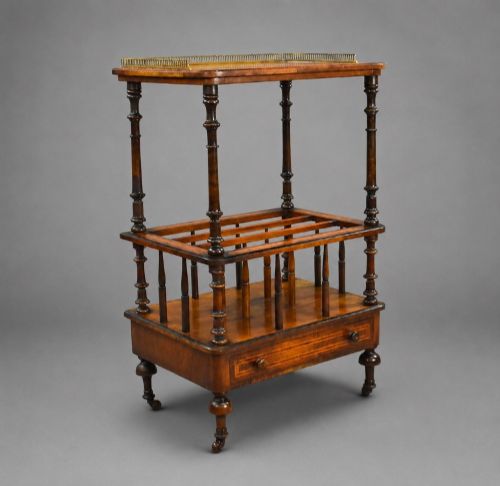


Turned Spindle Music Rack
A turned spindle music rack is a sturdy wooden stand designed to hold sheet music, offering a practical way to keep scores neat by the piano.

Turned Spindle Music Rack
When you search for a turned spindle music rack, you are looking at pieces generally identified across the trade as canterburys, music stands, and magazine racks. These items bridge the late Georgian, Regency, and Victorian eras, taking various forms from partitioned floor stands to tiered what-nots with drawers.
The version you are most likely to meet on this page is a walnut or mahogany Canterbury from the nineteenth century, often featuring turned wooden spindles framing the compartments below. Many examples incorporate a low drawer at the base and rest upon short turned legs fitted with castors.
The form developed to serve domestic music rooms and parlours, evolving from early nineteenth-century designs into heavier mid-Victorian interpretations. Makers used the term Canterbury to describe these partitioned stands, which frequently doubled as magazine racks and music stands as household fashions shifted.
How they were made
Cabinet makers constructed these pieces from dense hardwoods such as mahogany, rosewood, walnut, burr walnut, and ebonised mahogany. Timber selection determined the visual weight of the stand, with figured veneers adding decorative contrast to the primary surfaces.
The distinct structural divisions rely on turned wooden spindles and upright posts, which form the slatted partitions for holding sheets. Drawers incorporated within the lower framework feature hand-cut dovetail joints and matching secondary timbers.
Surface finish involved French polishing to bring out the grain of the walnut or mahogany, sometimes complemented by inlay work or ceramic castors attached to the feet.
Listings feature pieces spanning the Georgian, Regency, and Victorian periods, constructed primarily in walnut, mahogany, and rosewood.
What varies in quality
The choice of timber creates the primary distinction in quality, moving from plain mahogany or black walnut up to highly figured burr walnut and richly grained rosewood. The selection of veneer quality and the crispness of the turning on the spindles reflect the original workshop standards.
Construction details such as the integration of the lower drawer, the stability of the slatted divisions, and the presence of makers' stamps elevate certain pieces. The condition of the original castors and the depth of the hand-applied polish also distinguish workshop output.
Edwards & Roberts·Gillows·Shoolbred
The Turned Spindle Music Rack Glossary
- Canterbury
- A low stand with partitions for holding sheet music or books, typically fitted with a drawer below. The form dates back to the late eighteenth century and remained popular throughout the Victorian period.
- Burr Walnut
- Timber taken from a walnut tree growth that produces highly figured, swirling grain patterns. Cabinet makers used it as a veneer on prominent surfaces to create decorative contrast.
- Ebonised Mahogany
- Mahogany wood treated with a dark stain or finish to imitate ebony. This technique gained particular favour during the Victorian era for formal furniture.
- What-Not
- A piece of open shelving with multiple tiers supported by slender pillars or spindles. These stands served to display small ornaments alongside holding books or music.
- Regency
- An English design period spanning the early nineteenth century, characterised by classical restraint and neoclassical motifs. Furniture from this era often utilises dark mahogany with subtle brass mounts.
Turned Spindle Music Rack: Frequently Asked Questions
What is a turned spindle music rack used for?
These pieces were originally built to hold sheet music, scores, and folios near a piano or in a Victorian parlour. The vertical partitions kept unbound papers upright and sorted for daily practice.
Today, they serve equally well beside a modern seating area for holding magazines, newspapers, or books while maintaining a compact footprint.
How do I date a nineteenth-century Canterbury?
Dating relies on timber choice, turning style, and secondary woods used inside the drawer. Earlier Regency examples tend to feature straight-grained mahogany, whilst mid-Victorian pieces often showcase burr walnut or ebonised finishes.
Castors, handles, and construction methods also offer clues, shifting from hand-cut dovetails to more standardised machine work as the decades progressed.
Are these stands strong enough for daily use?
Most stands are constructed from solid hardwoods like mahogany or walnut, making them structurally robust for holding reading materials. The spindle partitions are joined securely into the base and top frame.
Care should be taken when moving them, especially if they rest on original castors, to avoid straining the lower joints of the drawer section.