
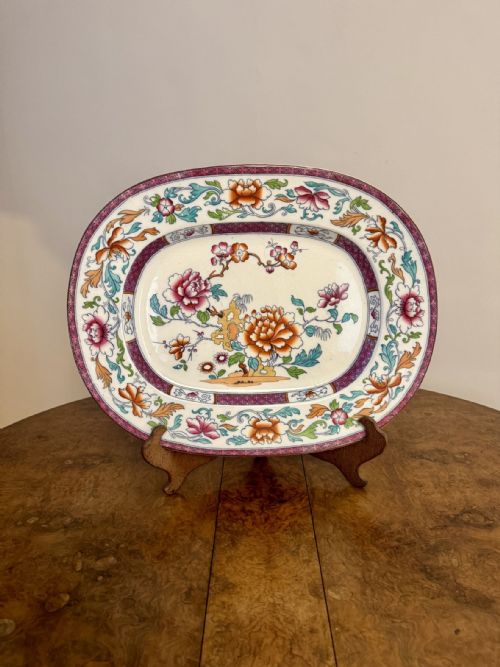


Transferware Turkey Platter
These large transferware turkey platter examples anchor a traditional dining table with their grand printed scenes.
Transferware Turkey Platter
A transferware turkey platter is a substantial serving piece designed for large joints and festive poultry. These items appear across the nineteenth century, including Victorian examples alongside earlier nineteenth century production.
The format encompasses serving platters and large meat plates featuring extensive printed imagery. Pieces span Victorian, Georgian, and Regency styles, occasionally incorporating Chinoiserie motifs.
Buyers encounter earthenware, ironstone, and glazed ceramic bodies decorated in blue and white. Forms include large meat platters, some accompanied by drainers, alongside serving plates.
How they were made
Potters applied cobalt pigment and enamel designs using copperplate transfer printing onto earthenware or ironstone bodies. This technique allowed intricate patterns such as cathedral views, Chinese gardens, and Italianate landscapes to be repeated across large surfaces.
A lead glaze or clear glaze protected the ceramic surface and gave the platter its polished finish. Firing in kilns fixed the transfer print beneath the glassy coating.
Certain platters include ceramic drainers designed to keep Sunday roasts clear of the gravy.
What varies in quality
The clarity of the transfer print and the registration of the cobalt pigment define the visual appeal of the piece. Crisp lines in complex landscapes or heraldic coats of arms distinguish finer potting output.
The weight and density of the ceramic body, particularly in ironstone pieces, indicate the sturdiness of the platter. Inclusion of accessories like matching drainers adds functional complexity.
Copeland and Garrett·Minton·Mason's Ironstone China
The Transferware Turkey Platter Glossary
- Transferware
- Pottery decorated by applying a printed design from a copper plate onto paper, then transferring it to the unglazed or bisque ceramic before glazing. This method enabled detailed pictorial scenes to be produced in volume.
- Ironstone
- A heavy, durable type of earthenware patented in the nineteenth century to imitate Chinese porcelain. It resists chipping and provides a solid base for large serving vessels.
- Cobalt Pigment
- A deep blue metallic oxide used under the glaze to create the characteristic blue and white coloration. It withstands high kiln temperatures without losing intensity.
- Lead Glaze
- A glossy coating containing lead oxide applied to ceramics before firing to seal the porous body. It enhances the brightness of the underlying transfer print.
- Drainer
- A perforated ceramic insert that fits inside the platter to lift meat above accumulated juices. These components complete the set for formal serving.
Transferware Turkey Platter: Frequently Asked Questions
What were transferware turkey platters used for?
These large vessels served as the centrepiece for presenting roasted meat and poultry at formal nineteenth century dining tables. Their generous proportions accommodated large joints and festive birds.
The integrated surface handled both the main dish and the accompanying juices, particularly when paired with a ceramic drainer.
How do I identify a Victorian platter?
Victorian examples often feature deep blue transfer prints depicting architectural views, pastoral landscapes, or Chinoiserie garden scenes. The style aligns with nineteenth century manufacturing trends.
Evidence on this page shows production spanning from the early decades through the late Victorian period.
Are ironstone platters heavier than earthenware?
Ironstone was developed to be a denser and more resilient ceramic than standard earthenware. This heavier body offered greater resistance to the knocks of daily Victorian kitchen use.
Platters made from ironstone maintain a substantial feel on the dining table.
How should I display a large platter?
Large meat plates suit wall mounting using secure wire hangers or placement on sturdy dresser grooves. Their printed scenes function effectively as decorative art when not in active use.
Ensure any display method supports the substantial weight of earthenware and ironstone bodies.