
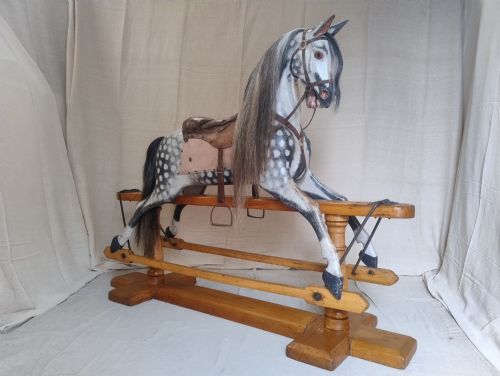


Traditional Toy Horse
A traditional toy horse brings the weight of nineteenth and twentieth century playrooms straight into a modern room.

Traditional Toy Horse
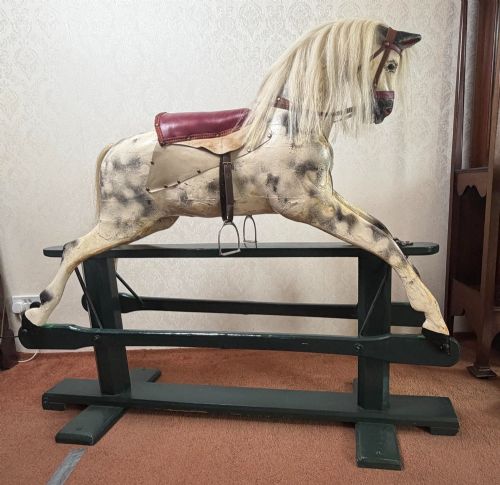
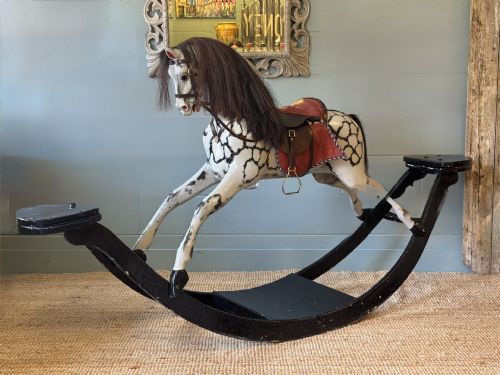
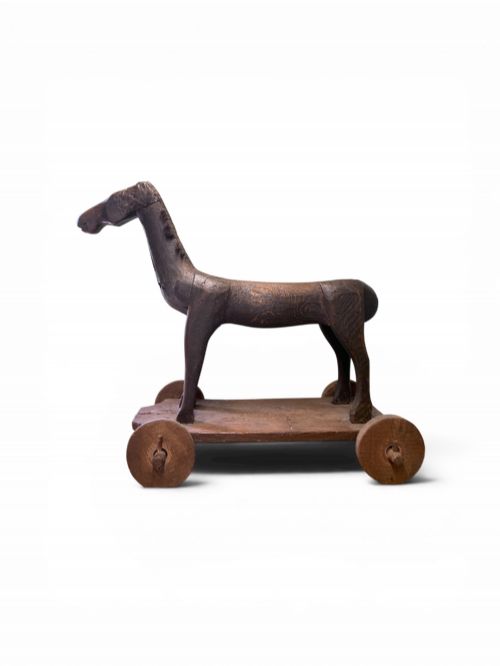
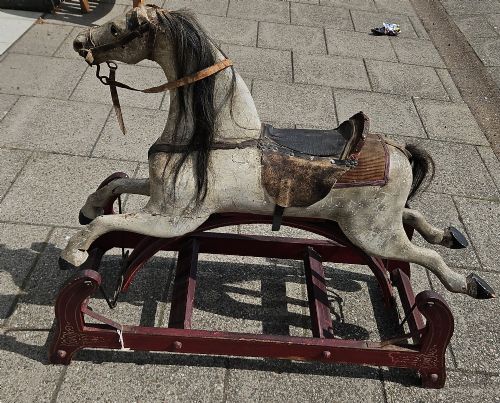
A traditional toy horse most frequently appears on this page as a substantial carved wooden rocking horse mounted on its original bow rockers or safety stand. These pieces span periods from the Victorian era and the nineteenth century through the Edwardian years and the interwar period up to nineteen forty. Forms range from large dappled nursery favourites and naive Spanish folk art carvings to pull along toys and decorative sculptures.
Makers recorded in the listings include established nineteenth and twentieth century firms such as G and J Lines, Lines Bros, and F H Ayres alongside Collinson and unnamed vernacular makers. Materials vary from pine and carved wood to leather, horsehair, metal, iron, and steel finishes. Buyers encounter everything from grand nursery centerpieces to smaller antique toys carved with naive charm.
How they were made
Traditional toy horse examples are primarily constructed from carved wood and pine, shaped by hand or workshop tools to form the body and legs of the animal. Metal, iron, and steel components often provide structural support within the mechanisms or secure the rockers and stirrups.
Surfaces are finished with paint, sometimes retaining original layers showing dapple patterns or naive brushwork. Details such as manes and tails utilise horsehair, while tack and fittings incorporate leather.
Listings feature wooden toy horses spanning the nineteenth century, the Victorian era, Edwardian period, and interwar years up to nineteen forty.
What varies in quality
Quality in a traditional toy horse rests upon the depth of the carving and the fidelity of the animal's anatomical form. Pieces from renowned makers display refined proportions and robust construction compared to simpler vernacular works.
The survival of original surface decoration, including early paint and dapple work, distinguishes superior examples. Retaining original leather tack, horsehair manes, and the proper wooden rocker base elevates the character of the piece.
G & J Lines of London·F.H.Ayres·Collinson·Lines Bros Sportiboy
The Traditional Toy Horse Glossary
- Bow rocker
- A curved wooden rail attached to the feet of a rocking horse that allows it to sway back and forth. This traditional form predates the later safety stand.
- Dappled
- A painted spot pattern applied to the body of a toy horse to imitate the coat of a grey horse. It is a defining decorative feature of many Victorian examples.
- Folk art
- Objects created by self-taught or vernacular makers outside academic traditions. These pieces often display a charmingly naive approach to proportion and form.
- Pull along
- A smaller toy horse mounted on a platform with wheels or small iron axles. Children pulled these pieces behind them using a cord or strap.
- Safety stand
- A rigid wooden frame that suspends the rocking horse above the floor using swing irons. This design prevents the horse from tipping over during vigorous play.
Traditional Toy Horse: Frequently Asked Questions
How do I identify an older rocking horse?
Look closely at the construction methods, nail types, and the shape of the wooden body. Nineteenth century examples often feature hand-carved pine bodies mounted on curved wooden rockers rather than later safety stands.
Examine the surface finish for traces of early paint or dapple work beneath later layers. Maker stamps or labels on the underside of the belly or rocker can also confirm the origin.
What is the difference between lines and ayres horses?
Makers like F H Ayres and G and J Lines produced distinct styles of carving during the Victorian and Edwardian periods. Ayres horses are frequently celebrated for spirited head carving and robust proportions.
Lines horses often exhibit characteristic sturdy construction suited for heavy playroom use. Comparing the shape of the ears, mouth, and chest helps separate the work of these major London workshops.
Are pull along horses different from rocking horses?
Pull along horses are smaller toys designed to be towed across the floor on wheeled platforms or iron axles. Rocking horses are larger stationary figures built on bow rockers or suspended frames for riding.
Both categories utilise carved wood and painted finishes, but their scale and mechanical purpose differ entirely. Pull along toys were scaled for toddlers to pull by hand rather than sit astride.
How should I care for original paint?
Preserve original paint surfaces by keeping the wooden horse away from direct sunlight and damp environments. Dust the piece gently with a dry, soft cloth rather than using liquid cleaners or abrasive agents.
Avoid attempting to strip or repaint vintage finishes, as the aged patina contributes significantly to the character of folk art and antique toys.