



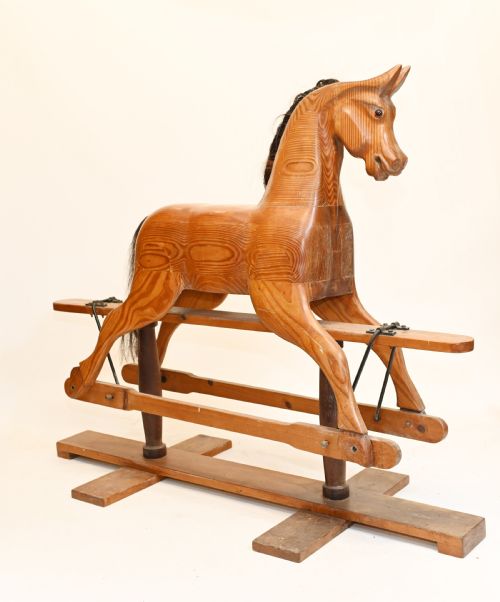

Safety Stand Rocking Horse
These safety stand rocking horse examples combine carved wood with steady iron frames, offering collectors sturdy children's toys from the Victorian era to the interwar period.

Safety Stand Rocking Horse
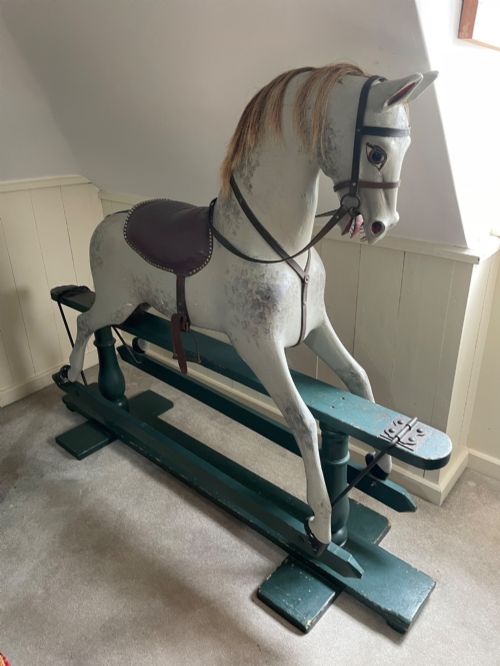
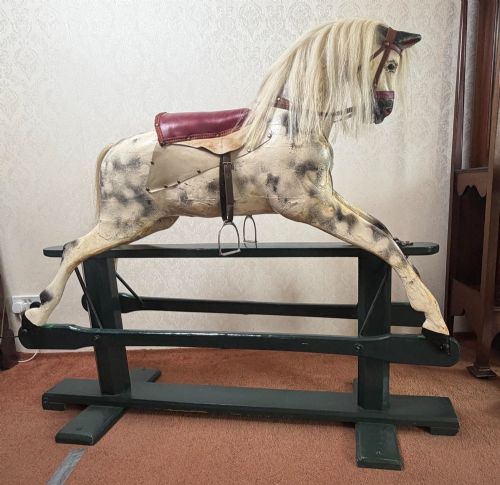
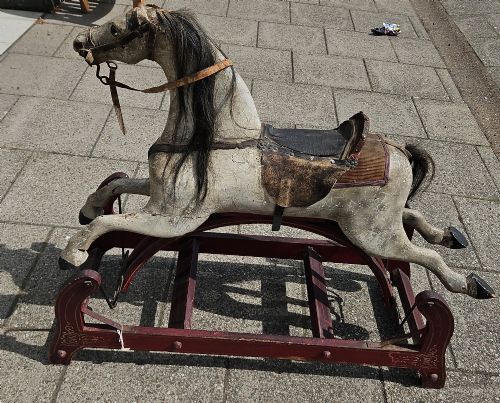
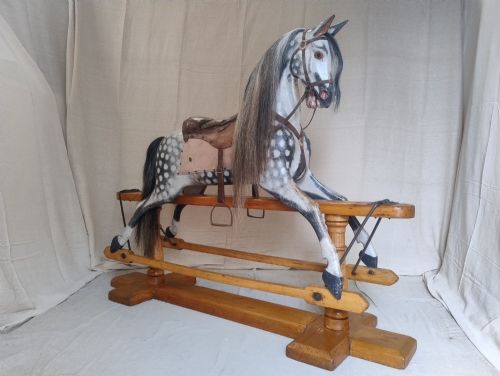
A safety stand rocking horse is a traditional child's toy mounted on a fixed metal frame rather than traditional curved rockers. This design allows for a much wider range of motion without the risk of the horse tipping over during vigorous play.
Buyers browsing this selection will frequently encounter pieces dating from the late nineteenth century through to the interwar period. These range from substantial Victorian specimens to later twentieth-century productions.
Makers such as F.H. Ayres, Collinson, and Lines Bros dominate the available forms. Their work captures the evolution of British toy manufacturing across several decades.
Materials and construction
Carved wood and pine form the primary structure of these horses, shaped to create realistic musculature and posture. Iron and steel components constitute the safety stands, providing the mechanical linkages that allow the horse to swing smoothly.
Traditional details include genuine horsehair manes and tails attached to carved wooden bodies. Leather tack, saddles, and bridles complete the construction, often showing the wear of active childhood use.
Safety Stand Rocking Horse Retail Price Guide 2026
Typical asking prices for safety stand rocking horse among the pieces listed under this phrase on Sellingantiques today, from the lower quarter to the upper quarter. They describe what is for sale here now, not the wider market.
Listings feature pieces spanning from the nineteenth century through the 1950s, utilising wood, iron, leather, and horsehair.
Evaluating quality and condition
The degree of original painted surface preservation largely determines the standing of an individual piece. Examples retaining their early dappled paint finish carry greater historical interest than those with later repainting.
The integrity of the carved wooden body and the mechanical soundness of the iron safety stand distinguish superior examples. Substantial proportions and well-documented maker attributions elevate certain horses above standard production models.
F.H. Ayres·Collinson·Lines Bros
The Safety Stand Rocking Horse Glossary
- Safety stand
- A rigid metal frame that holds the rocking horse off the floor. This invention replaced the traditional curved wooden rockers to prevent the toy from tipping over.
- Dappled
- A painted finish imitating the spotty coat of a grey horse. Traditional makers applied this pattern by hand across the carved wooden body.
- Tack
- The harness, saddle, and bridle fitted to the horse. These leather elements often show replacement or repair due to perishability.
- Horsehair
- Natural hair utilised for the mane and tail of traditional pieces. Period examples relied on this material before synthetic alternatives emerged.
Safety Stand Rocking Horse: Frequently Asked Questions
How do I date a safety stand rocking horse?
Dating relies on examining the construction methods of the carved wooden body and the patent details of the iron stand. Earlier Victorian examples often feature more detailed hand-carving.
Later interwar and mid-century pieces display different proportions and machine-made components that help narrow down the decade of production.
Are safety stand rocking horses safe for children?
While these antique toys were built for children, modern safety standards differ significantly from those of the Victorian and Edwardian periods. Many collectors now treat them primarily as decorative display items.
Those who permit children to ride them typically inspect the iron linkages and leather tack very carefully beforehand.
How do I maintain the original paint?
Preserving the surface requires keeping the wooden body away from direct sunlight and damp conditions. Gentle dusting with a dry cloth is sufficient for routine care.
Avoid using modern chemical cleaners or polishes, as these can strip away historic paint layers and horsehair details.
What is the difference between Ayres and Collinson horses?
F.H. Ayres pieces from the Victorian era are particularly noted for fine carved expression and distinct dappled paintwork. They represent high-status toy manufacturing of the period.
Collinson horses often date slightly later into the twentieth century, frequently providing robust construction designed for active play.