



Leather Saddle Rocking Horse
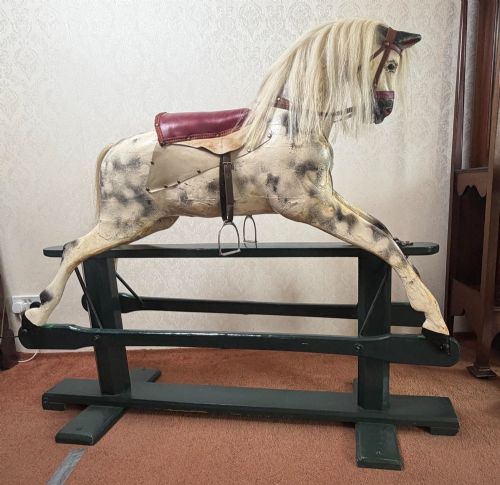
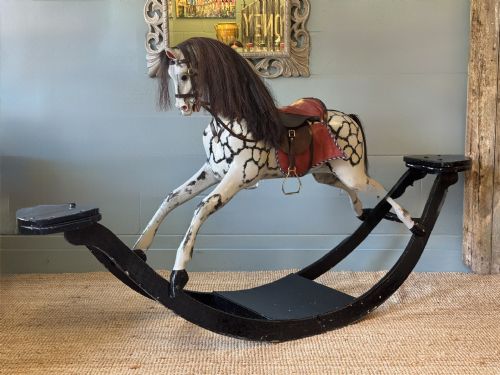
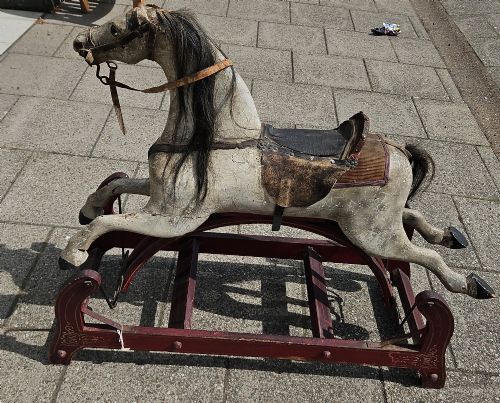
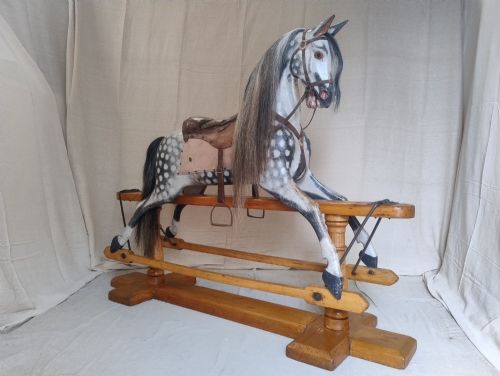
A leather saddle rocking horse brings nineteenth and twentieth century charm into a room, fashioned from carved timber and horsehair for generations of play.
Leather Saddle Rocking Horse
A leather saddle rocking horse is a traditional toy animal designed for children, mounted on curved wooden rockers or safety stands. These objects appear across various periods including the Victorian era, Edwardian years, and the interwar period.
The pieces on this page span from the late nineteenth century up to the 1940s. Most examples take the form of large carved wooden horses complete with traditional tack and reins.
How they were made
Craftsmen shaped these animals primarily from carved wood such as pine, utilising metal, iron, and steel reinforcements for stability. Glass eyes often bring the carved heads to life.
Finished surfaces feature painted dappling, while the manes and tails consist of genuine horsehair. Genuine leather forms the saddles and bridles that sit upon the wooden bodies.
Leather Saddle Rocking Horse Retail Price Guide 2026
Typical asking prices for leather saddle rocking horse among the pieces listed under this phrase on Sellingantiques today, from the lower quarter to the upper quarter. They describe what is for sale here now, not the wider market.
Many of these wooden chargers retain glass eyes that have watched over generations of nurseries without missing a single gallop.
What varies in quality
The survival of original surface paint and genuine leather tack separates superior examples from those that have undergone heavy restoration or replacement over the decades.
G & J Lines of London·F.H.Ayres·Collinson
The Leather Saddle Rocking Horse Glossary
- Curved wooden rockers
- The traditional curved wooden bows attached to the feet of the horse that allow it to swing back and forth. These appear on nineteenth century and early twentieth century examples.
- Dappled
- A painted spotted coat pattern commonly applied to nineteenth century rocking horses. This traditional finish mimics the natural markings of grey horses.
- Horsehair
- Natural hair utilised for the mane and tail of traditional rocking horses. It provides an authentic texture missing in modern synthetic alternatives.
- Tack
- The equipment fitted to the horse, including the leather saddle, bridle, and stirrups. These components complete the appearance of a ridden mount.
Leather Saddle Rocking Horse: Frequently Asked Questions
How do I date a rocking horse?
Dating relies upon examining the construction methods of the carved wooden body and the style of the wooden rockers. Earlier examples often feature more robust nineteenth century carpentry.
Makers' marks or stamps on the wooden stand can also provide a precise decade of manufacture.
Are these horses safe for children?
Antique rocking horses are primarily collected as decorative items or heirloom pieces rather than modern toys. Their heavy wooden construction requires careful supervision.
Collectors generally preserve them to maintain their historical fabric and original leather components.
What wood was used?
Carvers frequently utilised pine and other sturdy timbers to form the main body of the animal. Metal iron and steel brackets reinforced the internal structure.
Selected woods were chosen for their ability to hold intricate carved details without splitting over time.
What is original condition?
Original condition refers to pieces retaining their initial painted surface, glass eyes, and leather tack without modern replacements. Minor wear reflects the genuine history of the object.
Such examples hold greater interest for collectors seeking authentic period craftsmanship.