

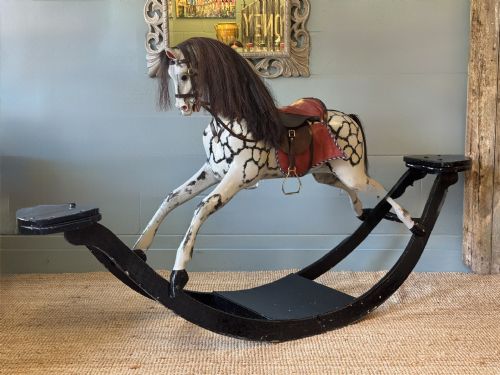


Edwardian Rocking Horse
An edwardian rocking horse brings timeless motion into a room, offering the charm of carved wood and traditional craftsmanship.
Edwardian Rocking Horse
An edwardian rocking horse represents a traditional children's toy, featuring a carved wooden body mounted on curved wooden rockers or safety stands. These pieces date primarily from the early twentieth century, spanning the Edwardian period and the early decades of the twentieth century.
Makers such as G & J Lines of London, F.H. Ayres, and Lines Bros Ltd appear frequently among these listings, alongside unmarked examples from the same era. Each piece captures the distinct proportion and character typical of British toy manufacture from this timeframe.
Materials and construction
Makers constructed the primary structure of pine and other carved wood, shaping the body to resemble a horse in motion. Metal, steel, and iron components reinforced the internal framework and the swing mechanisms where applicable.
Makers finished the pieces using genuine leather for tack and saddles, combined with horsehair for manes and tails. Glass eyes often completed the lifelike appearance, set into the carved wooden head.
Edwardian Rocking Horse Retail Price Guide 2026
Typical asking prices for edwardian rocking horse among the pieces listed under this phrase on Sellingantiques today, from the lower quarter to the upper quarter. They describe what is for sale here now, not the wider market.
Listings feature periods from nineteen hundred to nineteen forty, incorporating pine, leather, horsehair, and iron.
Judging quality in early toys
Quality rests in the depth and detail of the wood carving, particularly around the head and musculature of the animal. Finer pieces display spirited expression and balanced proportions that reflect the skill of the originating workshop.
The integrity of original materials such as horsehair manes, leather tack, and glass eyes dictates the standing of a piece within the range. Retaining authentic structural elements elevates an example above heavily altered counterparts.
G & J Lines of London·F.H. Ayres·Lines Bros Ltd·Lines Bros Sportiboy
The Edwardian Rocking Horse Glossary
- Rockers
- The curved wooden members upon which the horse moves back and forth. These allow the toy to glide across the floor during play.
- Tack
- The leather harness, reins, and saddle fitted to the animal. These items complete the realistic appearance of the toy.
- Horsehair
- The natural hair utilised for the mane and tail of the animal. It provides a traditional texture missing in synthetic alternatives.
- Safety stand
- A rigid wooden frame that holds the horse above the floor while allowing swinging motion. This design prevents the toy from travelling across the room.
Edwardian Rocking Horse: Frequently Asked Questions
How do I date an edwardian rocking horse?
Dating relies on construction methods, timber choice, and maker marks stamped into the wood or ironwork. Comparing the style of the carving to documented examples from nineteen hundred to nineteen twenty helps narrow the timeframe.
Makers often updated their designs between the Edwardian period and the early twentieth century, providing further clues to the exact year of manufacture.
What wood was used?
Makers predominantly utilised pine and other sturdy hardwoods for the carved body and structural rockers. This combination provided sufficient weight and durability for active use.
Internal iron and steel brackets frequently reinforced the pine framework, ensuring stability during movement.
Are mane and tail hairs original?
Many examples retain their original horsehair manes and tails, though replacement is common due to natural wear over the decades. Examining the attachment method reveals whether the hair dates to the original period of manufacture.
Natural horsehair exhibits a distinct coarse texture that differs noticeably from modern synthetic substitutes.
How should I clean the leather?
Leather tack requires gentle cleaning with specialised saddle soap to preserve the suppleness of the material. Avoid harsh chemicals that might strip the historic finish.
Light conditioning helps maintain the integrity of the leather reins and saddles found on antique pieces.