


Leather Saddle Toy Horse
These leather saddle toy horse pieces are sturdy child's playthings and nursery companions built to last generations.
Leather Saddle Toy Horse
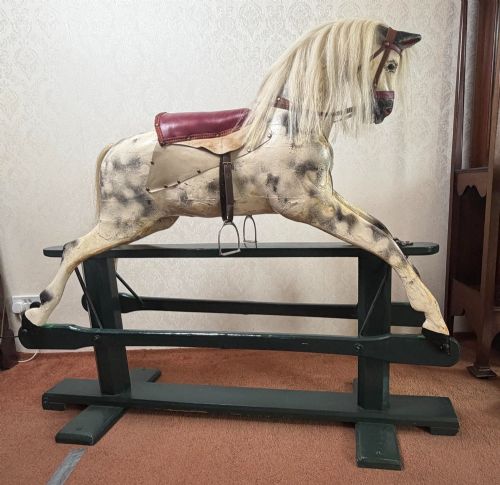
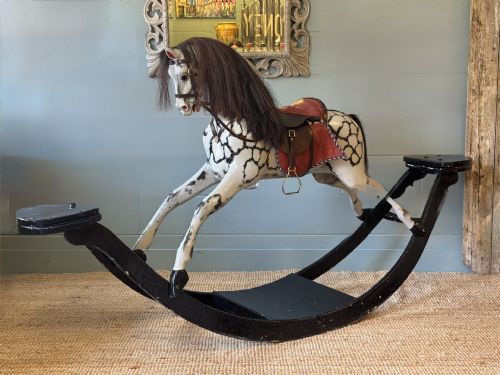
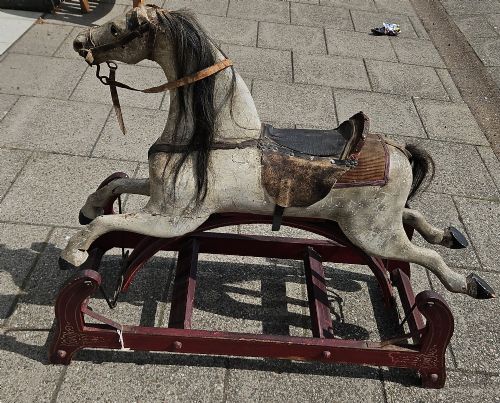
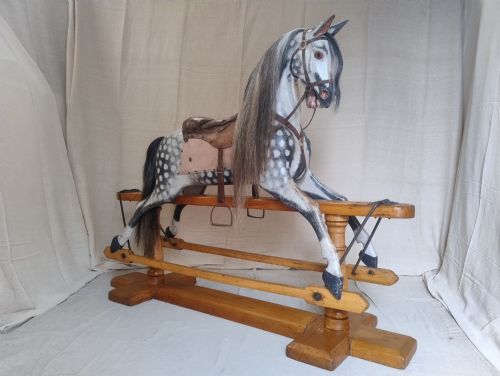
A leather saddle toy horse takes the form of a carved wooden or pine rocking horse or pull-along horse designed for children. When you examine a leather saddle toy horse on this page, you will most frequently encounter large antique examples dating from the Victorian era through the interwar period.
Makers shaped these toys to stand on curved wooden rockers or platforms, incorporating real horsehair for mannes and tails alongside glass eyes. These forms span from the late nineteenth century into the mid twentieth century, reflecting the shifting tastes of British and American toy manufacture.
Materials and construction
Artisans carved the bodies of these toys primarily from solid wood and pine, building internal frames to support the weight of a child. They mounted these carved wooden bodies onto robust curved wooden rockers made to withstand vigorous motion.
Upholsterers fitted genuine leather saddles onto the backs, completing the equine likeness with real horsehair and metal or iron brackets. Makers added glass eyes and painted dappled coats to finish the surface before attaching tack and stirrups.
Many of these wooden horses retain their original glass eyes, watching nursery floors patiently for over a century.
Distinguishing quality in these toys
The preservation of original painted surfaces, genuine horsehair, and intact leather tack determines the integrity of the piece. Surviving on original rockers without heavy structural replacement distinguishes the finest examples.
G & J Lines of London·F.H.Ayres·Collinson
The Leather Saddle Toy Horse Glossary
- Rockers
- The curved wooden members beneath the horse that allow it to swing back and forth. These form the base upon which the carved body rests.
- Horsehair
- Natural hair utilised for the mane and tail of traditional antique horses. It provides a realistic texture distinct from synthetic fibres.
- Dappled
- A painted spotted coat pattern applied over the gesso and wood surface to mimic a grey horse. This finish appears frequently on Victorian examples.
- Pull-along horse
- A toy mounted on a wooden platform with wheels rather than curved rockers, designed to be towed by a child. These represent an alternative form to the standard rocking horse.
Leather Saddle Toy Horse: Frequently Asked Questions
How do I date an antique rocking horse?
Dating relies on the construction methods, nail types, and the style of the carving and paintwork. Victorian and Edwardian examples often feature heavier carved pine bodies and distinct tack details compared to later interwar pieces.
Examining the metal brackets, fixings, and any maker stamps helps narrow the decade of production. Surviving trade labels on the safety rails or rockers offer the most reliable evidence for dating.
What wood was used to build these horses?
Carvers typically used pine and other accessible timbers to build the main body and rocker assemblies. Carpenters joined multiple blocks of wood together and carved the final shape by hand.
Internal frames often incorporated iron or metal reinforcements to ensure stability during use. Pine remained the standard medium across British workshops throughout the nineteenth and early twentieth centuries.
Are the saddles on these horses genuine leather?
Traditional makers fitted these toys with real leather saddles, bridles, and stirrups to replicate actual equestrian equipment. These leather components match the period of the toy and show appropriate ageing through use.
Saddles were stitched and secured to the wooden body using metal tacks. The quality of the leatherwork often reflects the overall tier of the workshop that produced the toy.
How should I care for a vintage wooden horse?
Keep the piece in a stable environment away from direct sunlight and damp conditions to protect the wood and leather. Avoid harsh chemical cleaners on the painted surfaces and genuine horsehair.
Apply suitable leather conditioner sparingly to preserve the saddle and tack. Gentle dusting with a soft cloth maintains the finish without disturbing the original patina.