


Traditional Spirit Decanter
A traditional spirit decanter brings heavy cut crystal and polished mahogany right to the sideboard, offering serious weight and sparkle for your evening pour.
Traditional Spirit Decanter
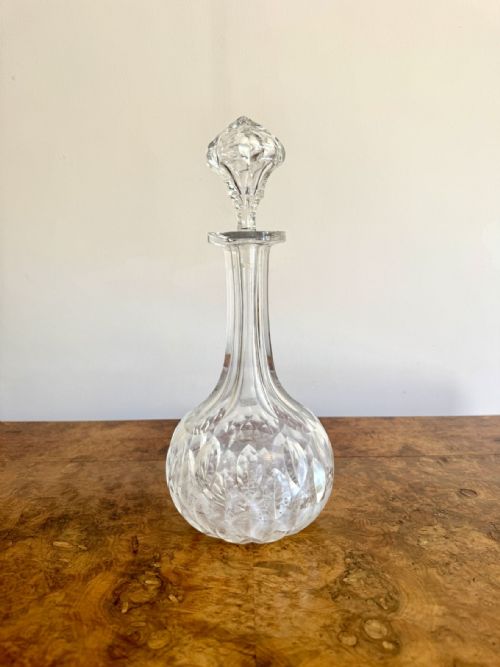
A traditional spirit decanter is a heavy vessel designed for holding whisky, port, or other spirits, usually rendered in deep-cut crystal or glass. When you search this phrase, you find pieces originating primarily from the Victorian and Edwardian eras, alongside occasional Regency and Georgian examples.
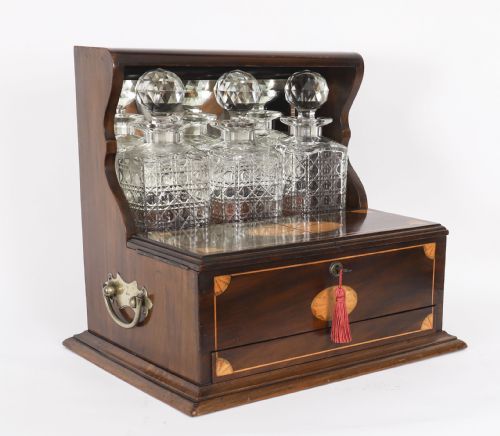
The selections here range from single bell-shaped decanters and tall Victorian bodies to matched pairs and elaborate inlaid mahogany tantalus sets complete with games. You also encounter smaller whisky noggins and silver decanter labels designed to sit alongside the main vessels.
Most specimens on this page date from the late nineteenth century and the early twentieth century, showing robust lead crystal construction built for daily service on the dining table or sideboard.
How they were made
These vessels rely on heavy lead crystal or glass that is deeply wheel-cut with geometric patterns, flutes, and diamond facets to catch the light. Skilled artisans shaped the molten glass by hand before applying precise cold-cutting and polishing techniques.
Many examples incorporate sterling silver mounts or collars fitted securely to the glass necks, while others sit within mahogany frames secured by brass hardware and locks in tantalus configurations.
Some Victorian tantalus sets included hidden compartments for playing cards and counters, ensuring the port and the poker stayed locked in the exact same box.
What varies in quality
The quality of a traditional spirit decanter rests on the depth and crispness of the glass cutting, the clarity of the crystal, and the substance of its weight in the hand. Superior pieces display sharp facets without softening, alongside thick walls that ring true when struck gently.
Associated fittings also dictate the overall standard, such as tightly matching stoppers, solid sterling silver mounts bearing crisp hallmarks, and dense, well-figured mahogany cabinetry fitted with original brass locks.
The Traditional Spirit Decanter Glossary
- Tantalus
- A locking wooden frame that holds decanters securely while displaying their contents, preventing uninvited pouring by keeping the stoppers trapped beneath a crossbar.
- Noggin
- A small vessel or flask used specifically for a single measure of spirits, frequently fitted with a sterling silver lip and handle.
- Lead crystal
- Glass containing a high proportion of lead oxide, which increases the weight, refractive index, and resonance of the material.
- Bell shaped
- A distinct vessel profile where the body flares outwards towards a wide base, providing stability and ample surface area for deep cutting.
Traditional Spirit Decanter: Frequently Asked Questions
How do I clean a cloudy decanter?
Residue builds up inside old glass over decades of holding spirits, leaving a cloudy film near the base. Specialist cleaning beads or warm water with mild detergent usually clear the interior without scratching the fragile walls.
Avoid extreme temperature changes when washing heavy lead crystal to prevent thermal shock and cracking. Allow the vessel to dry completely upside down on a soft cloth before replacing the stopper.
Should I leave the stopper in?
Leaving glass stoppers tightly sealed for long periods can cause them to stick permanently due to atmospheric changes or spirit residue. It is better to rest them loosely in the neck if the contents are gone.
For pieces kept on display without liquid, a thin paper barrier or simply resting the stopper slightly off-centre prevents the ground glass surfaces from binding together.
How do I date a cut glass decanter?
Dating relies on observing the shape of the body, the style of the cutting, and the presence of pontil marks on the base. Victorian and Edwardian examples often feature sharper diamond patterns and thicker walled lead crystal.
Silver mounts bearing legible hallmarks provide an exact year of manufacture, while Regency and Georgian pieces tend to show heavier neck rings and distinct mushroom or target stoppers.
Can I use these for modern whisky?
These vessels were built specifically to hold spirits and remain entirely functional for modern whisky, brandy, or port. Heavy lead crystal keeps liquids contained securely for everyday entertaining.
Ensure the interior is thoroughly cleaned and aired before filling, and avoid storing high-proof spirits inside old crystal for years at a time.