


Traditional Piano Bench
A traditional piano bench provides the right height and posture at the instrument while hiding your sheet music inside.

Traditional Piano Bench
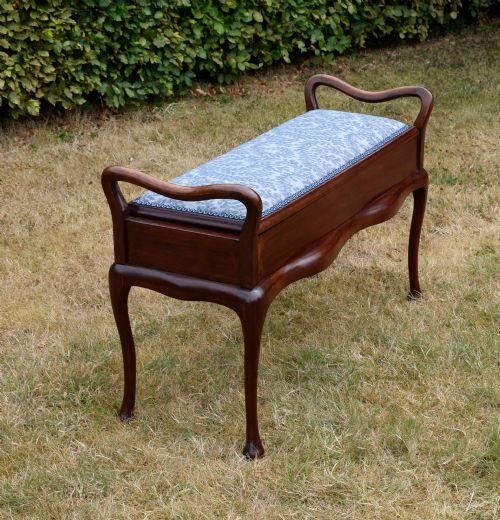
When you search for a traditional piano bench, you encounter seating designed specifically for musicians, often featuring a hinged seat that lifts up to store scores and exercise books. The listings here span the Victorian, Edwardian, and early twentieth-century periods, showing how domestic music-making shaped furniture design.
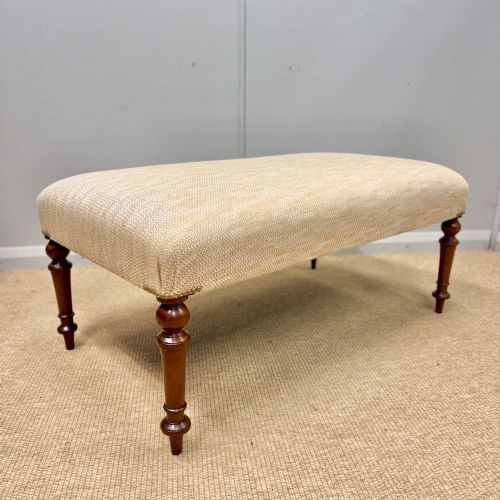
Beyond the standard single stool, you find longer duet variants and oblong footstools that double as dressing or piano seating. These domestic items bridge the gap between functional music room hardware and decorative period upholstery.
How they were made
Makers shaped these benches primarily from solid mahogany, walnut, and oak, frequently employing ebonised wood for a dark, polished finish. Timber framing was joined securely to withstand the shifting weight and posture adjustments of the player.
Upholstery forms a major part of the construction, utilising fabrics, velvet, and deep buttoning over padded seats. Many period variants incorporate brass castors on the feet and subtle inlay work on the wooden frames.
Styles recorded in the evidence span Queen Anne Revival, Chippendale Style, and Jacobean Revival.
What varies in quality
The distinction between ordinary and superior pieces rests on the crispness of carved details like ball and claw feet, alongside the precision of wood inlays. Better examples maintain structural rigidity in their hinged lift-up mechanisms.
Material selection and upholstery execution separate basic workshop output from finer parlour furniture. Richer timber grains and carefully fitted fabric coverings elevate the presence of a bench in a room.
The Traditional Piano Bench Glossary
- Duet stool
- A wider seat designed to accommodate two players side by side at the keyboard. These often feature the same lift-up storage compartments as single variants.
- Ebonised wood
- Timber treated with a dark finish to imitate expensive ebony. This technique was popular in Victorian and later period furniture for a dramatic, formal look.
- Lift up seat
- A hinged top that opens to reveal an internal compartment for sheet music storage. It is a defining mechanical feature of many piano stools.
- Deep buttoned
- An upholstery technique where stitches pull the fabric into a diamond pattern secured with buttons. This adds both cushion loft and visual texture.
- Ball and claw
- A carved foot motif representing a bird's talon grasping a ball. It is frequently seen on revival furniture styles originating from earlier centuries.
Traditional Piano Bench: Frequently Asked Questions
How do I spot an Edwardian piano bench?
Edwardian examples frequently incorporate lighter mahogany frames, subtle wood inlays, and refined proportions that reflect the early twentieth-century domestic interior.
They often abandon the heavy, dark finishes of earlier Victorian eras in favour of softer tones and simpler revival styles.
What is a duet piano stool?
A duet piano stool is an elongated bench built to seat two musicians simultaneously during piano practice or performance.
These wider variants usually include a long hinged seat giving access to a shared compartment for sheet music.
Are piano benches comfortable for daily use?
Yes, many period benches feature upholstered tops, velvet coverings, or deep buttoning designed to provide adequate support during long practice sessions.
The height is specifically calculated to keep the player properly aligned with the keyboard.
Why do some piano benches have castors?
Castors were added to allow the heavy wooden bench to move smoothly across carpets and floors without scratching the room surfaces.
Brass wheels were a common addition on Victorian pieces to help reposition the seat easily.