
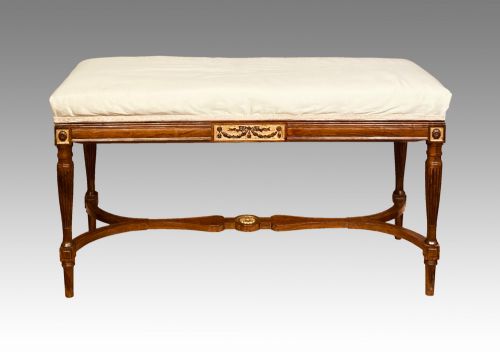


Victorian Music Bench
A victorian music bench gives a room character and purpose, offering sturdy seating designed specifically for the piano or organ.

Victorian Music Bench
When you search for a victorian music bench, you are looking at nineteenth century seating designed for musicians at the piano or organ. These pieces range from single revolving stools to long duet benches and wider recital seats.
The versions you are most likely to meet on this page date from the nineteenth century, including specific years like 1880, 1890, and 1920, with styles spanning Victorian, Edwardian, Neoclassical Revival, and the Aesthetic Movement.
Makers and designers working in mahogany, rosewood, walnut, and ebonised wood produced these seats with various mechanisms for comfort, such as revolving tops, adjustable heights, hinged seats, and fall fronts.
How they were made
Cabinet makers utilised dense hardwoods like mahogany, rosewood, walnut, and ebonised wood to build sturdy frames capable of withstanding constant movement and adjustment. These timbers were often polished to a high finish or turned into complex shapes.
Upholstery formed a central part of the construction, with makers employing fabric, velvet, and specialised upholstery materials over sprung or padded seats. Metal and brass components were integrated into the revolving screws and adjustable height mechanisms.
Organist benches occasionally turn up, bringing a surprisingly ecclesiastical atmosphere to the front room.
What varies in quality
The distinction between standard examples and finer workshop pieces lies in the choice of timber and the precision of the turning. Selected rosewood and figured mahogany denote higher production standards than plain secondary woods.
Mechanical complexity also separates ordinary stools from superior examples. Smoothly operating revolving screws, well-fitted fall fronts, and robust hinges demonstrate better original engineering.
Charles Nosotti·Jas Shoolbred
The Victorian Music Bench Glossary
- Duet stool
- A wider bench designed to seat two players side by side at a piano. These often feature hinged seats or open storage compartments.
- Revolving stool
- A seat with a threaded central screw allowing the user to alter the height by spinning the top. This mechanism is typically supported by three or four legs.
- Fall front
- A hinged panel that drops forward to reveal interior storage space for sheet music and books. It relies on small brass hinges and stays.
- Ebonised wood
- Timber treated with a dark stain or finish to resemble expensive ebony. This technique was particularly popular during the Aesthetic Movement.
- Aesthetic Movement
- A late nineteenth century design style emphasising visual beauty over narrative meaning. Pieces from this movement often feature clean lines and ebonised surfaces.
Victorian Music Bench: Frequently Asked Questions
What is a victorian music bench used for?
These benches provide stable, adjustable seating for pianists, organists, and musicians practising in the parlour or music room. Their solid construction ensures they remain steady during long practice sessions.
Many examples also incorporate internal storage beneath hinged seats or fall fronts to keep sheet music organised close to the instrument.
How do I adjust the height on these stools?
Many single stools utilise a central wooden screw mechanism that raises or lowers the upholstered top when rotated. Turning the seat clockwise or anticlockwise alters the height to suit the player.
Other designs rely on fixed frames or side levers depending on the specific nineteenth century patent and workshop method.
What woods were used for these benches?
Cabinet makers predominantly worked with rich timbers such as mahogany, rosewood, and walnut. These durable woods provided the necessary strength for weight-bearing joints and decorative turning.
Ebonised wood was also common, particularly in pieces influenced by the Aesthetic Movement where a dark, uniform finish was desired.
Can I use a music bench as a window seat?
Longer duet benches and rectangular forms adapt well to placement beneath low windows or in hallways. Their upholstered tops and compact proportions provide practical occasional seating in various rooms.
Care should be taken with placement to avoid direct sunlight fading the original fabric or delicate wood finishes over time.