
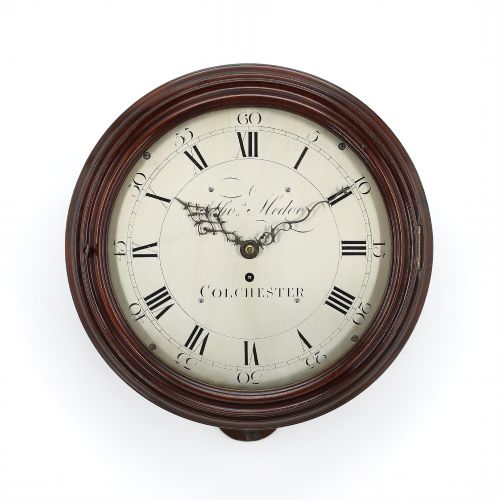


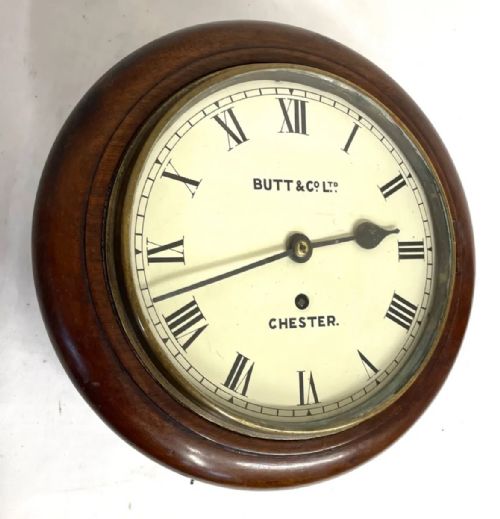


Traditional Circular Dial Clock
A traditional circular dial clock is a wall timepiece combining robust utility and quiet presence, prized for the steady rhythm it brings to a room.
Traditional Circular Dial Clock
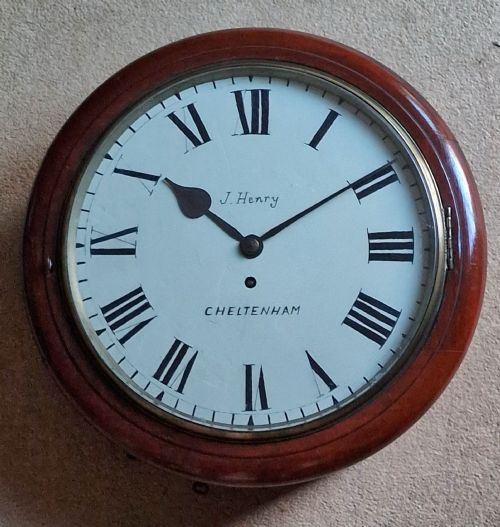
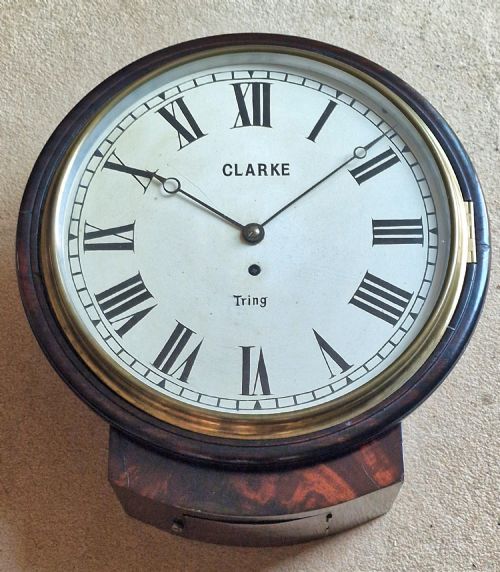
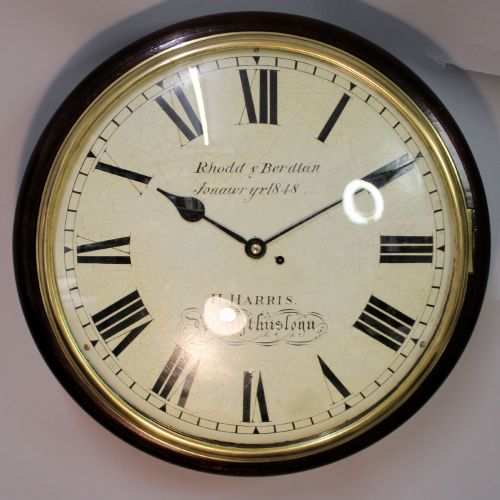
A traditional circular dial clock takes the form of a wall-mounted timepiece featuring a prominent round face enclosed by a protective bezel. These pieces originate across the Georgian, Victorian, and early twentieth-century periods, showing regional British provenance from makers working in London, provincial towns, and railway companies.
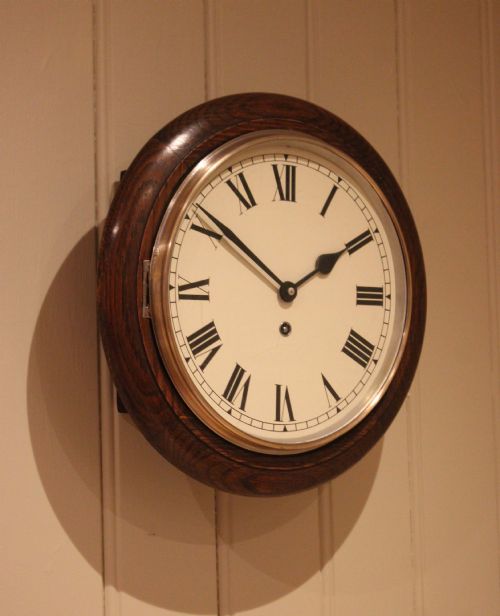
The most common examples on this page are fusee wall clocks housed in timber cases, alongside school and station clocks designed for clear legibility. They range from compact eight-inch faces to large railway variants measuring fifteen inches or greater across the dial.
Makers often inscribed their names and locations directly onto the painted metal or convex dial, anchoring each timepiece to a specific community or transport network. Their circular format reflects a lineage derived from practical public timekeeping rather than domestic decoration alone.
Quality and proportion
Superior examples distinguish themselves through the crisp execution of the dial lettering and the precise fit of the timber case. A well-proportioned mahogany or oak surround shows considered joinery and an appropriate depth that accommodates the movement without clumsiness.
The refinement of the movement itself, particularly the precision of the fusee cone and gear cutting, dictates the mechanical standard. Signed dials bearing the recorded details of provincial or London makers add historical weight compared to unsigned variations.
Dial diameters range from compact domestic sizes up to substantial fifteen-inch railway station and school variants.
J Henry Cheltenham·George Clarke Tring·Henry Harris Monythuslwyn·Thomas Hedge Colchester·John Walker·J C Ralls Clevedon·Butt Co Ltd Chester·John Wilson London·Palmer and Co·Sly Weymouth·J Beckett London
The Traditional Circular Dial Clock Glossary
- Fusee
- A conical pulley used in spring-driven clocks to equalise the torque of the mainspring as it unwinds. This mechanism ensures consistent force is delivered to the gear train for accurate timekeeping.
- Convex dial
- A dial face that curves outward toward the viewer. This design reduces glare from windows and ambient light.
- Verge escapement
- An early and simple escapement mechanism regulating the rotation of the gear train. It works with a balance wheel or pendulum to control the release of power.
- Drop-dial clock
- A wall clock featuring an extended lower case below the circular dial. This drop often houses a pendulum window or allows room for a longer drop.
- Timepiece
- A clock that indicates the time without striking hours or quarters. These movements focus solely on tracking the progression of hours and minutes.
Traditional Circular Dial Clock: Frequently Asked Questions
Where were traditional circular dial clocks used?
These clocks served utilitarian purposes in railway stations, schools, offices, and large domestic spaces where clear visibility mattered.
Provincial businesses and institutions relied on them to maintain synchronized schedules before widespread personal timekeeping.
How do fusee movements operate?
A fusee uses a spiral-grooved cone connected by a chain to the mainspring barrel.
As the spring loses tension, the chain pulls higher up the cone's wider radius, maintaining constant driving force.
How do I date a dial clock?
Makers' signatures, case timbers, and dial materials offer primary clues to a clock's period of origin.
Mahogany cases and convex dials often point toward the nineteenth century, while oak utility models frequently date to the early twentieth century.
Do all these clocks strike on the hour?
Many traditional dial clocks function purely as timepieces without any striking mechanism.
Chiming or striking variants, such as railway station examples, include additional gear trains and hammers configured to sound the hours.