




Tortoiseshell Credenza
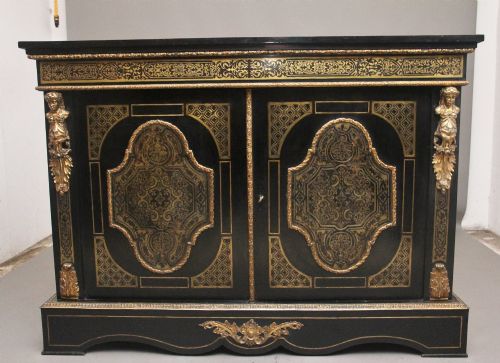
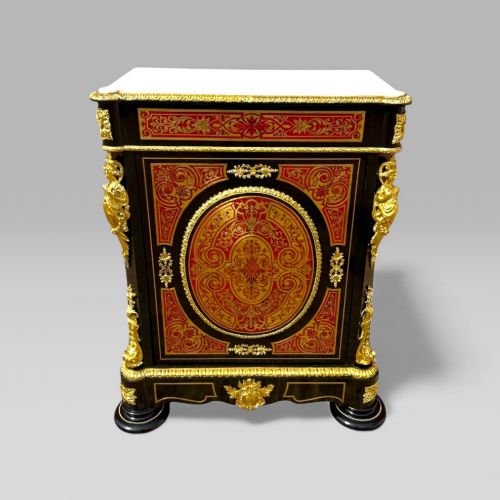
A tortoiseshell credenza brings high Victorian and French Napoleon III theatricality into a room through rich marquetry and gleaming metal mounts.
Tortoiseshell Credenza
A tortoiseshell credenza is a low, substantial cabinet designed for display and storage, often taking the form of a side cabinet, pier cabinet, or breakfront sideboard. These pieces emerge primarily from the nineteenth century, spanning Victorian and French Napoleon III periods.
The versions most commonly met on this page belong to the Boulle revival, showcasing ornate brass and tortoiseshell marquetry set against dark woods. Makers of the period drew heavily on Louis XVI style and French revival aesthetics to build grand display cabinets for formal interiors.
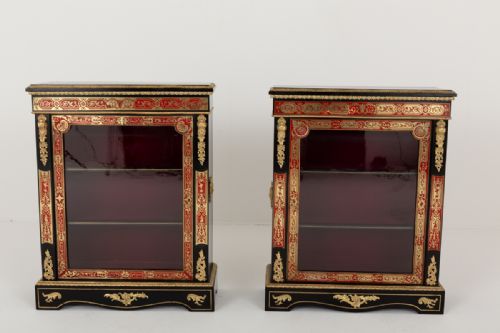
Forms vary from serpentine credenzas to upright pier cabinets and glazed display units, but all share a commanding architectural presence. They serve as focal points in drawing rooms and reception spaces, combining surface display with enclosed shelving.
What varies in quality
Quality rests heavily on the crispness of the brass and tortoiseshell cutting, where finer examples display unbroken lines and tight joints. The depth and definition of the cast ormolu mounts also set apart superior cabinets from standard production pieces.
The choice of timber foundation and the weight of the marble slab indicate the grade of manufacture. Pieces retaining their original glass, polished surfaces, and integrated hardware command greater appreciation for their craftsmanship.
Napoleon III cabinets often hide secret compartments behind their ornate brass inlay for storing love letters.
The Tortoiseshell Credenza Glossary
- Boulle
- A form of marquetry using contrasting pieces of brass and tortoiseshell, developed in France and revived during the nineteenth century. This technique creates a luminous, metallic pattern across the surface of the cabinet.
- Ormolu
- Gilded bronze used for decorative mounts and accents on nineteenth-century furniture. The metal is cast and then finished with a fine gold wash to catch the light.
- Credenza
- A low cabinet or sideboard designed for dining rooms and grand reception spaces. Nineteenth-century examples often feature glazed doors and elaborate surface decoration.
- Pier Cabinet
- A narrow cabinet built specifically to fit the wall space between windows. These upright pieces frequently incorporate glass doors for displaying collections.
- Ebonised Wood
- Timber treated to resemble ebony through a staining and polishing process. This dark finish provides a stark background for brass and tortoiseshell inlay.
Tortoiseshell Credenza: Frequently Asked Questions
What is a tortoiseshell credenza used for?
These cabinets were originally designed to store and display valuable porcelain, silver, and decorative objects in formal reception rooms. The enclosed shelving protected delicate items while the surface provided additional display space.
In modern interiors, they function well as statement pieces in living rooms or dining spaces. Their substantial presence anchors a room while offering practical storage behind decorative doors.
How do I date a Boulle cabinet?
Dating relies on examining the construction methods, timber choices, and stylistic revival markers typical of the nineteenth century. Most pieces date from the Victorian and Napoleon III eras between eighteen fifty and eighteen eighty.
Look at the interior woodwork, backboards, and hinge types to help determine age. The specific style of ormolu mounts and the exact shade of the ebonised wood also offer clues to the decade of manufacture.
Are these cabinets French or English?
The pieces listed span both English Victorian workshops and French Napoleon III ateliers. Many English makers adopted French Louis XVI styles and Boulle techniques during the mid to late nineteenth century.
Distinguishing between them often depends on secondary woods, construction details, and the specific character of the gilt bronze mounts. Both traditions produced high-status furniture intended for wealthy homes.
How should I care for tortoiseshell and brass?
Keep these cabinets away from direct sunlight and extreme temperature fluctuations to protect the delicate shell and wood. Gentle dusting with a dry microfibre cloth prevents the buildup of particles without harming the surface.
Avoid using harsh chemical polishes or water on the marquetry inlay. Professional conservation is recommended if the brass or shell requires securing.