
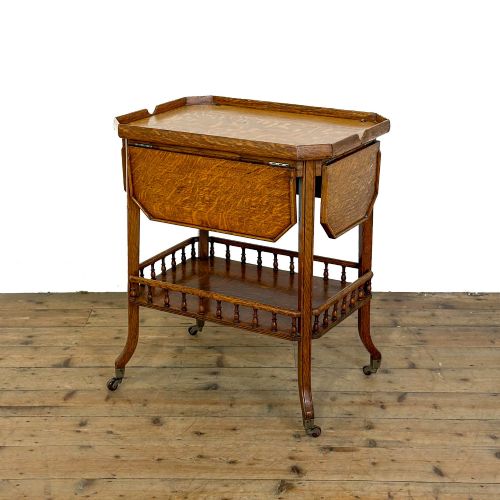
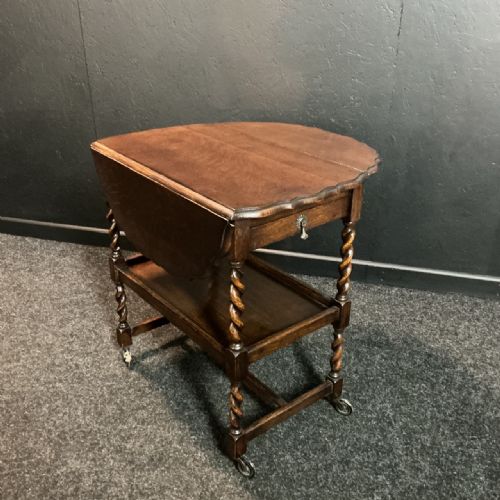


Tiered Drop Leaf Table
These tiered drop leaf table examples combine folding leaves with multiple levels, serving dining rooms and sitting spaces across Georgian and Victorian periods.
Tiered Drop Leaf Table
When searching for a tiered drop leaf table, you encounter forms ranging from George III dumb waiters to Edwardian tea trolleys and Victorian Sutherland tables. These designs utilise folding leaves alongside stacked surfaces, functioning as serving stands, tea carts, or occasional tables.
The pieces on this page span the Georgian, Victorian, and Edwardian eras, alongside the 1920s and specific revivals. You see rectangular, circular, and octagonal formats, often equipped with castors for mobility across rooms.
How they were made
Cabinet makers constructed these items primarily in mahogany, oak, and walnut, frequently incorporating rosewood, satinwood, and brass hardware. Timber sections were joined using traditional cabinet-making methods to support the pivoting drop leaves and multi-tiered shelves.
Surface decoration relies on natural grain figures, occasional inlay work, and turned supports such as barley twist legs. Folding mechanisms utilise hinges and swing-out brackets designed to bear weight when extended.
Object types include dumb waiters, Sutherland tables, afternoon tea trolleys, games tables, and occasional lamp stands.
What varies in quality
Quality shows in the selection of timber figures, such as figured mahogany or satinwood, and the precision of the folding leaf joints. Superior examples maintain stability across multiple tiers when loaded, with smooth operation in the drop-leaf hinges.
Gillow·Morison of Edinburgh
The Tiered Drop Leaf Table Glossary
- Drop leaf
- A table with a fixed centre section and hinged flaps that fold down when not in use. These flaps are supported by swing brackets or gate legs.
- Dumb waiter
- A multi-tiered freestanding piece used to hold dishes or drinks without requiring a servant present. Examples in this category often feature folding tiers.
- Sutherland table
- A narrow table with exceptionally wide drop leaves supported by swinging gate legs. They fold down to a slender footprint.
- Tea trolley
- A wheeled service cart used for afternoon tea, often featuring multiple shelves and wooden handles. Edwardian and 1920s versions commonly include these traits.
- Tiered table
- Furniture built with two or more horizontal surfaces arranged vertically to maximise display or storage space.
Tiered Drop Leaf Table: Frequently Asked Questions
What is a tiered drop leaf table used for?
These pieces served multiple domestic functions, from holding afternoon tea and serving courses during meals to acting as lamp stands or games tables. The combination of shelves and folding leaves allowed them to adapt to different room layouts.
In period homes, they moved easily between spaces to provide extra surface area when entertaining guests.
How do I identify a George III dumb waiter?
George III examples typically feature stacked circular or octagonal revolving or folding tiers supported by a central pillar and tripod base. They date from the late eighteenth century and were designed for dining room service.
The woodwork relies heavily on solid mahogany with traditional joinery and brass fittings.
What is the difference between a Sutherland table and a tea trolley?
A Sutherland table has very large drop leaves and a slim frame supported by gate legs, folding flat enough to slide against a wall. A tea trolley is built with fixed or tiered shelves on wheels for moving food and drinks.
Trolleys frequently date from the Edwardian period or the 1920s, whereas Sutherland tables are commonly Victorian.
How do folding mechanisms work on these tables?
Folding leaves are attached to the central surface via hinges, supported underneath by pivoting wooden arms, swing brackets, or gate legs. When lifted, these supports lock the leaves into a horizontal position.
Drop-down tiers on dumb waiters often utilise hinged brackets that fold flush against the central column.