



Three Panel Oak Coffer
A three panel oak coffer brings rugged timber storage into a room, offering sturdy utility shaped by centuries of English domestic life.
Three Panel Oak Coffer
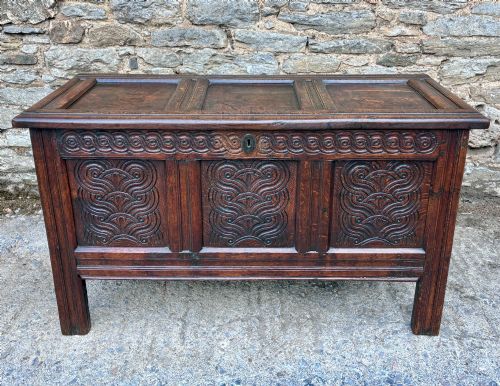
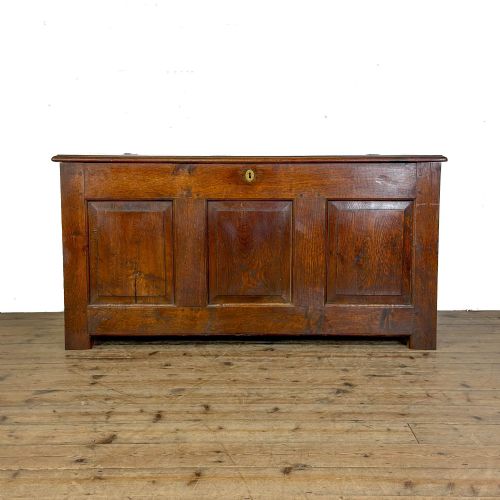
A three panel oak coffer is a robust storage chest constructed with a front divided into three distinct wooden sections, commonly found spanning the seventeenth and eighteenth centuries. These pieces serve primarily as heavy-duty blanket boxes, storage trunks, and mule chests, sometimes incorporating lower drawers beneath the main compartment or internal candle boxes. The form develops through regional English workshops, including Welsh and Yorkshire traditions, producing sturdy household containers built for daily utility.
Most examples seen on this page date from the seventeenth and eighteenth centuries, employing heavy timber framing known as joined construction. Pieces from the seventeenth century often display carved decoration across the front panels, while eighteenth-century iterations lean toward simpler panelled surfaces or transitional styles. Buyers encounter both small country chests and larger Georgian variants designed for substantial household storage.
Materials and Construction
Solid oak provides the primary structural material for these coffers, selected for durability and strength in domestic environments. Carpenters utilise joined construction methods, fitting panels into grooved framing uprights and rails to accommodate seasonal wood movement.
Metal hardware such as iron and brass appears on hinges, lock plates, and occasional internal fittings like candle boxes. Carving on the front panels is hand-chiselled directly into the solid timber, frequently displaying geometric patterns or arched motifs.
Listings show solid oak construction across seventeenth and eighteenth-century periods, alongside iron and brass hardware.
Assessing Quality
The degree of original timber preservation distinguishes superior examples from heavily altered pieces, particularly where lids and base boards survive intact. Original joined construction without extensive modern replacement parts indicates a better-surviving artefact.
The crispness and depth of hand carving on seventeenth-century panels separate master carpentry from simpler utilitarian work. Proportions also matter, with smaller, well-balanced country chests holding distinct appeal compared to clumsily proportioned boxes.
The Three Panel Oak Coffer Glossary
- Joined chest
- A piece of furniture constructed using mortise and tenon joints to frame individual panels. This method provides robust stability without relying on nails.
- Mule chest
- A storage chest fitted with one or more drawers at the base beneath the main compartment. It bridges the design gap between a standard coffer and a chest of drawers.
- Candle box
- A small internal compartment built inside a chest to hold candles safely away from coarser stored goods. It often lifts out or sits in the corner of the main well.
Three Panel Oak Coffer: Frequently Asked Questions
What were three panel oak coffers used for?
These chests stored household textiles, garments, valuables, and provisions in domestic settings across early modern England. Families relied on them to keep possessions secure and free from damp.
Over time, their roles shifted as domestic architecture evolved, leading to the inclusion of lower drawers for smaller linens and garments.
How do I date a three panel oak coffer?
Dating relies on examining the construction methods, joinery style, and decorative carving patterns visible on the front panels. Seventeenth-century examples frequently show geometric or arched chip-carving.
Later eighteenth-century pieces tend toward plain panel configurations or incorporate base drawers associated with the Georgian period.
Are these chests made of solid oak?
Yes, surviving examples utilise solid oak timbers throughout their structural framing, panels, and lids. Carpenters selected homegrown oak for its resilience and abundance.
Secondary woods sometimes appear in minor internal elements, but the main body remains heavy solid oak.
How do I care for an antique oak coffer?
Keep the wood away from direct heat sources and sudden temperature fluctuations to prevent timber splitting or warping. Maintaining stable room conditions preserves the dry finish of old oak.
Apply traditional wax sparingly when the surface feels dry, rubbing it thoroughly into the grain.