

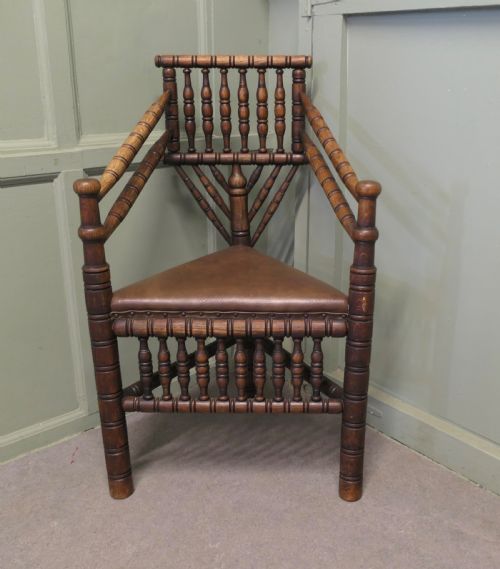


Three Legged Oak Chair
A three legged oak chair is a sturdy vernacular seat built to endure, offering collectors an honest piece of nineteenth-century domestic history.

Identifying the three legged oak chair
A three legged oak chair is typically encountered in the form of a turners chair, drawing upon centuries-old design traditions while taking shape during the Victorian period. These pieces frequently emerge as armchairs or accent chairs, sometimes found as ladies and gents pairs designed with elbow seats. The visual language bridges vernacular English country furniture and revivalist movements.
The aesthetic vocabulary spans styles such as English Country, Gothic Revival, Saxon Revival, and Old Saxon. Regional associations also surface, with Warwick appearing as a known point of origin within the listings. Such examples demonstrate how nineteenth-century makers reinterpreted earlier forms for contemporary domestic interiors.
Materials and construction
Construction relies primarily on English oak and oak, occasionally complemented by beech for structural components. These woods provide the density and grain required for turned spindle construction. The timber exhibits the natural figuring and warm tones characteristic of domestic hardwoods.
The structural framework is built using traditional turning techniques, assembling individual spindles and turned members to form the distinctive round or semi-circular seats and high backs. This method distributes weight efficiently across three floor supports, ensuring stability on uneven floors.
Retail Price Guide 2026
Typical UK retail prices for three legged oak chair, calculated from the Sellingantiques database of over a million retail prices indexed since 2003. This retail price guide relies exclusively on Sellingantiques data; no external sources or auction records are used, so the figures do not describe the wider market.
Current listings feature nineteenth-century oak and beech turners chairs spanning Victorian Gothic Revival, Saxon Revival, and English Country styles.
Assessing quality and character
Quality rests upon the crispness of the turning and the harmony of the timber selection. Finer examples display well-matched oak and beech components with deliberate attention given to the rhythm of the turned spindles. The integrity of the joints determines whether the seat retains its original rigidity.
Distinction also arises from the stylistic ambition of the piece, moving from plain vernacular utility to elaborate Victorian Gothic or Saxon revivals. Better versions integrate historical references convincingly while maintaining structural honesty.
The Three Legged Oak Chair Glossary
- Turners chair
- A heavy armchair constructed entirely of turned wooden spindles and posts, historically associated with medieval and vernacular forms. Nineteenth-century interpretations often incorporate Gothic or Saxon revival motifs.
- Elbow seat
- A historic term for an armchair, providing low arm rests that support the elbows. These seats appear frequently on vernacular turners chairs.
- English oak
- Quercus robur native to Britain, prized for its strength and distinctive medullary rays. It serves as the primary structural and visual medium for these seats.
Frequently Asked Questions
What is a three legged oak chair?
A three legged oak chair is a nineteenth-century vernacular seat, often styled as a turners chair, constructed from turned oak and beech components.
These pieces reflect historic English country traditions alongside Victorian Gothic and Saxon revivals, making them distinctive items for traditional interiors.
How were these chairs used historically?
These armchairs served as functional seating in domestic spaces, often positioned near hearths or in studies. Their sturdy three-legged construction provided reliable stability on flagstone or uneven floors.
Over time, they evolved from purely utilitarian furniture into decorative accent pieces reflecting historical revival interests.
How do I live with a three legged oak chair?
Integrating one of these chairs into a room requires minimal effort due to its compact footprint and strong vertical turnings. They function well as statement accent pieces or functional armchairs in studies and hallways.
Keep the timber conditioned and protect the oak from excessive direct heat or humidity to preserve the natural finish.
How can I tell the period and style apart?
Nineteenth-century examples frequently incorporate revivalist labels such as Victorian Gothic Revival or Old Saxon within their design vocabulary. Examining the turning style and the combination of oak and beech helps distinguish these later interpretations from earlier vernacular work.
Pay attention to the execution of the turned spindles and the specific regional attribution, such as Warwick, when evaluating individual pieces.