



Triangular Corner Chair
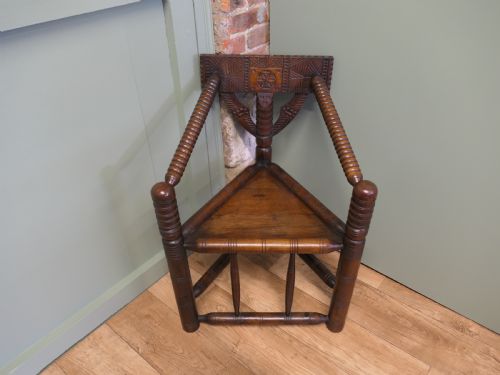
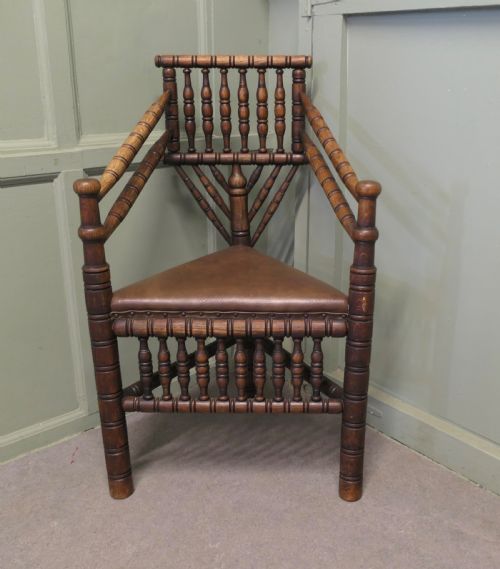
A triangular corner chair delivers a clever footprint for tight spaces, offering solid oak or beech frames and turned elbow seats rooted in Victorian revivals.

Triangular Corner Chair
A triangular corner chair sits neatly into room angles, bringing a distinctive footprint to a domestic interior. When searching for a triangular corner chair, buyers encounter nineteenth-century pieces spanning Victorian, Gothic Revival, and English vernacular styles.
The selections on this page lean heavily towards Victorian turners chairs and Old Saxon elbow seats. These armchairs and accent chairs utilise robust timbers shaped with traditional turning techniques.
Makers often drew inspiration from historic Jacobean and Saxon designs during the Victorian era. Alongside armchairs, the evidence includes occasional corner stools in mahogany.
How they were made
Carpenters built these triangular corner chairs predominantly from English oak and beech, selecting dense hardwoods capable of supporting heavy turned components. Structural integrity relied on intersecting turned spindles and rigid three-sided frames.
Seating surfaces incorporate woven rush or upholstered pads in leather and fabric. Turners shaped the wooden members on lathes before assembling the characteristic elbow seats.
The furniture forms shown here include armchairs, accent chairs, and corner stools utilising rush, leather, and fabric.
What varies in quality
Quality in a triangular corner chair rests on the crispness of the turning and the selection of timber. Dense English oak displays a tighter grain and greater weight than softer secondary woods.
The complexity of the regional revival style dictates the visual merit of the piece. Elaborate Gothic or Saxon detailing elevates the craftsmanship far above utilitarian workshop output.
The Triangular Corner Chair Glossary
- Turners chair
- A heavy armchair constructed entirely from turned wooden spindles and posts, also known as a round chair or cradle chair. These historic forms date back to medieval times but saw significant revival during the nineteenth century.
- Elbow seat
- An armchair featuring low, wrap-around arms designed to support the elbows rather than the full length of the arms. This compact seating configuration suits the tight geometry of a corner frame.
- Old Saxon
- A nineteenth-century revival style mimicking early medieval Anglo-Saxon furniture forms through heavy turned woodwork. It became a popular descriptor for Victorian turners chairs.
- Rush
- Dried marsh grass twisted into cords and hand-woven to form durable seating platforms. This traditional material appears frequently on vernacular chair seats.
Triangular Corner Chair: Frequently Asked Questions
Where should I place a triangular corner chair?
These chairs fit snugly into empty room angles and awkward junctions where standard four-legged seating obstructs pathways. Their unusual footprint makes them ideal as accent pieces in hallways or studies.
Because they occupy minimal floor space while offering an elbow seat, they function well beside desks or in small reception rooms without crowding the layout.
What timber was used for these chairs?
Cabinet makers and local joiners relied heavily on English oak and beech for the structural turnings. These domestic hardwoods provided the necessary strength for interlocking spindle construction.
Selected examples also incorporate mahogany, particularly in later Victorian stool variants, while seating areas frequently feature woven rush or upholstered leather.
How do I date a Victorian turners chair?
Nineteenth-century pieces often combine historic Jacobean or Saxon revival motifs with nineteenth-century manufacturing marks or tool signatures. Examining the density of the oak and the wear on the rush seating helps determine the age.
Stylistic cues such as Gothic Revival arches or label descriptions assist in narrowing down the period between eighteen-fifty and nineteen-hundred.
Are these chairs comfortable for daily use?
The rigid wooden spindles and upright elbow design encourage an engaged posture rather than deep lounging. They function best as occasional accent seating rather than primary armchairs.
Versions featuring upholstered leather pads or supportive woven rush offer a more forgiving surface for extended periods of sitting.