


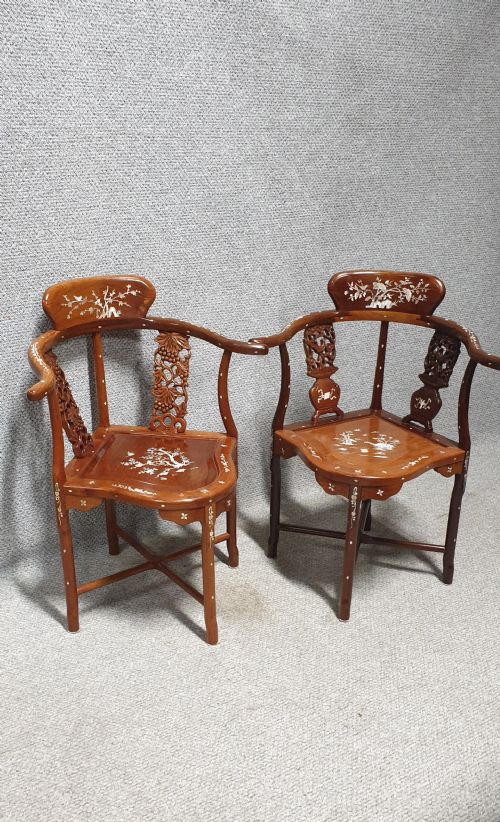
Pair of Corner Chairs
These pair of corner chairs bring distinctive seating into angles of a room, shaped in mahogany, oak, walnut and exotic inlays.

Pair of Corner Chairs
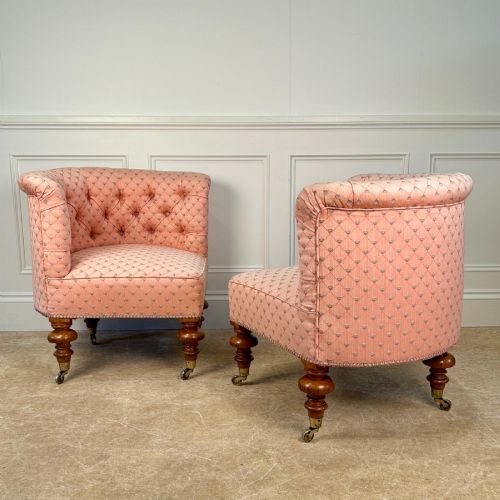
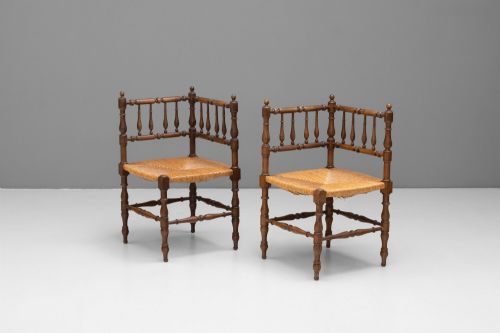
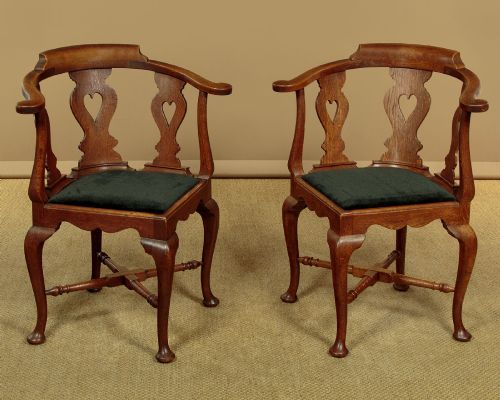
A pair of corner chairs provides dual seating designed specifically to fit into the ninety-degree angle of a room, utilising space that standard armchairs cannot reach. These pieces appear across Victorian, Edwardian and early twentieth-century periods, showing forms from simple bobbin-framed bedroom seats to heavily carved library armchairs.
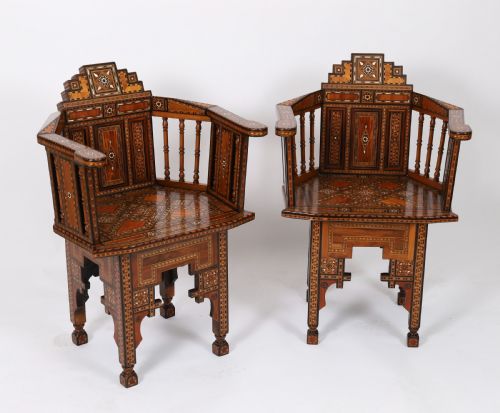
The most common examples met on this page are Edwardian mahogany models, often featuring delicate inlay work, alongside sturdy Victorian oak versions with turned spindles or upholstered seats. Makers adapted the diagonal frame for various styles, ranging from rustic country bobbin turnery to elaborate Moorish and Levantine inlaid designs.
Judging the standard of workmanship
Quality rests heavily on the crispness of the timber carving and the precision of the parquetry inlay, where lesser pieces show blurred edges and superior examples display sharp, exact geometric patterns. The choice of primary wood dictates much of the original value, with dense figured mahogany and richly grained walnut sitting above basic utilitarian pine or softwoods.
Structural integrity separates everyday seating from finer collector items, particularly in how well the angled joints and turned spindles handle weight over time. Original surface finishes and intact decorative elements like bone or mother-of-pearl inlay elevate the standard significantly.
Pair of Corner Chairs Retail Price Guide 2026
Typical asking prices for pair of corner chairs among the pieces listed under this phrase on Sellingantiques today, from the lower quarter to the upper quarter. They describe what is for sale here now, not the wider market.
Some nineteenth-century oak models were built to clip together, instantly transforming two solitary corner chairs into a miniature sofa.
The Pair of Corner Chairs Glossary
- Bobbin framing
- A method of turning wood on a lathe into a series of rounded spheres or beads resembling a thread bobbin, popular in vernacular and Arts and Crafts seating.
- Parquetry
- A geometric mosaic of wood pieces used for decorative inlay on furniture surfaces, often combining contrasting timbers like mahogany and boxwood.
- Corner chair
- A chair designed with a diagonal orientation, featuring a semicircular or curved backrest supported by posts that fit neatly into room corners.
- Turner's chair
- A heavy wooden chair constructed entirely from turned cylindrical or bobbin-like members, sometimes associated with traditional vernacular forms.
- Inlay
- A technique where contrasting materials such as bone, mother-of-pearl or lighter woods are embedded into recesses in the primary wood surface to create patterns.
Pair of Corner Chairs: Frequently Asked Questions
Where do I place pair of corner chairs?
These chairs fit naturally into empty room corners, framing architectural angles or filling dead space beside larger furniture items. Their diagonal stance allows them to occupy tight spots without blocking pathways.
In bedrooms or libraries, they serve as compact reading seats or decorative accents that utilise awkward wall junctions effectively.
How are pair of corner chairs constructed?
Makers build these frames around a central diagonal axis, positioning the main backrest to wrap around the corner while the seat forms a distinctive diamond or triangle shape. Four legs typically support the structure, with one leg pointing directly forward.
Turned spindles, bobbin frames or solid upholstered backs provide the vertical support, depending on whether the piece belongs to a rustic country style or an urban Edwardian drawing room.
How do I date pair of corner chairs?
Dating relies on identifying the prevailing timber choices and decorative motifs, such as heavy carved oak for Victorian pieces versus lighter inlaid mahogany for Edwardian examples. Bobbin-turned frames appear across both nineteenth-century vernacular styles and later Arts and Crafts revivals.
Comparing construction techniques and upholstery methods against known period styles helps narrow down the decade of manufacture.
Can pair of corner chairs be used daily?
Sturdy hardwood examples in oak or mahogany handle regular seating comfortably, provided the frame joints remain tight and secure. Lighter decorative models featuring delicate inlay or low bobbin work function better as occasional accent seating.
Checking the stability of the central corner leg and the condition of the internal bracing ensures safe everyday use.