

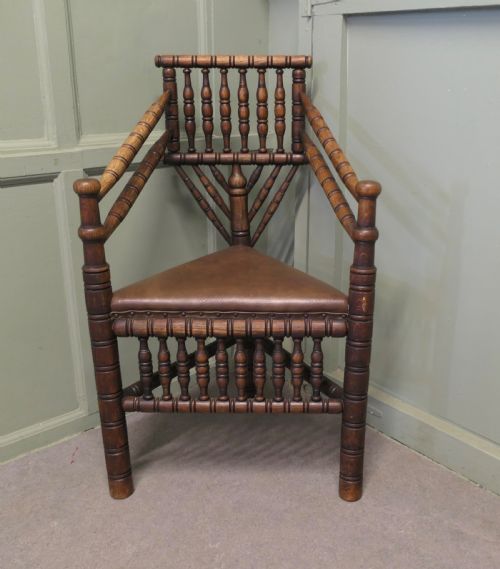


Oak Turners Chair
An oak turners chair offers solid timber construction and traditional spindle turning, bringing historical character and sturdy seating to any room.
Understanding the Oak Turners Chair
An oak turners chair is a distinctive historical seating form defined by its heavily turned spindle construction. These armchairs and accent chairs draw upon centuries-old design traditions, appearing frequently in Victorian interpretations of earlier styles.
Buyers browsing this selection encounter pieces primarily dating from the nineteenth century, including Victorian Gothic Revival and Old Saxon expressions. These chairs serve as striking focal points in traditional and country interiors.
Originating as sturdy elbow seats, these items combine solid wood frameworks with functional nineteenth-century craftsmanship. The forms range from standard armchairs to corner chair configurations.
Materials and Construction
The primary material across these listings is oak, frequently specified as English oak, providing a dense and durable structural framework. Beech also appears as a secondary timber utilised within the turned components.
Makers constructed these chairs using heavy wood-turning techniques, shaping individual spindles and structural members on a lathe. Leather occasionally appears as a material element within the seating specifications.
Retail Price Guide 2026
Typical UK retail prices for oak turners chair, calculated from the Sellingantiques database of over a million retail prices indexed since 2003. This retail price guide relies exclusively on Sellingantiques data; no external sources or auction records are used, so the figures do not describe the wider market.
Assessing Quality and Character
Quality rests in the precision and complexity of the spindle turning, where crisply executed profiles distinguish finer examples from simpler work. The choice of timber grain and the depth of the natural finish contribute significantly to the visual presence of the chair.
Structural integrity and the retention of original timber elements dictate the standing of a piece within the range. Refined regional interpretations, such as Victorian Gothic or Saxon revivals, display a greater ambition in design.
The Oak Turners Chair Glossary
- Spindle
- A cylindrical turned wooden rod that forms the structural and decorative uprights of the back and arms. These elements are shaped individually on a lathe.
- Elbow seat
- A traditional term for an armchair, often used to describe antique seating with low arms designed to support the elbows. This form provides a compact seating option.
- Gothic Revival
- An architectural and decorative style popular during the Victorian era that draws inspiration from medieval design. Pieces in this style feature pointed arches and heavy geometric detailing.
- Corner chair
- A seating form designed to fit into the corner of a room, featuring a diagonal orientation with a rounded backrest supported by turned pillars.
Frequently Asked Questions
What is an oak turners chair?
An oak turners chair is a traditional seating form constructed primarily from turned wooden spindles and solid timber. These pieces typically feature low elbow rests and a sturdy, architectural silhouette.
Originating in earlier centuries, the examples available today are predominantly nineteenth-century revivals that capture historical vernacular design for domestic use.
How were these chairs used historically?
These chairs served as principal seats in domestic interiors, offering sturdy construction and a distinctive upright posture. Their solid build suited everyday household activities.
Placed by a hearth or used as an accent seat in a hallway, they provided both utility and a display of traditional woodworking skill.
How do I style an oak turners chair today?
An oak turners chair works well as a statement piece in a study, living room, or hallway. Its strong vertical lines contrast effectively against plain walls or modern textiles.
Pair the chair with simple surrounding furniture to allow the complex turned woodwork to remain the visual focus of the space.
How do I identify Victorian examples?
Victorian examples often incorporate revival styles such as Gothic Revival or Old Saxon, combining nineteenth-century manufacturing methods with historical motifs. The timber and turning style provide key clues to the era.
Examination of the underside and joint construction reveals the nineteenth-century approach to assembly, distinguishing them from earlier originals.