


Terracotta Wool Woven Panel
When you handle a terracotta wool woven panel, you touch centuries of tribal craftsmanship rooted in practical nomadic life.
Terracotta Wool Woven Panel
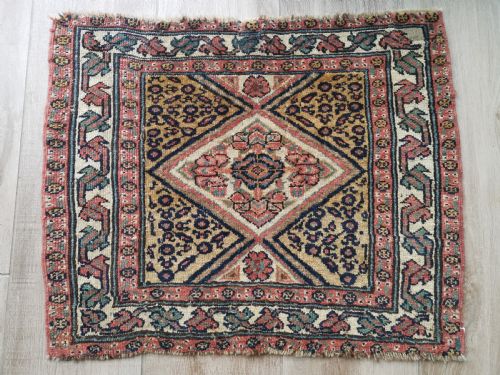
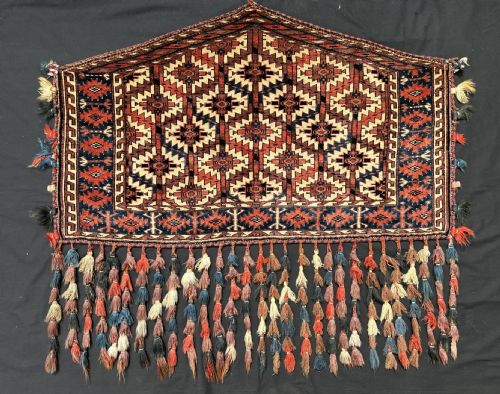
A terracotta wool woven panel brings together tribal textiles and fragments originating from Turkmen, Persian, Caucasian, and Central Asian makers. These pieces often take the form of bagfaces, torbas, asmalyks, mafrash panels, and kilims produced across the nineteenth and early twentieth centuries.
The version most commonly met on this page is a nineteenth-century tribal weaving utilising natural dyes and wool. Collectors encounter utilitarian nomadic items that served as storage bags, saddle-bags, or tent hangings before finding new life as wall textiles.
How they were made
The construction relies primarily on wool and cotton, worked into flatweaves, soumaks, and piled carpets. Artisans bound these materials using traditional techniques specific to regional groups such as the Yomut, Tekke, Shahsavan, and Qashqa'i.
Natural dyes provided the enduring terracotta hues and secondary colour palettes seen across the pieces. Weavers constructed panels in individual strips or sections, occasionally combining fragments into larger wall hangings and covers.
Camel wedding processions provided the grand stage for these textiles, where matching asmalyks swung proudly from the flanks of the bride's mount.
What varies in quality
The standard of a weaving depends on the clarity and precision of its traditional guls, compartmental motifs, or graphic designs. Tightly beaten weaves and balanced symmetry distinguish finer examples from simpler utility pieces.
The preservation of original wool pile, structural completeness with backs intact, and the depth of natural dyes dictate the standing of a textile within its regional group.
The Terracotta Wool Woven Panel Glossary
- Torba
- A small Turkmen storage bag used within nomadic tents for household possessions. These pieces frequently survive as decorative panel faces.
- Gul
- A primary medallion or repeating guli motif characteristic of Turkmen carpet design. Each tribal group utilised distinct geometric variations.
- Soumak
- A flatweave technique involving wrapping weft threads over and under warp threads to produce a textured surface. This method creates durable structures with detailed motifs.
- Mafrash
- A rectangular storage chest or bedding bag panel produced by tribes such as the Shahsavan and Yomut. They often feature banded flatweave or Soumak designs.
- Asmalyk
- A large pentagonal trapping hung on bridal camel flanks during Turkmen wedding processions. These highly decorative woven panels display elaborate tribal iconography.
Terracotta Wool Woven Panel: Frequently Asked Questions
What are tribal panels?
Tribal panels are sections, faces, or complete examples of nomadic weavings made for daily use in tents and transport.
Nomads produced these wool textiles using traditional patterns that identified their specific regional affiliation and tribe.
How were bagfaces used?
Bagfaces formed the visible fronts of storage sacks used to hold carpets, clothing, and domestic goods inside felt tents.
Over time, many worn bags were cut down, preserving the decorative face panels as wall hangings and textile art.
How do I hang a panel?
Textile panels require gentle support across the upper edge to distribute weight evenly without damaging the antique wool.
Many collectors use professional mounting methods involving Velcro strips stitched to cotton sleeves or specialised display frames.
How can I tell regions apart?
Regional attribution relies on identifying specific design vocabulary, such as Turkmen guls, Caucasian geometric borders, or Persian compartment layouts.
The choice of natural dye palettes and weaving structures further distinguishes pieces made by groups like the Shahsavan, Yomut, or Qashqa'i.