

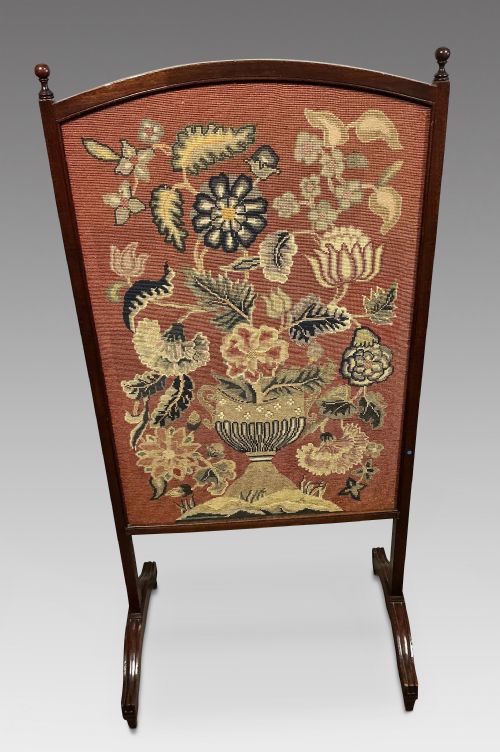


Tapestry Hearth Screen
A tapestry hearth screen stands as a clever defence against the fierce heat of an open fire while framing hand-worked needlepoint.
Tapestry Hearth Screen
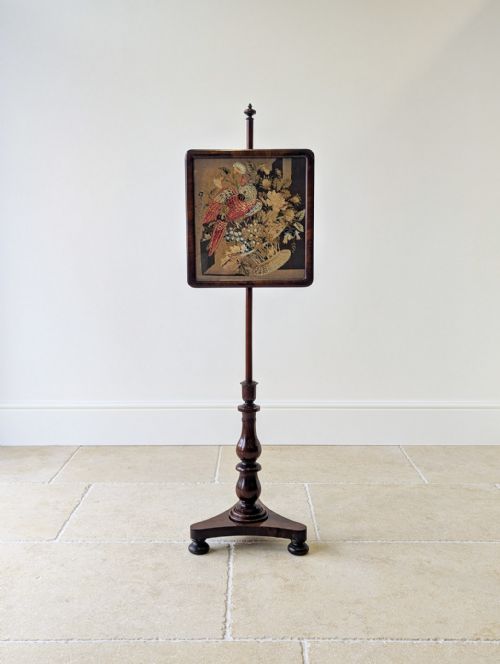
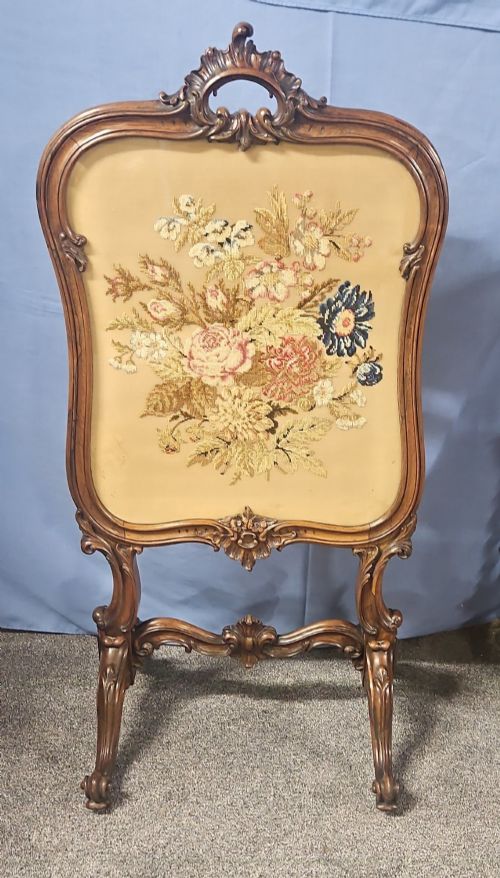
A tapestry hearth screen acts as a decorative shield for the parlour, designed to protect the complexion from the direct blaze of an open fire. These pieces emerge primarily from the Georgian, Regency, William IV and Victorian periods, taking two main architectural forms. You meet upright pole screens with sliding panels alongside cheval or framed folding screens designed to rest directly on the floor near the hearth.
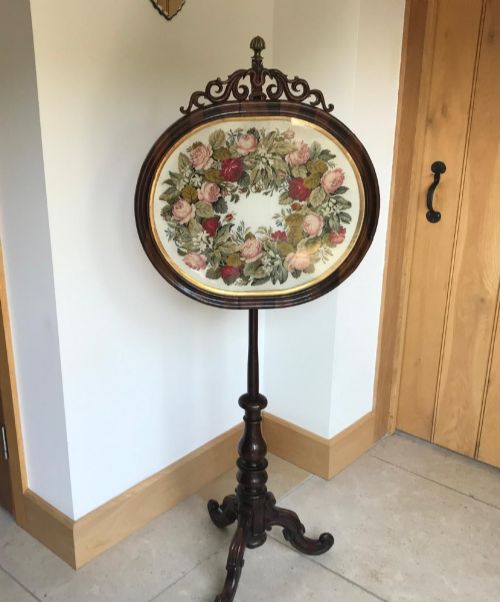
The timber frames reflect the prevailing taste of their decade, constructed in mahogany, rosewood, walnut, satinwood and oak. Many examples incorporate adjustable mechanisms allowing the textile panel to rise or fall along a turned column, or tilt to deflect the warmth. Needlework, woolwork and silk embroidery panels dominate the visual weight of these objects, often depicting armorial bearings, florals or classical scenes.
Materials and construction methods
Cabinetmakers shaped dense hardwoods like mahogany and rosewood into slender turned poles, carved tripod bases and solid framing members. Joinery relied on precise turning, mortise and tenon joints, and occasional gilding or brass fittings to secure the moving parts. These dense timbers provided the necessary weight at the base to prevent the tall, narrow structures from tipping over on uneven floorboards.
The textile panels themselves represent countless hours of domestic or professional needlework, utilising wool, silk and glass beads on canvas grounds. Needlepoint and embroidered woolwork were tightly stretched within wooden rebates or held by brass mounts, sometimes backed with secondary fabric. This combination of heavy joinery and delicate textile work required careful balance so the frame could support the hanging weight without warping.
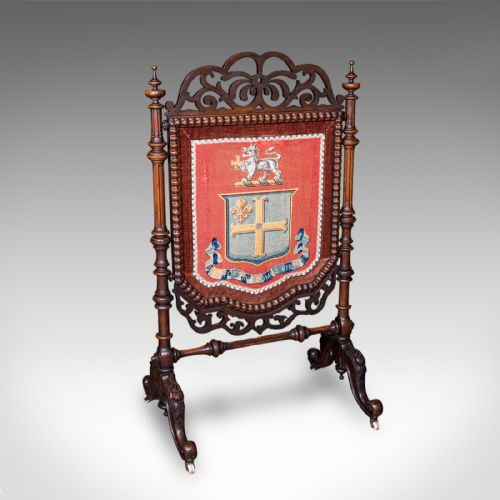
Several screens proudly preserve centuries-old family loyalty stitched into wool, including a detailed depiction of the Clan Maclellan coat of arms.
Distinctions in craftsmanship and design
Quality rests heavily on the ambition of the timber carving and the stability of the base. Finer pole screens feature crisply turned columns, carved tripod legs with acanthus or scroll detail, and robust adjustment mechanisms that hold the heavy panel firmly at any height. Lesser examples rely on plain turned posts and simpler, lighter footings that offer less stability.
The artistry and condition of the needlework panel dictate the upper tier of the range. Masterful woolwork or silk embroidery with fine shading, complete heraldic detail, or undamaged wool surface elevates a piece far above standard floral canvases. The integration between the textile and its enclosing frame also marks the division between standard workshop production and finer cabinet work.
The Tapestry Hearth Screen Glossary
- Pole screen
- A freestanding wooden shaft on a base with a vertically adjustable needlework panel. It was placed near a fireplace to shield the face from radiant heat.
- Needlepoint
- Hand-stitched embroidery executed on a stiff open-weave canvas ground. It forms the decorative pictorial surface of many firescreens.
- Cheval screen
- A floor-standing frame supported by two side pillars and feet. Unlike a pole screen, it does not use a central vertical column.
- Armorial
- A textile panel displaying a coat of arms or heraldic insignia. These bespoke pieces frequently record family lineages or historical alliances.
- Palisander
- A dense, dark exotic timber related to rosewood with strong grain figuring. Cabinetmakers utilised it during the Regency period for high-status furniture.
Tapestry Hearth Screen: Frequently Asked Questions
How did people use a tapestry hearth screen?
These screens sat between the seated occupant and the fireplace to shield the face from the intense glare and heat of open coal or wood fires. Ladies especially valued them to prevent facial cosmetics containing lead from melting or discoloring.
As rooms cooled or warmed, the adjustable panel slid up or down the pole to block the heat at the exact height required. When not needed near the hearth, they functioned as decorative room dividers or ornamental furniture against a parlor wall.
Are tapestry hearth screens adjustable?
Many pole screens feature a mechanical collar or thumb screw at the back of the needlework panel allowing it to slide vertically along the turned wooden shaft. Some designs also permit the panel to tilt forward or backward on a pivot.
Floor-standing cheval and framed screens generally remain fixed in one position without moving parts. When examining a pole screen, check that the internal mechanism still grips the central pole to hold the heavy panel securely.
What is the difference between needlepoint and woolwork?
Needlepoint refers to stitching worked through a stiff grid canvas where every thread of the backing is covered by coloured yarn. Woolwork is a broader term encompassing various embroidery stitches executed primarily with wool threads.
On these screens, both techniques created durable pictorial surfaces depicting flowers, animals, coats of arms, or historical figures. The tightness of the stitch and the complexity of the colour shading usually indicate the skill of the maker.
How do I date a wooden pole screen?
The timber choice and turning style offer the clearest clues to age. Georgian and Regency pieces often feature rich rosewood or mahogany with slender, elegant pedestals, while William IV and early Victorian examples display heavier carved walnut or mahogany bases with bolder proportions.
Later Victorian versions frequently incorporate elaborate bobbin turning, satinwood highlights, or darker oak frames with dense baronial motifs. Examining the method used to mount the textile panel also helps align the piece with its manufacturing era.
Where should I place a screen at home?
These pieces fit naturally beside a living room armchair, beside a fireplace, or as a focal point against an empty wall space. Their narrow footprint makes them ideal for filling awkward corners without dominating the room.
Keep them away from direct, strong sunlight to protect the fragile wool and silk embroidery threads from fading. If placed near a working radiator or modern heat source, ensure the timber does not dry out excessively.