


Tambour Front Nightstand
These tambour front nightstand pieces bring concealed storage and refined timber work to the bedside.
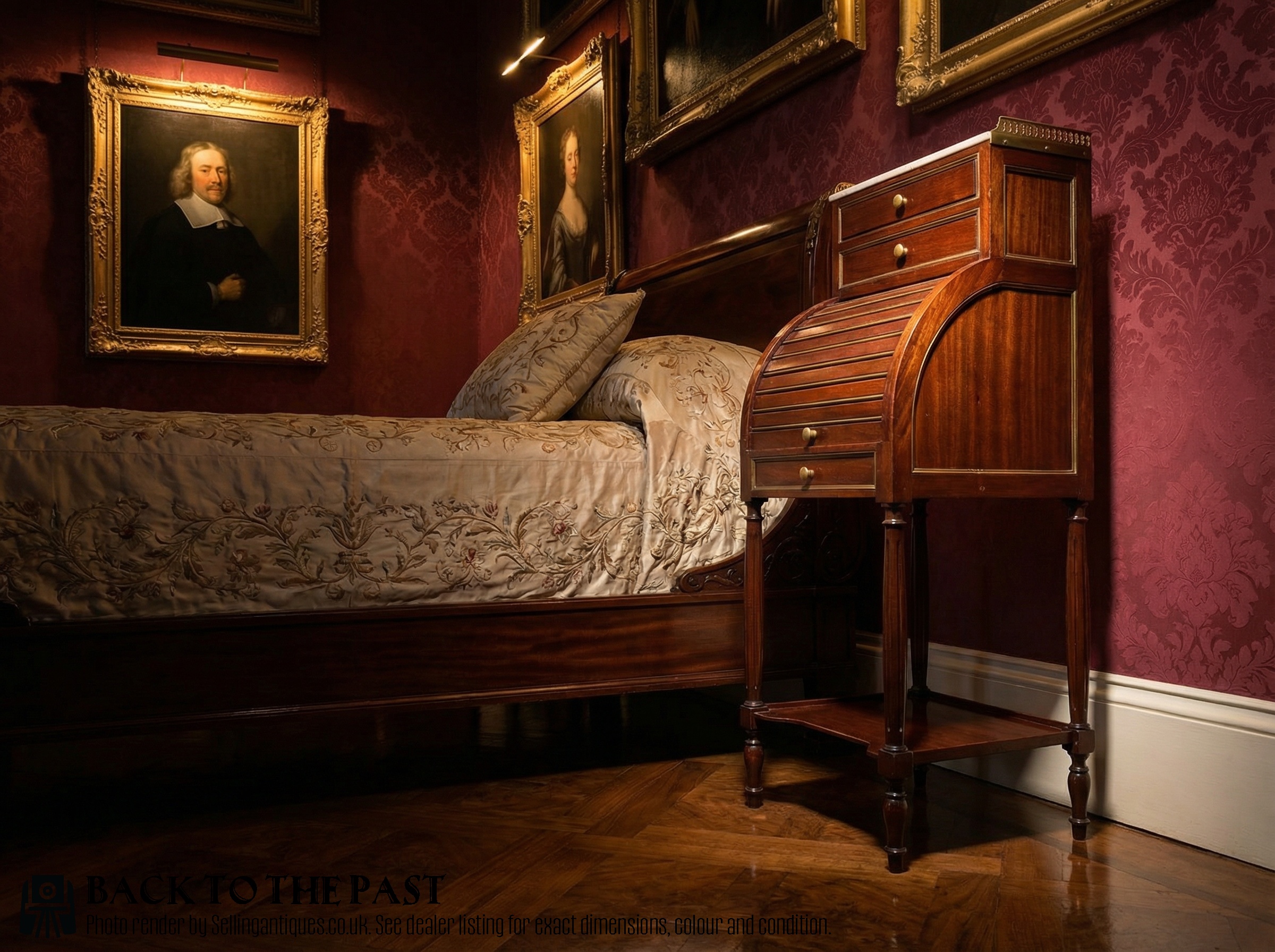
Tambour Front Nightstand
A tambour front nightstand offers a compact bedside table or commode fitted with a slatted sliding door that conceals the interior compartment. When searching for a tambour front nightstand, buyers encounter examples primarily from the Georgian, Regency, and nineteenth-century periods, alongside French provincial and Victorian variants.
The form appears under several historic designations in the listings, including bedside cupboards, bedside cabinets, commodes, and night tables. Mahogany dominates the surviving forms, frequently complemented by satinwood, walnut, and boxwood inlay.
Most pieces date to the eighteenth and nineteenth centuries, with George III and Regency iterations appearing frequently alongside French provincial models. Buyers find both single cabinets and matched pairs equipped with tray tops, serpentine fronts, or bow fronts.
Materials and construction
Cabinet makers constructed these bedside tables predominantly in solid mahogany and mahogany veneers, often incorporating contrasting boxwood inlay for decorative stringing. Interiors and secondary framing utilised supportive timbers while exterior surfaces displayed careful grain matching.
The characteristic sliding tambour shutter consists of narrow strips of wood glued to a fabric or canvas backing, allowing the flexible door to run smoothly within routed wooden tracks. Some pieces incorporate inset marble tops above the wooden cabinetry, particularly in nineteenth-century French variants.
Brass fittings such as handles, hinges, and gallery rails appear on select models, whilst specialised joinery secured the curved fronts and enclosed compartments.
Periods represented span the eighteenth century, Georgian era, Regency, and nineteenth-century French designs.
Distinctions in quality
The sophistication of the timber selection and the precision of the inlay work separate standard bedside cabinets from superior examples. Finely figured mahogany grain and crisp boxwood stringing indicate higher workshop standards during the Georgian and Regency periods.
The smooth operation of the slatted tambour mechanism reveals the standard of original joinery, as well as the stability of the timber over time. Well-executed serpentine or bow fronts demand advanced cabinet-making skills compared to straight-sided carcasses.
The inclusion of specific top treatments, such as shaped tray tops or fitted marble slabs, alters the architectural presence and physical weight of the piece.
The Tambour Front Nightstand Glossary
- Tambour
- A flexible shutter made from narrow vertical strips of wood attached to canvas, allowing a sliding door to follow a curved track.
- Commode
- A historic term for a decorative enclosed cabinet or chest of drawers, frequently used in bedrooms.
- Tray top
- A raised rim around the upper surface of a bedside table designed to prevent items from rolling off.
- Serpentine front
- A furniture front curving inward centrally and outward at the ends in a continuous undulating line.
- Bow front
- A convex, outward-curving front profile popular in Georgian and Regency cabinet work.
Tambour Front Nightstand: Frequently Asked Questions
What is a tambour front nightstand?
A tambour front nightstand is an enclosed bedside cabinet featuring a sliding slatted wooden door that hides the storage space.
These pieces span the Georgian, Regency, and nineteenth-century eras, appearing in forms such as commodes and pot cupboards.
How were tambour doors made?
Makers joined narrow strips of timber to a canvas or fabric backing so the resulting shutter could bend around curved tracks.
This technique required precise woodworking to ensure the sliding shutter operated smoothly without jamming.
Where were these cabinets used?
Bedside cabinets and commodes stood beside sleeping quarters to hold personal items and chamber equipment out of sight.
The enclosed tambour design kept bedside necessities neatly concealed behind the sliding wooden shutter.
How do I identify a Georgian nightstand?
Georgian and George III pieces typically feature solid mahogany construction, sometimes with satinwood or boxwood inlay and curved fronts.
Many examples from this period also incorporate shaped tray tops or delicate brass fittings.