
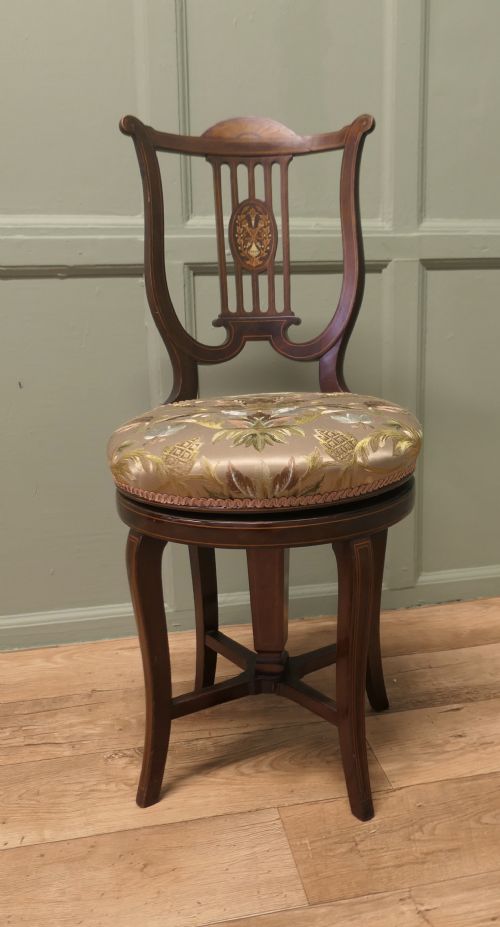
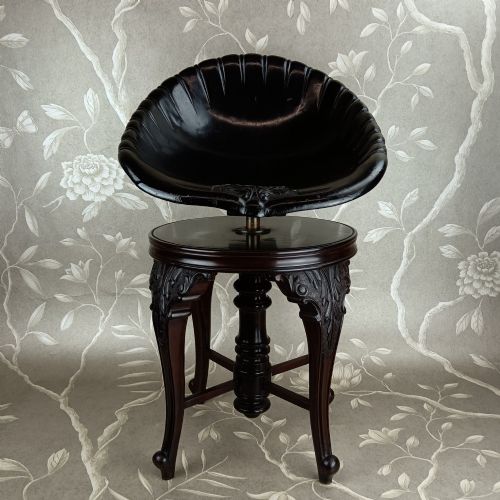
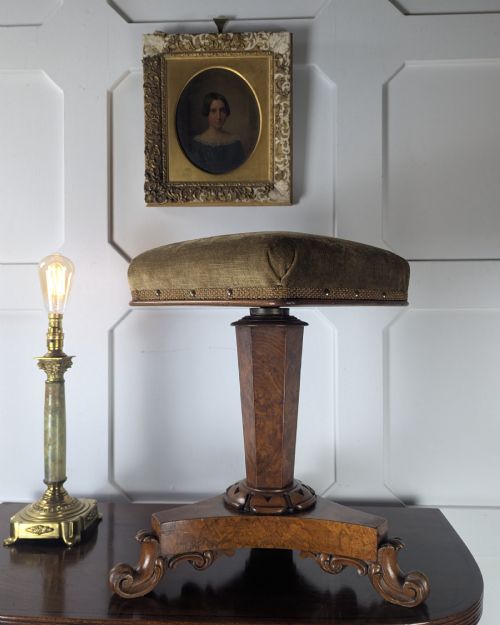
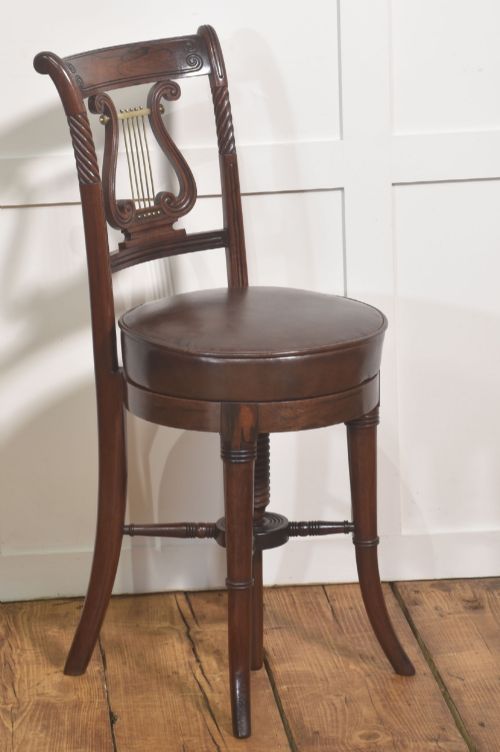
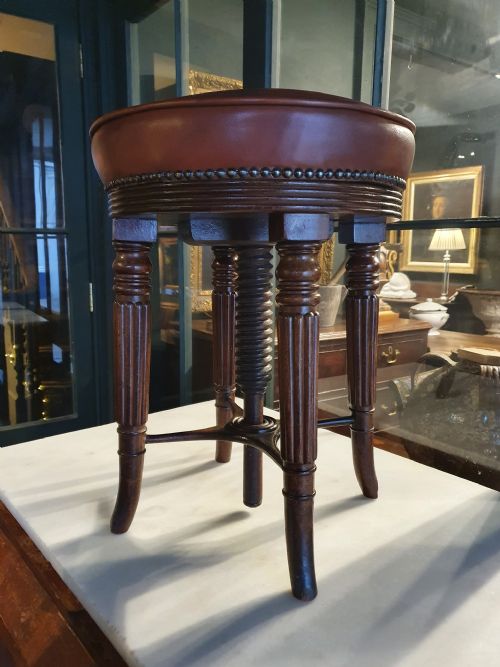
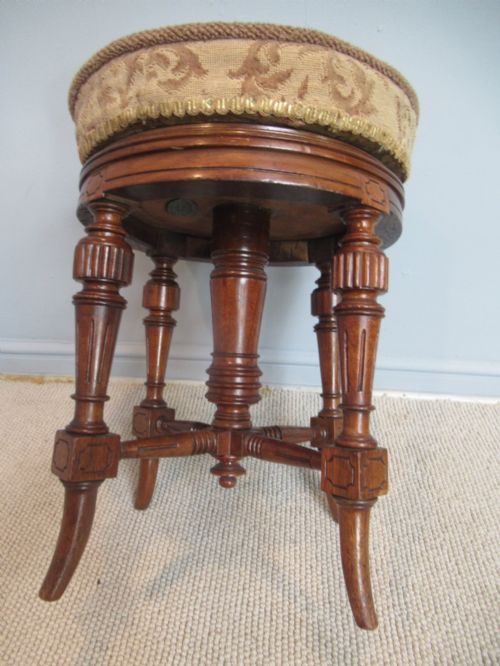

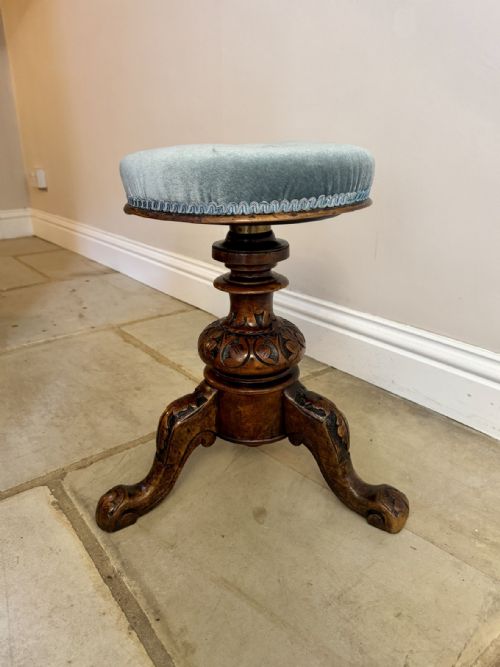
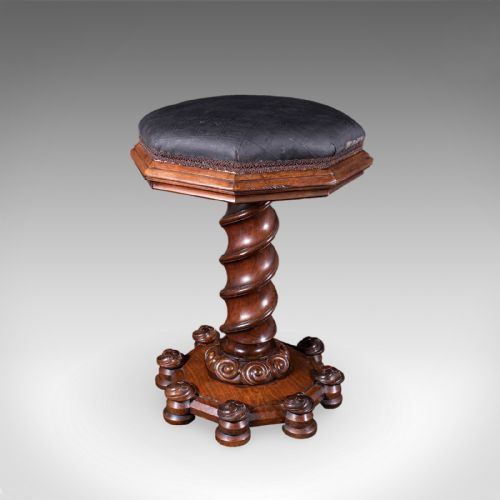


Swivel Music Stool
These swivel music stool examples provide adjustable seating for musicians and dressing tables, combining mechanical ingenuity with period timbers.
Swivel Music Stool
A swivel music stool is designed primarily for keyboard players, harpists, and cellists who require height adjustment and rotational movement during performance. The selections here span the nineteenth century, including Victorian, Regency, William IV, and Edwardian periods.
Most pieces function as piano stools or music chairs, though forms extend to dressing chairs and organist stools. Users encounter circular tops, lyre backs, and rise and fall mechanisms across mahogany, walnut, and rosewood constructions.
Materials and construction
Timbers such as mahogany, walnut, rosewood, and padouk form the structural framework, occasionally augmented by papier-mâché, ebonised finishes, or simulated rosewood. Brass components integrate into the internal rise and fall screw mechanisms and decorative inlay.
Upholstery relies on fabric, leather, or velvet to pad the revolving seats. Carved hardwood details and papier-mâché panels demonstrate the decorative techniques applied by period makers.
Swivel Music Stool Retail Price Guide 2026
Typical asking prices for swivel music stool among the pieces listed under this phrase on Sellingantiques today, from the lower quarter to the upper quarter. They describe what is for sale here now, not the wider market.
Listings feature nineteen-century eras including Regency, William IV, Victorian, and Edwardian periods, constructed in mahogany, walnut, rosewood, and brass.
Assessing craftsmanship and execution
Quality rests in the precision of the adjustable mechanism and the stability of the revolving joint under regular turning. Finer examples display crisp hand-carving on walnut or mahogany frames rather than soft, moulded detailing.
Material selection dictates distinction, with dense figured rosewood or padouk elevating a piece above standard mahogany. Original upholstery foundations and robust brass screw threads indicate superior workshop origin.
Jennens and Bettridge·Gillows·James Shoolbred
The Swivel Music Stool Glossary
- Rise and fall
- A mechanical system utilising a central wooden or brass screw to alter the height of the seat. This allows the player to adjust the stool to their preferred playing posture.
- Revolving
- A top designed to turn three hundred and sixty degrees on a central spindle. This movement assists musicians in positioning themselves comfortably at the keyboard or music stand.
- Papier-mâché
- A composite material made from paper pulp or layers of paper bound with glue, then lacquered and painted. It provides a smooth dark surface suitable for inlaid mother-of-pearl or gilding.
- Lyre back
- A chair back shaped in the symmetrical outline of an ancient stringed musical instrument. This design motif appears frequently on nineteenth-century music seating.
- Simulated rosewood
- Paintwork applied to a lesser timber to imitate the distinctive dark grain and figuring of genuine rosewood. This technique achieved a high-status appearance economically.
Swivel Music Stool: Frequently Asked Questions
How do you adjust the height?
The seat rotates continuously to raise or lower via an internal wooden or metal screw mechanism concealed beneath the upholstery. Turning the top clockwise or anticlockwise alters the vertical position.
This design allows musicians to find their exact playing height quickly without needing external levers or loose pins.
Were these made exclusively for pianos?
While primarily associated with keyboards, these seats served harpists, cellists, and organists in domestic parlours and estate chapels. Some variations also function as dressing table chairs.
Specialist versions featured low backs or armless profiles to accommodate wide dresses and freedom of arm movement.
How do I date a Victorian piece?
Dating relies on stylistic shifts from Regency curves and William IV heavy rosewood towards lighter Victorian walnut and later Edwardian satinwood touches. Screw mechanisms and timber types offer further clues.
Early examples often display robust mahogany or rosewood frames, while later nineteenth-century pieces embrace Arts and Crafts simplicity or ebonised finishes.
Can I use these as everyday seating?
These pieces function well in modern interiors as occasional seats, dressing table chairs, or piano stools. Their compact footprint suits small spaces.
Care should be taken not to subject the central screw mechanism to excessive lateral weight shifts or heavy continuous loading.