




Swiss Mechanical Clock
These pieces of a swiss mechanical clock offer precise horology housed in brass, glass and gilt metals.
Swiss Mechanical Clock
A swiss mechanical clock brings together precision horology and decorative forms ranging from desk models to mantle timepieces. The selection on this page draws heavily from mid-century designs alongside earlier nineteenth-century examples and twentieth-century variations.
Buyers encounter diverse object types, including carriage clocks with travel cases, perpetual motion mantel clocks, and inline skeleton timepieces. These items span periods from the Victorian era through Art Deco and Mid-Century Modern styles.
The assortment relies on portable formats like fob watches and folding clocks as well as substantial mantelpieces. Each variation reflects the technical output of Swiss workshops across different decades.
Materials and construction methods
Construction utilises durable metals such as brass, gilt brass, chrome-plating, and rhodium plating to form the structural cases and chassis. Glass panels and bell-jars protect the delicate dials and movements while allowing visibility of the internal mechanics.
Movements incorporate steel components, jewel bearings, and enamel dials. Portable variants often include leather travel cases or gold and silver housings designed for everyday use.
Some travel watches fold neatly into their own leather purses, ready to pack for a Victorian railway journey.
Distinctions in execution and finish
The integrity of original boxes, paperwork, and fitted travel cases distinguishes well-preserved examples from loose timepieces. Exterior finishes like rhodium plating, gilt bronze, and enamel dials retain distinct levels of crispness depending on their age and maintenance.
Jaeger LeCoultre·Mappin and Webb·Harrods of London·Vogel·Mundus
The Swiss Mechanical Clock Glossary
- Atmos clock
- A mechanical mantel clock manufactured by Jaeger-LeCoultre that operates using temperature fluctuations in the atmosphere to wind its mainspring.
- Carriage clock
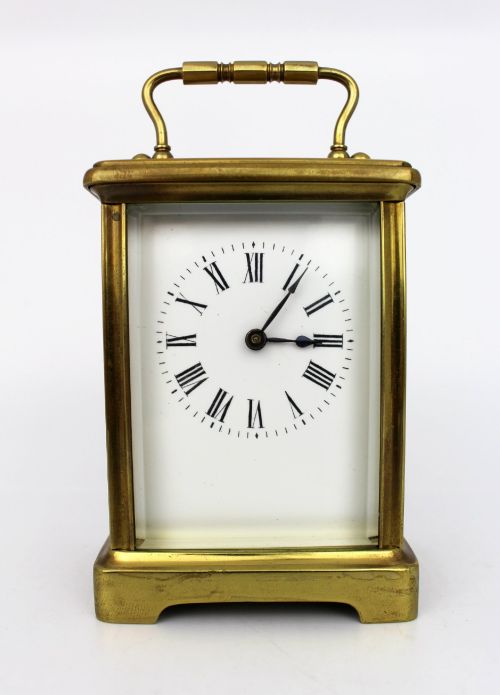
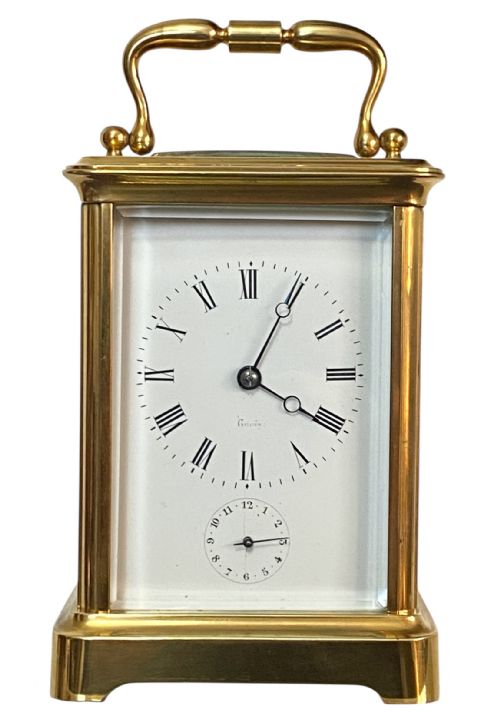
- A small spring-driven clock designed for travel, traditionally featuring a rectangular brass case with glass panels and a carrying handle.
- Skeleton timepiece
- A clock designed with an open movement that exposes the gear train and escapement mechanism to view.
- Gilt brass
- Brass coated with a thin layer of gold to provide a bright, decorative finish that resists tarnishing.
- Fob watch
- A small pocket watch or timepiece attached to a short strap or ribbon, often housed in a purse or specialised case.
Swiss Mechanical Clock: Frequently Asked Questions
How does an Atmos clock work without winding?
An Atmos clock contains a hermetically sealed capsule filled with a gas and liquid mixture that expands and contracts with changes in room temperature. This motion winds the mainspring continuously.
This self-winding mechanism allows the timepiece to run independently of human intervention or batteries for decades if kept in stable conditions.
Are carriage clocks intended for actual travel?
Carriage clocks were originally built for nineteenth-century travellers who required portable timekeeping during transit in carriages or trains. They frequently include fitted leather travel cases to protect the brass and glass housing.
Today, these objects function primarily as stationary desk or mantel pieces while retaining their robust travel construction and folding handles.
What is an inline skeleton clock?
An inline skeleton clock arranges its gear train in a single horizontal or vertical line rather than the traditional clustered layout. This design exposes the working components between transparent panels.
Such configurations emerged strongly during the mid-century period, showcasing the visual mechanics of the escapement and gear wheels.
How do I identify the period of a timepiece?
Dating relies on stylistic indicators such as Art Deco geometric lines, Victorian brass ornamentation, or Mid-Century Modern minimalist framing. Signatures, hallmarks, and accompanying original documentation also help pinpoint the era.
Materials such as rhodium plating and specific calibre numbers further narrow down the decade of manufacture for Swiss movements.