
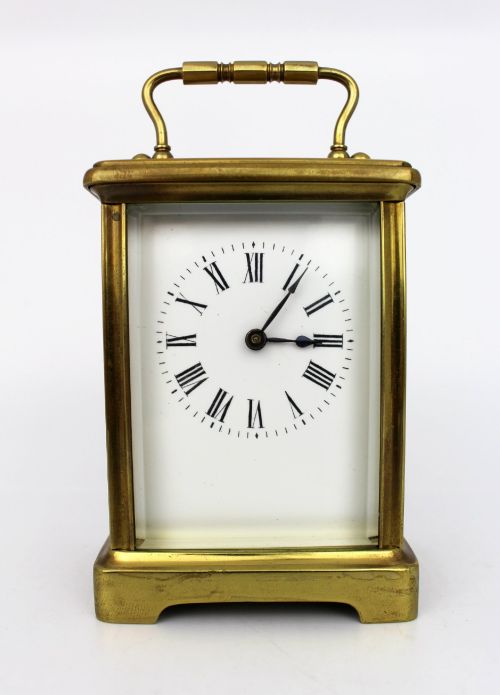


Swiss Desk Clock
These small timepieces bring precise mechanics and cabinet work together, offering a functional centrepiece for a table or bureau.
Swiss Desk Clock
A swiss desk clock encompasses varied forms ranging from heavy brass carriage clocks designed for travel to delicate enamel strut clocks intended for boudoir use. Buyers searching for a swiss desk clock frequently encounter brass and gilt metal models housing movements made for international markets.
The selection includes mid-century modern skeleton timepieces and Atmos variants alongside nineteenth-century carved linden wood examples from the Black Forest. These items serve both practical timekeeping and decorative roles within a room.
Dated pieces span from the mid-nineteenth century through to the 1960s, showing shifts from ornate rococo wood carving to clean art deco lines and mid-century luxury. Carriage clocks often retain original leather travel cases, while larger mantel versions utilise substantial wood or metal frames.
Materials and construction
Brass, gilt brass, and chrome-plated metal form the structural chassis for many movements, often paired with glass panels or enamel dials. Carved linden and walnut timber provide the housing for Black Forest pieces, showing traditional woodworking techniques.
Movements utilise jewelled bearings and complex gear trains, with some high-end examples incorporating eight-day power reserves, alarms, or barometer functions. Rhodium plating and champlevé enamelling appear on luxury variants from the twentieth century.
The inventory records carriage clocks, Atmos models, and skeleton timepieces alongside traditional Black Forest mantel pieces.
Evaluating craftsmanship
Quality rests in the precision of the movement and the integrity of the housing, distinguishing standard production items from grand sonnerie complications or Atmos barometric mechanisms. Finer examples display crisp hand-carving on timber cases or flawless enamel work on dials and bezels.
Originality of components and the survival of fitted travel cases or original boxes elevate a piece's standing. Weight, materials such as solid silver or heavy gilt brass, and the complexity of the escapement separate standard timepieces from luxury editions.
Bergen and Co·Harrods of London·Imhof·Van Cleef and Arpels·Asprey·J F Bautte Et Cie·Mappin and Webb
The Swiss Desk Clock Glossary
- Atmos clock
- A mechanical clock that runs without winding by utilising changes in atmospheric temperature and pressure to power the movement. This system was developed in Switzerland.
- Carriage clock
- A small, portable spring-driven clock with a handle, originally built for travellers in the nineteenth century. Many include alarms or striking trains.
- Champlevé
- An enamelling technique where troughs are dug into a metal surface and filled with vitreous enamel before firing. It frequently decorates Edwardian and Victorian clock bezels.
- Strut clock
- A timekeeper supported by a hinged prop or leg at the rear, allowing it to stand upright on a desk or dressing table. They often feature silver or enamel frames.
- Skeleton timepiece
- A clock designed with an open framework that exposes the wheels, gears, and escapement to view. Mid-century makers produced inline variants of this style.
Swiss Desk Clock: Frequently Asked Questions
How do Atmos clocks work?
An Atmos clock operates on thermal expansion, using a sealed chamber containing a gas and liquid mixture that expands and contracts with temperature fluctuations. This movement winds the mainspring continuously.
Because the mechanism requires almost no friction, it functions without human intervention for years once set.
What is a carriage clock?
A carriage clock is a portable spring-driven timepiece fitted with a carrying handle, originally designed for use during nineteenth-century travel. They usually feature glass panels that reveal the interior escapement.
Most sit on small feet and are housed in brass or gilt cases, frequently accompanied by protective leather travel boxes.
How do I date a Black Forest clock?
Nineteenth-century Black Forest pieces rely on hand-carved linden or walnut wood cases, often displaying rococo revival motifs or animal carvings. Movement construction and dial materials help narrow the decade of production.
Earlier examples feature wooden plates within the movement, whereas later twentieth-century versions adopt standard metal mechanics.
Are mid-century desk clocks reliable?
Mid-century models from makers like Imhof or Jaeger-LeCoultre utilise jewelled movements designed for regular desktop use. Many offer eight-day power reserves requiring weekly winding.
Servicing history influences daily performance, so maintaining the mechanical gear train ensures accurate timekeeping.